





Binghamton University’s Human Rights Institute is sponsoring research on women activists to document their experiences of peacebuilding in their home countries and while in exile.
The Women In Exile Project, supervised by Alexandra Moore, co-director of the Human Rights Institute and professor of English, aims to speak with women peacebuilders and give them space to share experiences with one another.
“The project emerged from a gap we identified in the research between the UN’s Women, Peace and Security agenda and refugee rights protections,” Moore wrote in an email to Pipe Dream. “The project aims to help fill that gap by bringing together insights from the two different areas of research and from interviews with women peace builders who have been forced to flee their countries of origin because of their peace building work.”
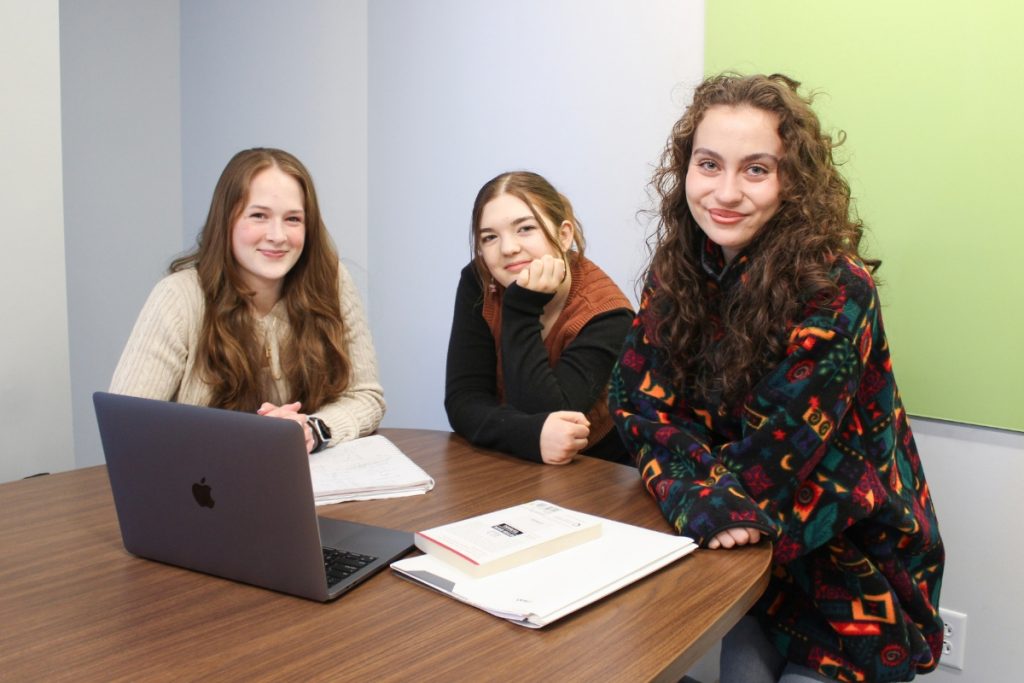
University students led the project, including Caryn Gagnon, a senior majoring in political science; Taylor Rogers, a sophomore majoring in political science; and Samantha Boragine, a sophomore majoring in musical theater.
Christopher Davey, a lecturer of political science, and Belinda Walzer, a professor of English at Appalachian State University, taught a graduate-level seminar called “Approaches to Peacebuilding,” designated as a community-engaged learning course in connection with the project and contributed to the students’ research.
“I led them in some training in doing interviews, particularly with a mind or with a focus on trauma-informed practice,” Davey said in an interview with Pipe Dream.
Interns involved in the project interview the peace builders about their experiences with advocacy at home, the circumstances surrounding their exile and how they continue their work.
After interviews, interns coded elements of the conversations by reviewing the transcripts and documenting similar themes and definitions between the women. The team conducted 14 total interviews and coded 12. Interviews occurred in two rounds and researchers used both to support their coding. Rogers explained that the team coded several elements of the interview.
“Specific themes that I remember were the definition of activism and peacebuilding, and how those differed per woman in exile,” Rogers said. “We also looked at what it means to be away from their home countries and how we could take terms such as ‘home country’ and bring that more into an academic conversation.”
Davey explained that women felt differently about words like peacebuilding and activism as descriptors of their work. He said some women shied away from the word activist and preferred to be called a peace builder “partly because of the politically sensitive nature of one versus the other.”
Gagnon became involved in the Women in Exile Project through working at the Human Rights Institute. Rogers and Boragine joined the project through their Human Rights Source Project, taught by Moore, as an extension of their independent research.
“My personal work was in the right to an abortion, so when I was starting that research and looking more upon that, I saw the opportunity of women peace builders,” Rogers said in an interview with BingUNews.
Most of the women peace builders involved in the project were approached by the University to participate, and some have academic ties to BU. The women interviewed were involved in activism in their home countries through a variety of methods, including organizing, academia and art.
Gagnon told Pipe Dream that she found the project to be informative because of a lack of visibility for women in “this kind of area of work.”
Gagnon and Rogers are working to publish some of their results in Open Global Rights, an online human rights forum.
Last April, many of the women peacebuilders and researchers came together for a workshop. The workshop gave the researchers the opportunity to develop their findings with the participants and for the participants to share experiences.
“They identified concerns that have not been thoroughly documented in existing scholarly literature and also are pushing us to think in much more nuanced ways about the relationship between peace building and activism and how refugee women can retain political agency in peace efforts,” Moore wrote to Pipe Dream.
The project aims to create a community for exiled women peacebuilders and to better understand how the international community can support them.
“For us, it was enough to be able to listen and hear,” said Davey. “And then hopefully some sort of publication to share that out to a wider audience.”
Editor’s Note: Caryn Gagnon is a former Opinions writer for Pipe Dream. She had no part in the writing or editing of this article.