





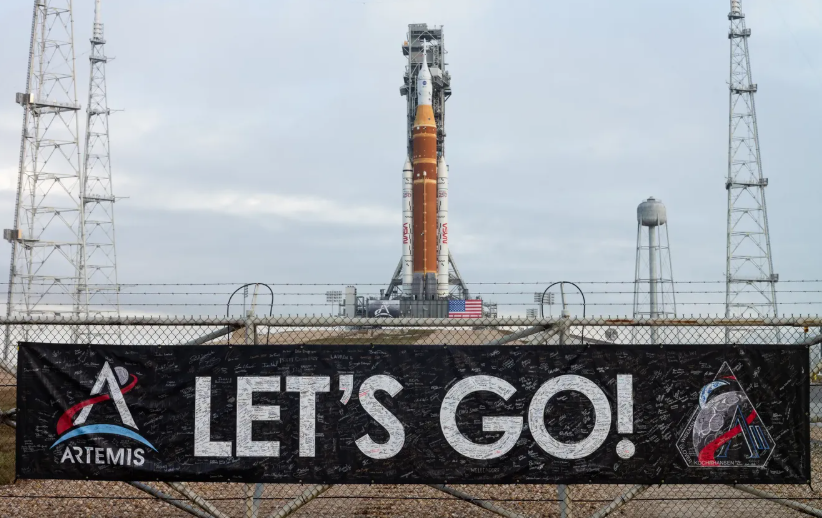
Technology developed by a local company will be used in the National Aeronautics and Space Administration’s upcoming Artemis II mission.
ENSCO Inc., an engineering and technology company operating in the aerospace, national security and surface transportation sectors, has an office in Endicott, New York. The company will provide software called IData to NASA’s Orion spacecraft in the Artemis II mission, set to launch later this month.
“It’s a great honor for ENSCO to be involved in that program,” Arnaud Gain, ENSCO Director of Avionics Software and Certification, told Fox 40. “And I know the team is very excited that they’re very proud of it. That’s kind of different. And the day-to-day life is that you need to focus on your task, looking at your code, and looking at your test. It can be very tedious, but when you think of it, and you look up, and you go ‘look what I did,’ and it is going to space, that’s kind of fun.”
The Artemis II mission will send four astronauts to orbit the moon and return to Earth after 10 days. This mission’s test flight will be the first time NASA’s Space Launch System rocket and Orion spacecraft are launched with a crew.
The IData software will aid the Orion spacecraft crew in developing graphics without generating code, making safety and mission controls more accessible and faster. The software, driven by data, provides multitouch cockpit functionality, 2D and 3D digital moving maps and behavior-based animations.
“We provide the tools that allow them to display the data in the cockpit display,” Gain said. “That would be all kinds of flight data. So I guess altitude, speed, location, that kind of thing.”
ENSCO Inc. has been working on this project since 2014.
NASA says the mission “is a key step toward a long‑term return to the Moon and future crewed missions to Mars.”
The Artemis II mission builds on the discoveries made four years ago in the uncrewed Artemis I, the first of a series of missions meant to enable human exploration of the moon and, later, Mars. During the Artemis I flight, the unmanned Orion spacecraft traveled thousands of miles past the moon, flying for 25 days.
The Artemis missions will become increasingly more complex as they allow astronauts to establish “a long-term presence at the Moon that will enable future crewed missions to Mars,” according to NASA’s website.
ENSCO’s aerospace technology extends beyond software like IData. It also serves launch ranges and the space industry by providing cost-effective engineering, modeling and cybersecurity systems that aid successful missions. The company did not return Pipe Dream’s request for comment.
NASA operations have a large economic impact on New York. According to NASA’s state economic reports, the “Moon-to-Mars” campaign created an economic output of $40.8 billion and supported 151 jobs in New York in the 2023 fiscal year.
Gain added that seeing ENSCO’s technological achievements in Artemis II might inspire local engineers to pursue work in related fields.
“A lot of people don’t necessarily expect us to do that kind of work here,” Gain told Fox 40. “But yeah, that’s some excitement, and it really motivates people even more when they can maybe not touch what they’re doing, but they actually see it. They’ll see it on TV. You’ll see that it’s talked about.”