





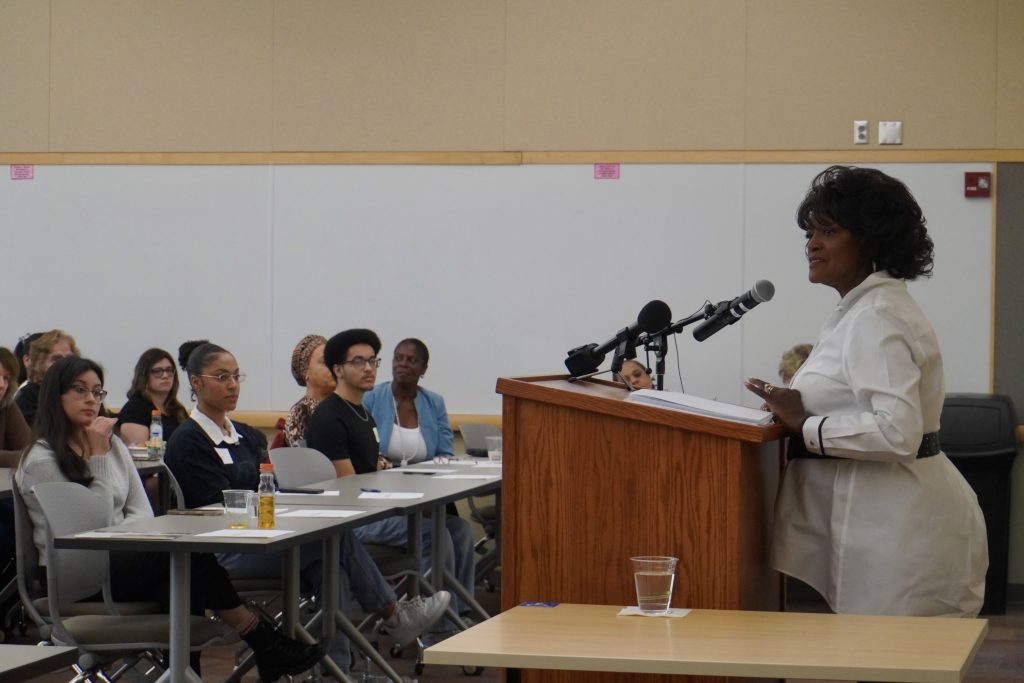
The Harriet Tubman Center for Freedom and Equity hosted Michele Jones Galvin, a descendant of Harriet Tubman, for a discussion last Tuesday.
Galvin, the great-great-great-grandniece of Tubman and co-author, along with her mother, Joyce Stokes Jones, of “Beyond the Underground: Aunt Harriet, Moses of Her People,” delivered a lecture on Harriet Tubman Day about Tubman’s life through the context of their family lineage.
Sharon Bryant, an associate professor of public health and associate director of Harriet Tubman Center, opened the event with a quote by the activist and author James Baldwin, written in a letter to Angela Davis on Nov. 19, 1970, a month after she was arrested by the Federal Bureau of Investigation. Bryant explained that while the quote referenced Davis’s arrest, she has reflected on its broader meaning this past semester.
“James Baldwin, he wrote, ‘For, if they take you in the morning, they will be coming for us that night,’” Bryant said. “And I think that this is so poignant, showing the intersectionality of us all. And so this was one of my responses. Silence is not neutral. Silence is not neutral, even when you doubt that you can find the words to express what you want to say.”
Brenda Cave-James, a local poet, then read her poetry on the legacy of Harriet Tubman. The poem was dedicated to Tubman’s family, particularly her father and the skills he taught her that aided her in leading enslaved people to freedom.
“He knew she was predestined for ‘sheroic’ feats,” Cave-James read. “He gifted her with knowledge to maneuver through forest and stream quietly and swiftly, how to discern nature’s plenteous gifts for sustenance.”
Anne Bailey, director of the Harriet Tubman Center and a professor of history, spoke about important legislation of the Civil Rights Movement of the 1960s, like the Civil Rights Act of 1964 and the Voting Rights Act of 1965. Referencing the words of Martin Luther King Jr. on the moral arc of the universe, she argued that the United States must “bend that arc toward justice” to thrive.
Paris Defreitas, a first-year graduate student studying public administration and founder of the National Black Law Students Association at Binghamton University, discussed Tubman’s legacy. She expressed her admiration toward Tubman as a leader who fought oppression with “bravery, faith and determination.”
Opening her lecture, Galvin paid homage to her late mother, who began the investigation into the family’s lineage. It was through this work that Tubman could be seen in a new light, through a “family lens.
“It’s upon my mother’s research, time, talent and treasure that our family now knows exactly how we are related to Harriet Tubman,” Galvin said. “And I was given the blessed opportunity to work with her, to write with her and to reveal our story about the social justice leader Harriet Tubman. So [this is the] the first time we, the relatives of the woman they called Moses, have written a book, which is an intricate mix of memoir, family lore and historical reconstruction.”
“And so in the wake of my mother’s death, it is with my humble and grateful heart that I tell our story about Harriet Tubman,” Galvin continued. “Thanks, Mom.”
Tubman spent the last 50 years of her life around 75 miles from Binghamton in Auburn, New York. It was there that she had a home, and where Galvin’s great-grandmother and grandmother were born. She traces her lineage all the way back to Tubman’s sister, Sophia, who is Galvin’s great-great-great-grandmother.
“Harriet Tubman left an indelible mark, not only on our history, but on her heritage and on her family, one that cannot be erased or forgotten,” Galvin said. “While many call her an American heroine, in our family, we simply called her Aunt Harriet.”
Galvin came to Binghamton on Harriet Tubman Day last year to unveil a new statue of Tubman located along the Downtown Binghamton Freedom Trail.
Bryant told Pipe Dream that research assistants at the Harriet Tubman Center searched for known relatives of Tubman, eventually finding Galvin and inviting her to the unveiling.
Galvin said that Tubman embodied “faith, hope, activism, patriotism and perseverance.”
“Harriet was a liberator, abolitionist, humanitarian and a patriot,” said Galvin. “Her service to others was a testament to her values and commitment to faith, family, fortitude and freedom. And when we dig a little deeper, we found that self-sacrifice, service to others, compassion and trustworthiness were her notable qualities. Yes, at the end of the day, Harriet Tubman was an extraordinary woman.”