





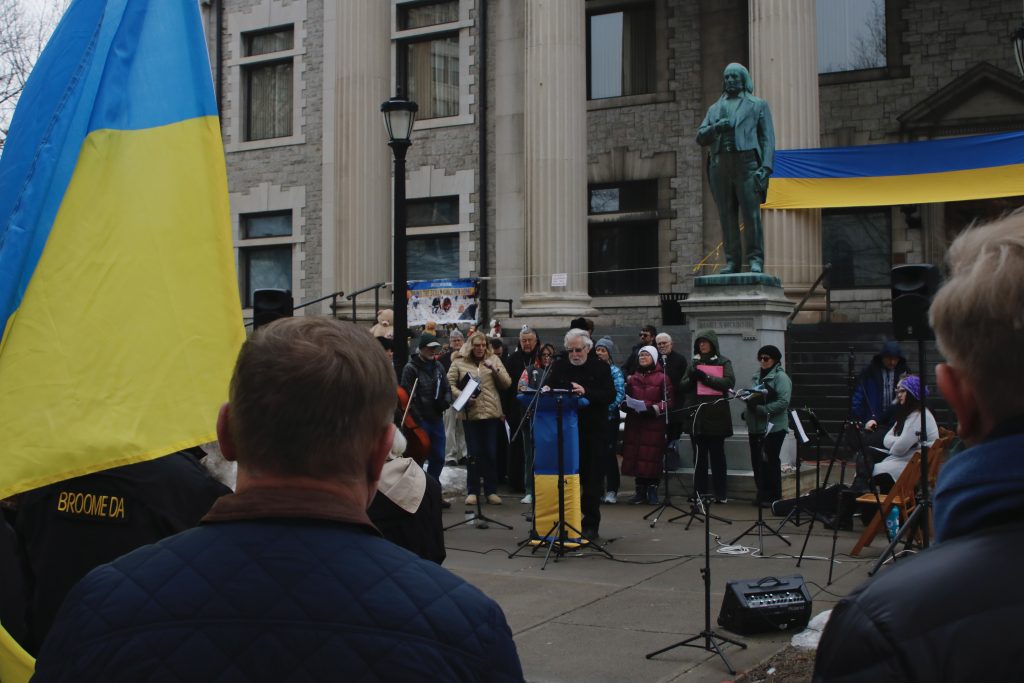
Community members gathered at the Broome County Courthouse on Saturday to commemorate the fourth anniversary of Russia’s invasion of Ukraine.
The commemoration opened with remarks by Stephan Wasylko, a retired foreign service officer who performed diplomatic work in Ukraine on behalf of the United States in the 1990s. Wasylko currently chairs the St. John the Baptist Ukrainian Orthodox Church’s humanitarian committee. His remarks were followed by a performance of the U.S. and Ukrainian national anthems.
“Despite what we hear from Washington these days, Ukraine does not pose an obstacle to peace and ending this horrific war,” Wasylko said. “As [Ukrainian President Volodymyr Zelenskyy] has stated repeatedly, Ukraine wants peace, but not at any cost. Ukraine wants an end to this war, but not an end to Ukraine.”
Wasylko called for Congress to vote on the Sanctioning Russia Act of 2025 and urged the Trump administration to support Ukraine’s 20-point peace plan, which calls for a long-term nonaggression agreement with Russia, reaffirming Ukrainian sovereignty and allowing the country to enter the European Union.
Originally introduced in the Senate and later in the House of Representatives, the Sanctioning Russia Act of 2025 calls for penalties to be placed if the U.S. president concludes that “the Russian government or a person acting at Russia’s direction” refuses to negotiate or violates a peace agreement with Ukraine, initiates another invasion of that country or seeks to overthrow the Ukrainian government. Penalties include at least a 500 percent tariff on countries that continue to purchase Russian petroleum or uranium. Congressman Josh Riley of New York’s 19th congressional district is one of the 153 cosponsors for the House bill.
First introduced in April 2025, the bill has not been brought to the floor for a vote.
The 20-point peace plan, proposed by Ukrainian President Zelenskyy, is a response to the Trump administration’s 28-point plan. The Trump administration’s proposal would recognize Crimea, Luhansk and Donetsk as Russian territory, while Zelenskyy’s plan would create demilitarized zones at Donetsk and Luhansk.
Wasylko also called for the return of Ukrainian children who have gone missing under Russian occupation. Estimates range from 19,500 abductions that have been verified by the Ukrainian government to as many as 35,000 as of March 19, 2025, according to the Yale Humanitarian Research Lab. About 1,600 children as of Nov. 20, 2025 have been rescued with the help of third parties like Qatar, South Africa and the Vatican.
On Saturday, a memorial was set up in front of the Broome County Courthouse to advocate for the return of the missing children. Local priests also shared prayers and scripture readings.
Elected officials attended the service, including Broome County District Attorney Paul Battisti, State Sen. Lea Webb ‘04, Assemblywoman Donna Lupardo MA’ 84 and Johnson City Mayor Christina Charuk MAT ‘19.
Broome County Executive Jason Garnar ‘99 was not in attendance, but a statement was read on his behalf. In his statement, Garnar called for solidarity with Ukraine and praised the Ukrainian people for their “extraordinary courage and resilience” amid “brutal aggression from Russia.”
In her speech, Webb noted that while faith was important in creating connections, congressional action was also needed, asking representatives to “not just simply act through legislation, but to remember our shared humanity and to do the right thing.”
“We stand here, Senator Webb and I, and we represent so many of our colleagues in the state legislature who send their best in their regards to you,” Lupardo said. “We stand here in solidarity with you, because your pain is our pain, your fight is our fight. Your cause is our cause.”
Battisti voiced his support for Ukraine and offered his prayers to the families that had been displaced. He also called for the return of Ukrainian children and for people to pray for peace.
Charuk, the president of the local branch of the Ukrainian National Women’s League and a first-generation Ukrainian American, stressed the importance of human resilience. She cited the opening lines of the Ukrainian national anthem, translating them as “still, Ukraine is not dead.”
“Despite everything, these words are about resilience, but they are also about responsibility and they remind us that survival doesn’t happen by accident,” Charuk said. “It happens because ordinary people like us here today refuse to stay silent.”
“So when we speak up for truth, equity and human dignity, our democracy is also not dead,” she continued. “When we organize and show up and hold these institutions accountable, our community is not dead and when we refuse to accept injustice as just the way things are, hope is not dead.”
Kalyna Raguso, president of the Binghamton University Ukrainian Culture Association and a senior majoring in neuroscience, shared the importance of creating spaces for Ukrainian students on campus.
“When the war began, we realized that on our campus, Ukraine was often spoken about only in terms of conflict, strategy, geopolitics, breaking news,” Raguso said. “What was missing was the culture, the history, the humanity. That is why we founded the first Ukrainian Cultural Association of Binghamton University, because Ukraine is not just a war. It is a language. It is music and poetry. It is centuries of tradition. It is resilience woven into identity long before 2022.”
Evan Meccarello, director of the Binghamton Community Orchestra, highlighted the orchestra’s concert on Sunday, which featured the North American premiere of music by Stefania Turkevych, considered to be Ukraine’s first female composer in the early 20th century. He added that the orchestra periodically changes its program to include Ukrainian classical music.
Wasylko closed the vigil with a brief thanks to the audience and urged elected leaders to pass legislation to support Ukraine.
“People ask, what is America all about these days?” Wasylko said in an interview with Pipe Dream. “What are our values if we don’t recognize and empathize with what’s going on? Ukraine has never asked for boots on the ground. They are fighting their own war. All they need is arms, moral support, economic support, to keep their economy going.”