





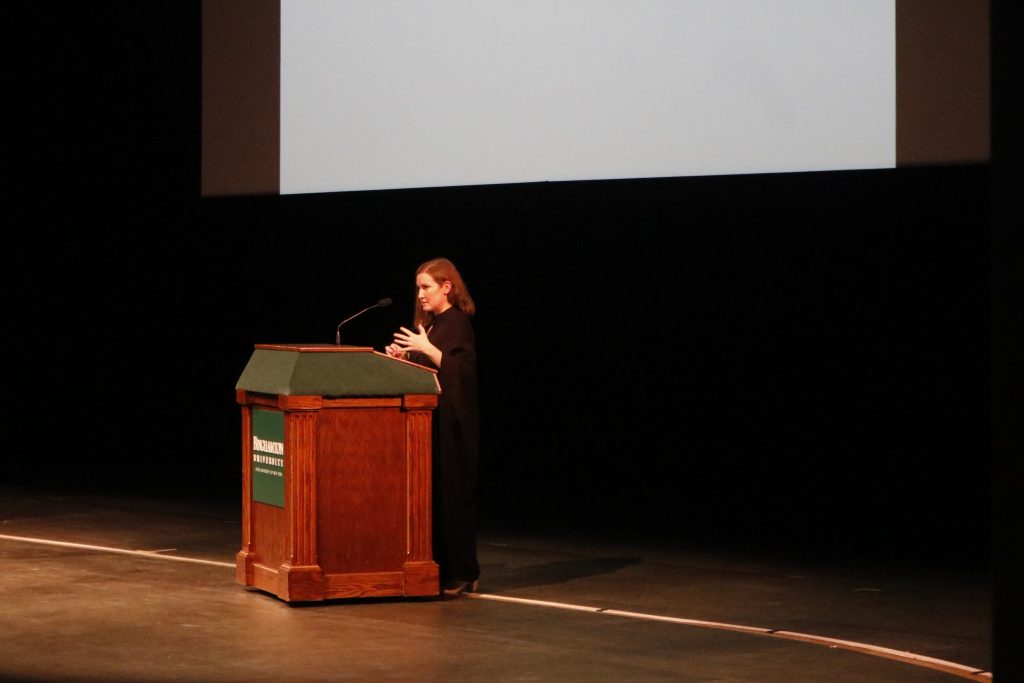
Binghamton University hosted a keynote speaker to celebrate its sixth annual Common Read Experience, a program to help first-year students explore new perspectives and connect with other freshmen.
Held on Tuesday, this year’s talk featured Kristen Radtke, author of “Seek You: A Journey Through American Loneliness,” this year’s Common Read Experience book. The book is an illustrated novel composed of prose, personal anecdotes and illustrations covering themes of loneliness and isolation.
Hosted at the Osterhout Concert Theater in the Anderson Center, the talk began with Radtke discussing her fascination with the people she saw while commuting in New York City who were physically alone. Alongside her talk, she presented photos that she took of these people from her iPhone camera roll.
“There was nothing very highly lonely about any of these people, and the fact that I identified that disconnect had a lot more to do with me than them,” Radtke said. “I wanted to see their loneliness since I was lonely myself.”
The book was born out of a desire to write about a universal emotion outside of her own experiences, like loneliness, which Radtke noted differed from her previous works. She began with nearly three years of research, collecting data on loneliness in America.
“What I found was much worse than I could imagine,” Radtke said. “Basically, loneliness will kill you. Lonely people are more likely to have heart attacks and cancer and alcoholism. Loneliness can make you assume the worst in others, which can make enemies from total strangers.”
The end product blended a mixture of the data with her personal anecdotes. Radtke explained how grateful she was that the final book had changed from her original concept.
She then read an excerpt of her book. Radtke explained that the title of the book, “Seek You: A Journey Through American Loneliness,” was a play on the amateur radio term, “CQ call”. The term CQ came from the French term “sécurité,” meaning “pay attention.”
“A CQ call is a reaching outward, an attempt to make a connection across a wavelength with someone you’ve never met,” she read. “It means, essentially, ‘Is there anyone out there?’ and invites anyone listening to answer.”
In the excerpt, she describes her surprise learning from her uncle about her father’s obsession with sending out CQ calls, despite her father being “stoic, religious, extraordinarily strict.”
“My uncle’s story was the first time I had access to my dad’s need for anything other than order,” Radtke continued. “I’d seen no evidence of desire beyond it — I’d never thought that he’d have looked for, of all things, connection.”
The excerpt went on to describe Radtke’s experience with friendships and relationships on TV shows like “Friends” and “Frasier,” which taught her what love and friendship are supposed to look like.
The passage continued to discuss the creation of laugh tracks in early recordings of comedy routines, creating the illusion of being in a room full of others for listeners and viewers. This illusion of social laughter releases endorphins in the brain, suggesting that it is used to build and reinforce relationships.
The keynote ended with an explanation of graphic novels as a form of art, including visual examples. Examples included a panel from “Fun Home: A Family Tragicomic” by Alison Bechdel, an American cartoonist, and a landscape photograph by Ansel Adams.
“I think one of the most important things when we are reading and creating graphic work is that it’s not actually illustrative, meaning the text should not match the image exactly, at least not if it’s going to function effectively,” Radtke said. “The function of graphics is about creating a relationship that challenges book elements.”
Radtke also authored the graphic novel “Imagine Wanting Only This” and is the creative director of photography and art at The Verge, a technology-focused news website.
The talk ended with Radtke answering audience questions.
“I think college is such an important time of exploration and having your own ideas and figuring out how you want to operate in the world,” Radtke said to Pipe Dream in an interview. “And I think that sometimes that can come with difficult emotions, like loneliness, because you kind of have to reconsider who you thought you were, or where you came from, or what that means. So I think moments of transition can be really hard, but there are also these great opportunities for growth.”
“I hope that students realize that we have these rosy sunny ideas about college being this time of connection and community — and that can be totally true — but it doesn’t mean that we are immune to feelings of isolation and loneliness,” she continued.