





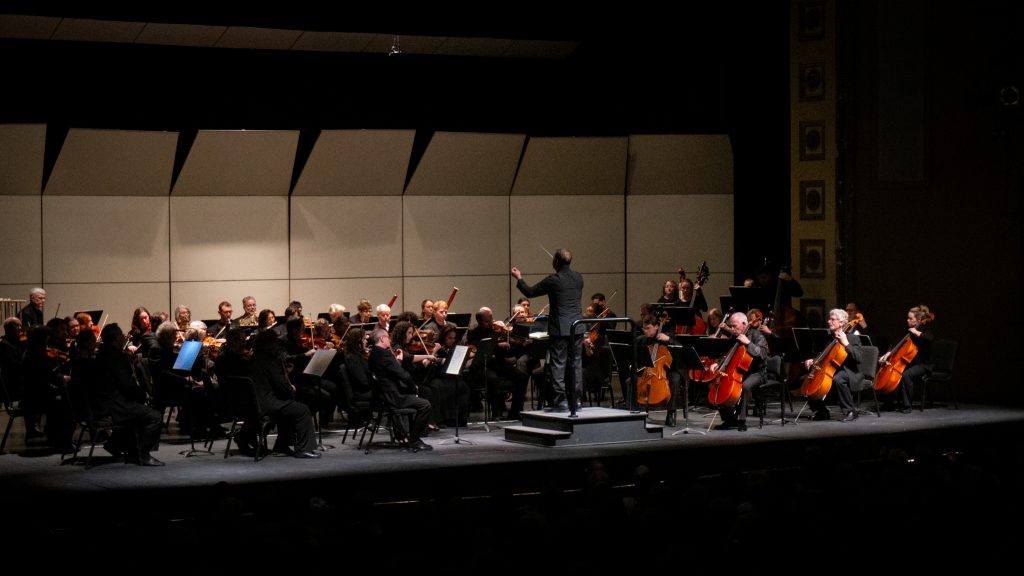
Audiences filled the Broome County Forum Theater on Nov. 15 to watch the Binghamton Philharmonic Orchestra perform with featured cellist Annie Jacobs-Perkins.
After the lights dimmed and the audience’s chatter faded, Maestro Daniel Hege, the Philharmonic’s music director, took the stage. He spun the tale of the performance’s theme, “Creations of Fire,” while explaining how each musical selection fit the fiery tone. Paul Cienniwa, executive director of the orchestra, explained the inspiration behind the theme.
“The program’s title, ‘Creations of Fire,’ immediately refers to the opening piece on the program, Beethoven’s Overture to the Creatures of Prometheus,” Cienniwa wrote in an email. “Prometheus is said to have stolen fire from the gods in order to provide it for humanity. The fire runs throughout the program.”
The opening selection lit the fire under the orchestra as they began with a bold opening note, followed by triumphant melodies from the full ensemble. They engaged in a battle of sweetness and intensity of melodies, truly telling the story of Prometheus with the juxtaposition of descending and ascending scales. Prometheus was fabled in Greek mythology to have stolen fire from the gods to enlighten mankind. Julia Grella O’Connell, the director of education and community engagement, wrote about the musical invocation of Prometheus in the first movement in her program notes.
“The overture to The Creatures of Prometheus begins with a series of stark chords in an indeterminate key, evoking the chaos of the universe before demi-god Prometheus intervenes to arrange it within the elegant constraints of classical order,” O’Connell wrote.
Breaking the Beethoven tradition, Jacobs-Perkins selected Dmitri Shostakovich’s “Cello Concerto No. 1 in E-flat major” as her solo piece. The 28-year-old musician is originally from Pittsford, New York but now resides in Berlin, Germany. Jacobs-Perkins has been involved with the past two series of the Binghamton Philharmonic and the Binghamton Community Orchestra.
“It is so nice to come back to the same place to perform multiple times — I love getting the chance to travel to play concerts, but it can get lonely sometimes,” Jacobs-Perkins wrote in an email. “It’s important to me to build a sense of community with audience members, and this time especially I recognized so many people in the audience, as well as already having a rapport with the orchestra, the orchestra’s organizational team, and of course with Maestro Hege. I feel really grateful to have the chance to work with such a sensitive conductor!”
Jacobs-Perkins emerged to thunderous applause, her smile and sparkling pink pants lighting up the stage. Her excellence on the cello was immediately apparent, as she shifted from the lowest melodies to the highest harmonies with fluidity and grace. She set the tone for the orchestra to follow, her questioning expression and repetition of phrases calling out for response from the full ensemble.
The piece was filled with tones of both uncertainty shown through flats and minor keys and panic with warning shrills echoing from the violins. The cellist’s body language reflected the themes of the piece as she retreated for the quietest notes and flourished her bow with the biggest crescendos. Jacobs-Perkins described her connection to this emotional number.
“When I’m playing this Shostakovich I feel just like I do when I’m surrounded by awe-inspiring nature,” Jacobs-Perkins wrote. “I feel so small and insignificant, like a tiny cog in a giant machine that will keep turning whether I’m on board or not. It’s really meaningful to feel a part of something so much bigger than myself.”
After the piece had concluded, Jacobs-Perkins was met with flowers and a standing ovation from the audience. The audience hushed as she readied to play again. She introduced a piece called “Human Voices” by Marin Malay, which was originally written for viola in the 1700s. It was a reverential piece, filled with vibrato and deep endings of musical phrases that reverberated in the charged silence of the theater. The title of the piece relates back to the idea of humanity evoked by Prometheus in the first selection.
As Jacobs-Perkins finished, she lifted her bow, took a deep breath and sank into her chair. The audience erupted into a second standing ovation. Isaac Lartey, 38, a resident of Cooperstown, New York, attended the Philharmonic for the first time in an effort to discover different mediums of music and spoke about his experience with this piece. He praised Perkins’ musical ability alongside her interpretation of the piece.
“It was pretty cool to see one instrument commanding the room,” Lartey said.
The Philharmonic is set to conclude its nine-part series of Beethoven’s symphonies this season, and Maestro Hege communicated his excitement in the inclusion of “Symphony No. 8 in F major, op.93” as the final installment in the “Creations of Fire” Program. This four-movement powerhouse of a piece was filled with striking, bold sounds, almost like a clock tower ringing. A call-and-response of short and long phrases between the woodwinds and strings created a conversation. The theme of life shone through the regal sounds of the melodies, proudly building intensity and speed as the music reached an end.
Brian Nayor, the director of development and patron relations, provided some insight in an email on how he believes the orchestra impacts its patrons.
“To me the Binghamton Philharmonic is, in many ways, a lightning rod for Downtown Binghamton’s storied and vibrant arts community,” Nayor wrote. “The talented men and women who make up our orchestra give the people who live here, including myself, something remarkably special to look forward to time & time again across the calendar.”
“We’re in our 70th year, and that longevity speaks to just how meaningful the symphony is to many more people than just me, but also to thousands of our friends and neighbors,” he continued.