





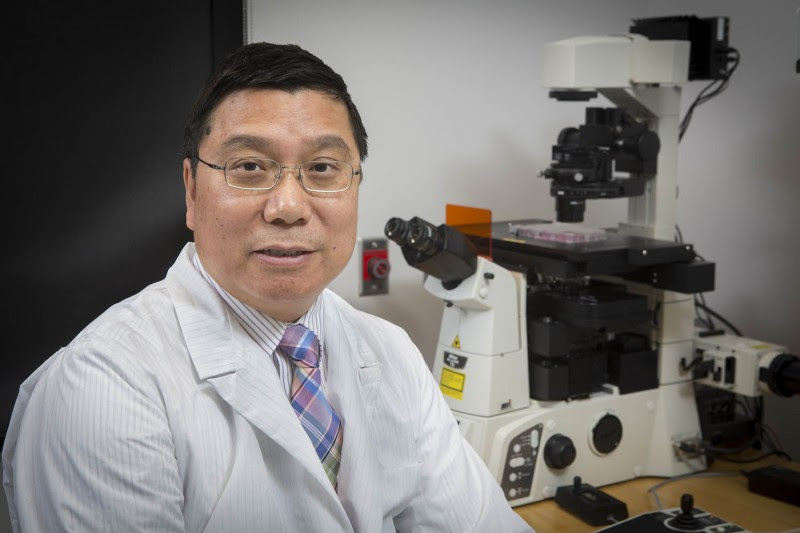
Professor Kaiming Ye, the former chair of the Thomas J. Watson College of Engineering and Applied Science’s Department of Biomedical Engineering, passed away on Nov. 16.
As chair from 2013 until earlier this year, Ye redirected the former bioengineering department at Watson to biomedical engineering. He was the director of Binghamton University’s Center of Biomanufacturing for Regenerative Medicine and the Douglas Hsu Research Laboratory. Ye received the 2025 BU Council/Foundation Award, which recognizes one faculty member, staff member, undergraduate student and graduate student who provide outstanding service and leadership to the University.
“Dr. Ye was a leader in medical and bioengineering who made key breakthroughs in cancer and diabetes research, among other areas,” said Atul Kelkar, the dean of Watson College in a statement to BingUNews. “He also oversaw and helped the work of many other researchers during his time at Binghamton University, the National Science Foundation and his other service to the biomedical field. He will be missed by his colleagues at Binghamton and around the world.”
Ye received his bachelor’s, master’s and Ph.D in chemical engineering at the East China University of Science and Technology in Shanghai, China. Before becoming chair of the Department of Biomedical Engineering, he served in several roles at other academic institutions, including as program director for the National Science Foundation’s Biomedical Engineering Program from 2011 to 2014 and as a faculty member at the University of Arkansas, the University of Pittsburgh and the Kyushu Institute of Technology in Fukuoka, Japan.
In 2011, Ye cowrote a book, “Human Embryonic and Induced Pluripotent Stem Cells,” with Sha Jin, a professor and undergraduate director of biomedical engineering at the University. He also contributed writing for six biomedical textbooks and was an editor-in-chief, executive editor, associate editor and member of editorial boards for 13 academic journals.
Together with other researchers, Ye devised six patents and published many research articles. His work in advanced biomanufacturing was featured in the American Society for Engineering Education’s Prism magazine, which reports the latest information about technology and other trends in engineering education to more than 12,000 readers. His work with fluorescent nanosensors for continuous glucose monitoring for patients with type one diabetes was featured in the Pittsburgh Post-Gazette.
In the field of immunology, Ye invented recombinant yeast-based influenza vaccines and was working on the development of cancer immunotherapeutic vaccines.
“His contributions, mentorship and influence have left an indelible mark on our community, and his impact will continue to guide and inspire us for years to come,” Kelkar added.
For his work in bioprinting and tissue biofabrication, Ye received backing from multiple prominent organizations, including the National Science Foundation, the National Institutes of Health and the Juvenile Diabetes Research Foundation — now known as Breakthrough T1D.
He was also a member of several interagency working groups, including the Interagency Workgroup for Neuroscience, the Interagency Modeling and Analysis Workgroup and the Multiagency Tissue Engineering and Regenerative Medicine Workgroup.
“Dr. Kaiming Ye laid the groundwork for the BME department, as I had the pleasure of getting to know him in my BME 201 class,” Samuel Levine ‘25, a first-year graduate student studying biomedical engineering, wrote in a statement to Pipe Dream. “Outside of academics, he was a cordial person to talk to along with bringing a plethora of knowledge.”