





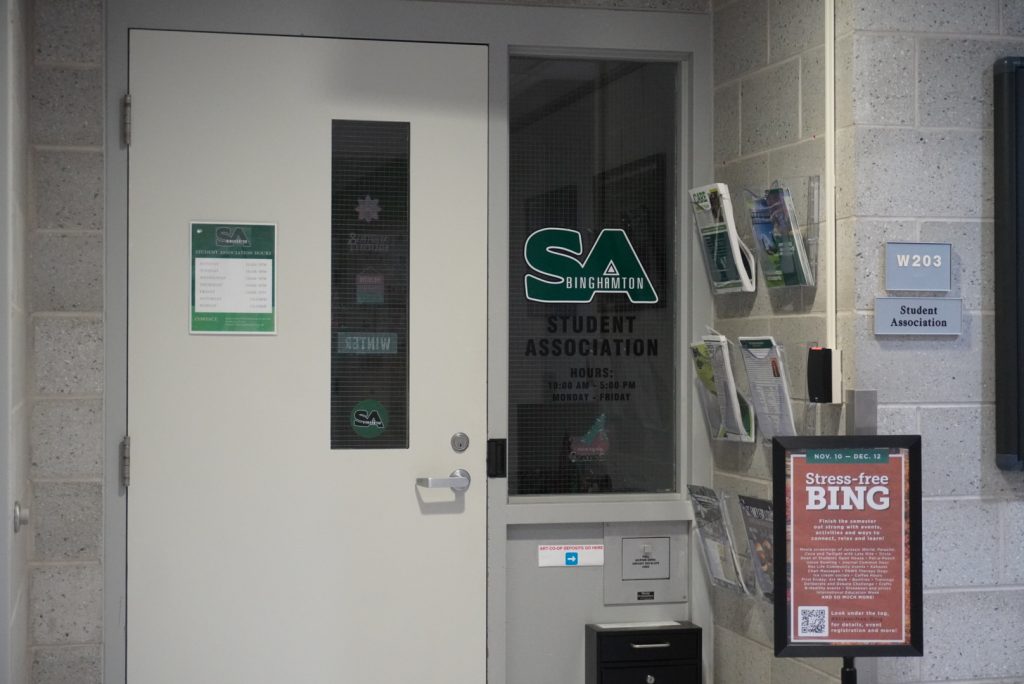
The Student Association Congress recently created a public opinion form for students to share their opinions and concerns with the governing body.
The resolution implementing the form passed unanimously on Nov. 4 and was authored by Blake Goldstein, speaker of the SA Congress and a junior majoring in political science. Students can fill out the seven-question survey on the SA website and by scanning QR codes posted around campus to contact their representatives. The form asks students to propose ideas for new legislation, voice their concerns and indicate potential changes they believe would improve representation and visibility in student governance.
Consisting of 35 members elected by residential and off-campus communities, the SA Congress has five committees that work on different issues impacting student life. In an interview with Pipe Dream, Goldstein said one of the body’s primary responsibilities is to advocate for the needs of all students and pass legislation to make their lives better. However, many students are unaware of what the SA Congress actually does, Goldstein said, and others have expressed “distrust in government or feeling not represented.”
Lotus Taylor, a senior majoring in sociology and chair of the SA Congress’ Diversity, Equity and Inclusion Committee, said greater transparency and communication are vital to the Congress’ functioning.
“I came at supporting this resolution from the fact that many students have been dissatisfied with the Student Association Congress for a good period of time now, especially in the past three to four academic years, and they’ve expressed that,” Taylor said. “Student organizations have demonstrated to that point. I was someone who served on Congress last year and was not satisfied with how Congress was effectively representing the vast diversity of the student body and their opinions through legislation that was passed.”
“What’s great about the public opinion form is it gives students a really easy way to make their voices heard, to make sure that their constituencies and who represents them understand what exactly students are thinking and feeling and what their priorities are and what they would like changed on this campus,” she continued.
The legislation comes after the SA Congress debated and voted on several contentious issues last year. In October 2024, the Congress voted to rescind the Boycott, Divestment, Sanctions legislation [https://www.bupipedream.com/news/sa-congress-rescinds-bds-resolution/157045/] that passed that April. At the meeting, representatives passed five other resolutions, including an amendment to a 2021 resolution that would recognize the right of Jewish self-determination and classify any attempts to undermine it as antisemitic. The body also considered and approved a resolution [HYPERLINK: https://www.bupipedream.com/news/what-happened-at-tuesdays-sa-congress-meeting/157161/] expressing support for prohibiting face coverings during protests except for religious or medical reasons, which the SA E-Board subsequently vetoed [https://www.bupipedream.com/news/sa-e-board-vetoes-two-resolutions-passed-last-tuesday/157343/].
Another resolution prohibiting student organizations from cooperating with outside groups like Binghamton Solidarity for Palestine and SUNY BDS was also vetoed.
Last semester, SA representatives debated whether to amend its Management Policies [HYPERLINK: https://www.bupipedream.com/news/sa-congress-passes-resolution-to-amend-management-policies-e-board-vetoes/165001/] to allow special committee chairs to cast votes on bills. The resolution passed in April at an emergency meeting, but was vetoed by the E-Board one day later, which argued that the proposed changes would “contribute to a power imbalance in the Student Association.”
Taylor said the public opinion form will provide useful data and information to SA leaders on how to “better improve the student life experience here at Binghamton University.”
“My committee spends a lot of their time going directly to student organization events and getting feedback from them directly,” Taylor said. “But we don’t always have that direct pipeline and pathway for student-to-student communication, and this gives students the ability to [at] any place, anytime they have an issue, they have an opinion on Congress, they have an issue on campus, they’re able to communicate it with us and we’re able to collect it in a manageable form through data and use that to better inform our legislation.”
The public opinion form allows students to share ideas at any point, rather than just during an official body meeting. While this form will help to increase communication with students, Goldstein said the “communication crisis” will not be solved through just one piece of legislation.
“It’s going to take a lot that’s really going to earn people’s trust,” Goldstein said. “And the goal of this is to just show that we’re starting and we’re trying to make an effort.”
Goldstein and Taylor both encouraged students to make their voices heard through the opinion form and during Congress meetings, which are open to the public.
As speaker, Goldstein will check responses to the form at least twice a week and communicate its contents at Congress meetings.
“We want to know exactly how you’re feeling as students, because that’s what allows us to do our job well and effectively, and as we were elected to do so,” Taylor said.