





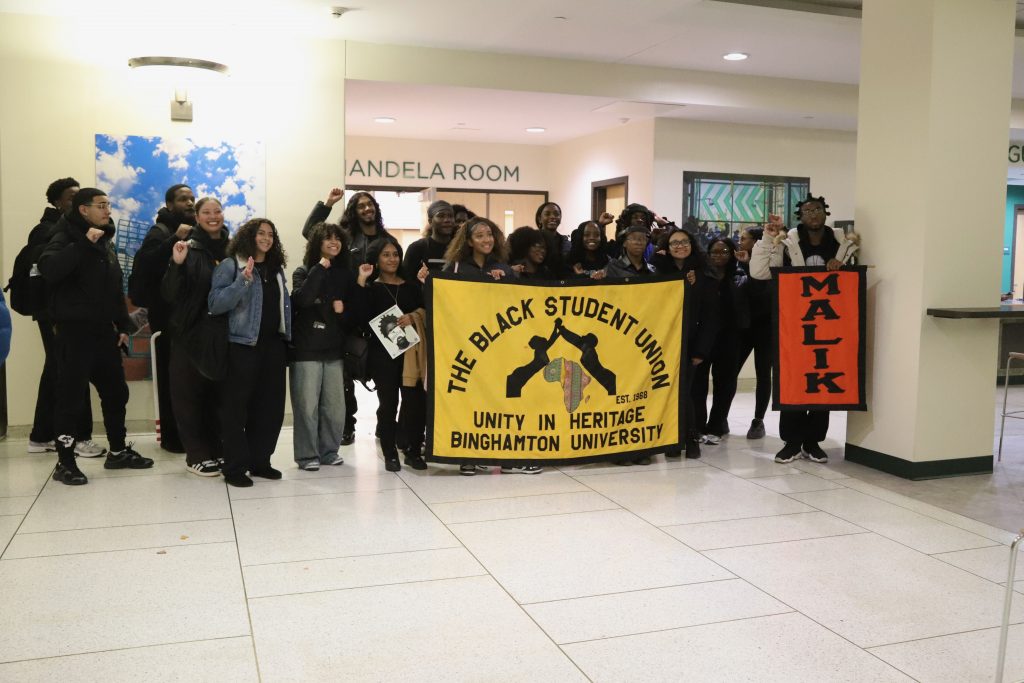
The Black Student Union held a discussion and protest on Monday in observance of Black Solidarity Day, inviting students to reflect on Black identity, history and culture.
The theme of this year’s celebration was “Stories of an Unbroken Lineage,” a theme that explores the Black experience in the United States and across the diaspora.
“It is a celebration of what it means to grow up immersed in Black culture, the sound of laughter over Sunday dinners, the peace that fills a home on a Sunday morning, the rhythm and warmth that remind us we come from a people who have always found joy even in the midst of struggle,” BSU wrote in a statement to Pipe Dream. “This is a love letter, a thank you to the ones who dreamed.”
Black Solidarity Day, established in 1969 by Afro-Panamanian activist Carlos E. Russell, takes place on the first Monday of November, the day before Election Day. At the first Black Solidarity Day event in New York City, Russell said the day would serve as a “general protest against the intensifying repression that threatens the very existence of Black people in America.”
In 2023, then-Student Association President Nia Johnson ‘23 led an effort [HYPERLINK: https://www.bupipedream.com/news/student-association/sa-president-bsu-push-to-add-black-solidarity-day-to-academic-calendar/137150/] in collaboration with BSU to add Black Solidarity Day to Binghamton University’s academic calendar. The day, however, is not recognized as an official holiday on the 2025-26 academic calendar.
A link on BSU’s Instagram page contained a template that students can use to request accommodations for an excused absence from class to honor Black Solidarity Day at the event.
The University’s Diversity, Equity and Inclusion webpage provides a nonexhaustive list of cultural recognition days and heritage months, including Black Solidarity Day, for students wanting to request “reasonable and appropriate academic accommodations.”
From 5:30 p.m. to 8 p.m. on Monday, students were invited to the Multicultural Resource Center for a discussion about the African diaspora, Black identity and cultural exchange.
Members of the BSU’s Vanguard Creative Team read selections of poetry and prose they published in their latest literary publication, “The Narrative.” The publication explored a deeper understanding of identity that extends “beyond the superficial, beyond the stereotypes that have long been imposed and misunderstood,” wrote Aiyana George, BSU’s publications coordinator and a senior majoring in cinema.
Attendees discussed their favorite aspects of Black culture and whether they ever felt disconnected from the diaspora. Students were invited to share information about their cultural heritage with each other.
The role of the media in depicting Black culture and identity was also a topic of discussion on Monday.
Students shared their perspectives on attending the University, with some expressing concerns over a lack of resources and representation on campus, particularly in mental health and support services When discussing how advocacy for Black students can be sustained long term, attendees highlighted the importance of multicultural organizations in building community at a predominantly white institution.
According to a spreadsheet compiled by the University’s Office of Institutional Research, about 48.2 percent of students identified as white in fall 2024, while around 4.4 percent identified as Black or African American.
“On BSD we pause our routines to acknowledge the strength of our communities, the struggles we’ve overcome, and the ongoing fight for justice and equity,” BSU said in a statement. “It’s a time to celebrate our Blackness unapologetically and to recognize how our creativity has shaped the world, from the rhythm of our music and the movement of our dance to the emotion in our poetry and the innovation in our art.”
BSU then led a march starting at the Glenn G. Bartle Library, walking through the Lecture Hall and across the Spine. The protesters stopped at various points across the route to read poems or speeches. Students recited chants like “Black lives matter, our safety matters” and “I’m Black and I’m proud.”
Five poems were read throughout the march by members of BSU.
“Tamir Rice, 12, shot for playing. Emmett Till, 14, lynched for daring to live. Breonna Taylor, George Floyd, Ahmaud Arbery, Sandra Bland, Trayvon Martin — all stolen, all silenced, all branded as villains by the world that should have loved them,” read one poem, commemorating Black Americans who were killed by police officers.
The march ended at the University Union, outside of Old Union Hall.
“The University can better serve the needs of Black students and students of color by making an effort to have meaningful conversations with POC students and student leaders,” the Thurgood Marshall Pre-Law Society wrote in a statement to Pipe Dream. “We think that University administrators and leadership need to make an effort to attend events like BSU’s black solidarity day event because these are really the only spaces where Black and POC students’ voices are not overshadowed by the majority groups on campus.”