





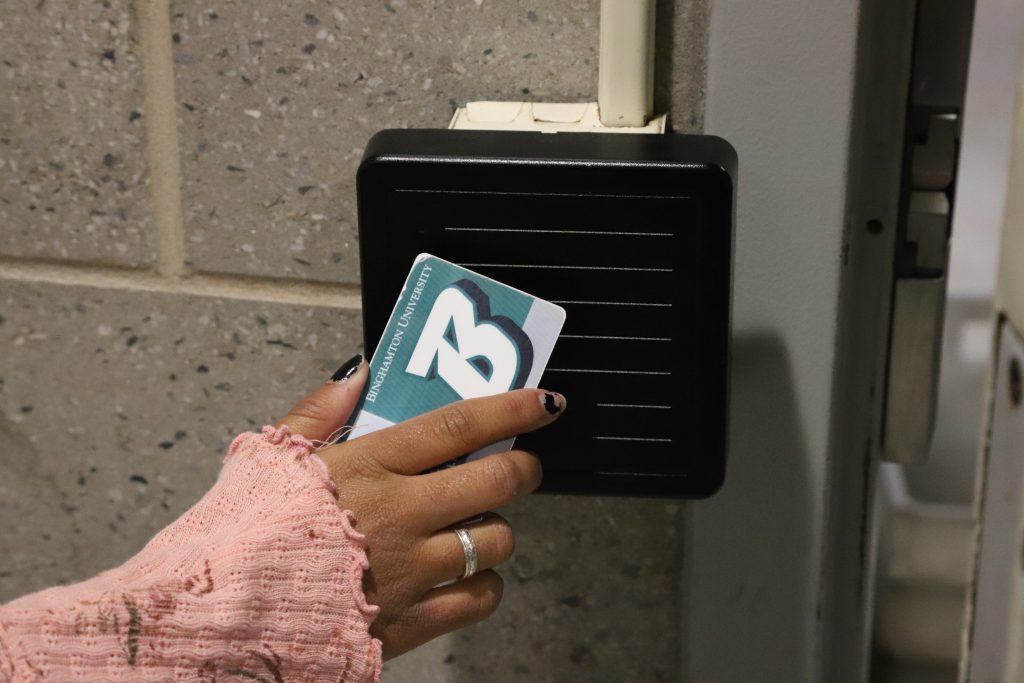
Binghamton University is considering replacing student and faculty physical identification cards with a mobile credential system.
On Oct. 16, a Dateline announcement said that University administrators are exploring the possibility of transitioning from physical campus ID cards to a mobile app. David Martin, assistant director of security infrastructure and support, told Pipe Dream that “mobile credentialing” could improve operational efficiency and user experience. This proposed replacement of the physical card with a mobile app hopes to improve the student experience and campus efficiency.
“This new system aims to enhance campus safety by strengthening security through advanced technologies and protocols against unauthorized access and facilitating rapid response in emergencies,” Martin said in a statement. “To address integration with existing campus systems — such as door access, meal plans, library services, and attendance tracking — the plan assumes implementing a mobile one-card provider to integrate all current downstream use cases.”
Information Technology Services provides technological support to students across all University campuses.
The student ID card provides access to essential facilities and services, like campus dining and some residence halls. Electronic photographs submitted for inclusion on a physical card are uploaded to an electronic system called Banner. The system also includes a student’s electronic record for faculty for class rosters, testing and academic advising. Administrative staff may also use the photographs to verify a student’s identity.
These ID cards are managed by the Student Records and Registrar Service, located in the Admissions Center. The Student Handbook requires students to carry their ID card with them at all times and states that students are “responsible for its use or misuse.”
For faculty and staff, ID cards are issued by the Office of Human Resources. Similarly, staff are expected to carry their card with them at all times, providing access to various University facilities, events and services like athletic events, the library and the Fit Space. Faculty may also use the ID to verify employment with the University.
According to IdentiSys, a company that provides security and identification services, physical ID cards have several advantages, like not depending on cell phone technology and battery life. However, physical cards are also prone to being lost, stolen, cloned or tampered with.
On the Student Records and Registrar Service website, students are advised to avoid storing their ID next to a cellphone or charger to prevent damage to the magnetic stripe. Students must pay $20 to get a new physical ID.
A mobile system complete with two-factor authentication could strengthen security and allow for more flexible updates, according to IdentiSys.
Broome County Transit buses, for example, accept swipes from University IDs so students can ride for free. Some businesses offer discounts for college students.
As part of the current exploratory phase, the University released a Google Form to faculty and staff asking how their department currently uses physical IDs. On the form, faculty and staff can report whether physical ID usage is “critical” to their operations and whether it can be integrated with other software.
In UClub, student residents already use a mobile identification system to access certain facilities and living spaces. This system requires students to open a mobile app and hold their phone up to a door scanner to unlock it.
“I have heard nothing but bad things from the current mobile system for UClub,” said Isaac Kolisch, a senior majoring in chemistry. “This does not give me high hopes since ID cards have been very versatile and easy to open doors. I can’t imagine what they will do for the labs in [Innovative Technologies Complex], I use my ID card at least five times a day when I am in lab. This will just waste time from my day and precious minutes that could be going to my research.”