





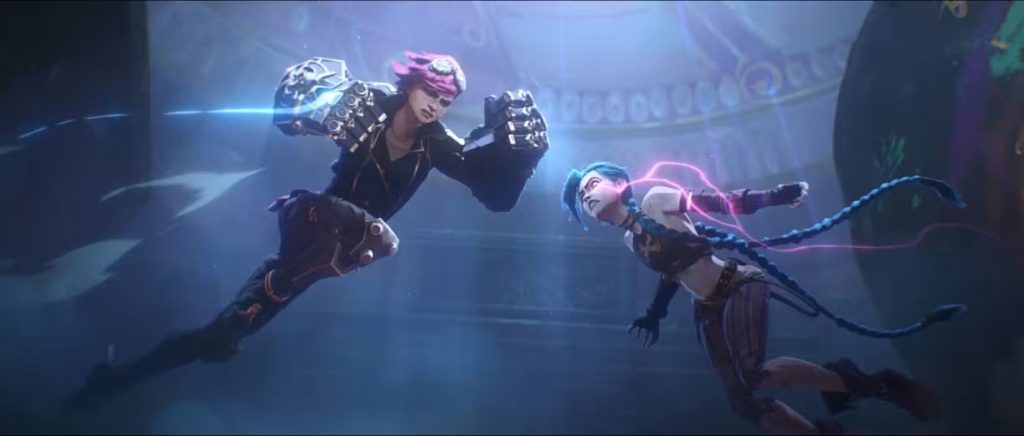
The final arc of “Arcane” season two, created by Christian Linke and Alex Yee, was released to Netflix just over a year ago, concluding their masterfully written steampunk, action-adventure series with epic battles, dimension-shattering heroes and heart-wrenching tragedies all depicted in Fortiche Production SAS’s one-of-a-kind animation style.
Following the release of each season, “Arcane” quickly accumulated successes, such as receiving 100 percent from critics on Rotten Tomatoes, setting the record for Netflix’s highest-rated series within one week of its premiere and winning a variety of awards for animation, music, effects, voice acting and LGBTQ+ entertainment, among others.
Now, a year later, removed from all the excitement, does the show still hold up?
While “Arcane” broke standards for animation and successfully executed complex parallelism and character dynamics in a nearly flawless first season, the show simultaneously contains numerous shortcomings in its second season. This is a small drawback that keeps the show sitting pretty at near perfection.
Starting with the positives, “Arcane” draws on the overly cartoony in-game depictions of the League of Legends world and characters created by Riot Games. From there, art director Julien Georgel and Fortiche expertly translated the designs to highlight the juxtaposing characterizations of the gloriously rich city of Piltover and its moodier, rugged underbelly, Zaun.
While maintaining some fantastical elements known to League of Legends, “Arcane” prioritizes the realism and practicality of every look in the show, with every element of the redesign reflecting its contextualizing mentality and environment.
On top of the iconic designs, Fortiche’s unique animation style enhances the immersive storytelling. Fortiche begins with 3D animation, before layering traditional hand-drawn 2D animation over it to create effects like explosions and dynamic lighting. Moreover, “Arcane” utilizes variations in frame rate between the 3D and 2D elements and cinematic camerawork to evoke chaotic or emotional atmospheres.
With the seamless incorporation of impact frames and a variety of animation styles, Fortiche sets new expectations for what is visually and emotionally possible with animated storytelling.
Adding to the emotional resonance “Arcane” evokes, each piece on the soundtrack functions to further articulate the emotions, tensions and motivations of the present moment and character. In and out of the context of the show, each song, but particularly “Wasteland,” “The Line” and “What Could Have Been,” is a creative masterpiece.
From the songs to the animation to the small, utmost unnoticeable detail in the corners of the frame, “Arcane” incorporates recurring motifs, deep symbolism and the narratives of background characters, which quietly express foreshadowing and untold lore to keen-eyed viewers. As a result of this unimaginable attention to detail, each piece in every frame feels essential to the narrative.
Portrayed beautifully through these elements, Linke and Yee’s multi-layered character-driven plot articulates the complex mentalities, decisions and intertwined, unfolding relationships of characters within a deeply unequal world. The estranged relationship between two Zaunite sisters, Vi and Jinx, takes center stage as Piltover faces an uprising from Zaun in search of political autonomy. Paralleling the fight for Zaun’s freedom, on which their father figures previously took opposing sides, the sisters carry on an endless cycle of war and inequality between the cities.
Throughout season one, every scene feels essential to the plot and every character’s reaction feels in line with their growing knowledge, yet restricted perspective. The development of unlikely relationships, complex motivations and misunderstandings leads to escalating tension. This results in Jinx’s masterfully portrayed psychotic breakdown in the finale, leaving fans in a three-year-long state of lovingly devastated anticipation for resolution in season two.
Unfortunately, despite the incredible setup in act one of season two, the subsequent acts introduced and underdeveloped a few too many new fantastical elements, leaving viewers unfamiliar with League of Legends confused. With these fantastical inclusions broadly expanding several characters’ storylines, the already grand scope of season two’s plot grew beyond its allotted runtime.
As a result, the season progressed with few scenes that developed characters’ motivations and relationships. Unable to extend the run time, the show suffered from introducing a supporting character who only functioned as a plot device to develop Jinx’s character, inconsistent pacing and confusing character choices.
Despite the drawbacks of season two, “Arcane” remains a milestone in animation, proving that game adaptations and animation for mature audiences can be successful. The show as a whole raises the standards for visual artistry, casual disabled and LGBTQ+ representation and emotional resonance previously unseen in animation.
Beyond leaving a legacy on animation, the show’s worldwide popularity has led Riot Games to achieve its goal of establishing League of Legends as a global brand. As a result, the company expanded the game’s universe. At the same time, “Arcane” extended international acclaim to Fortiche, which, with the monetary success of the show and the intensive work of its animation, grew its production team from 15 to around 300 people.
With three series in the “Arcane” universe underway, the show’s exciting legacy is far from over.