





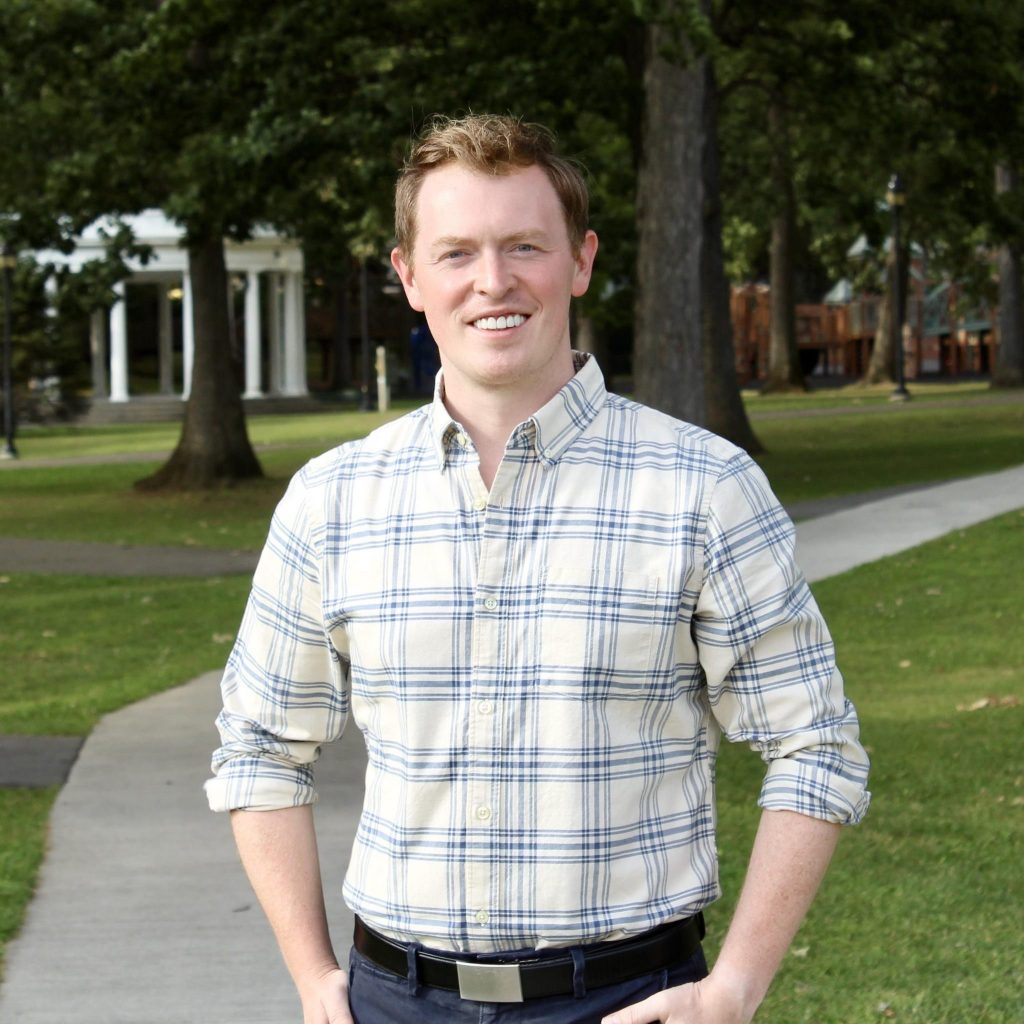
Miles Burnett is the Democratic and Working Families Party candidate for the City of Binghamton mayoral race. A South Side native, Burnett served as deputy chief of staff for State Sen. Lea Webb ‘04 from 2023 to 2024. Before that, he was an aide to former New York City Council Member Andrew Cohen and as executive director of a nonprofit advancing economic development projects. If elected, he would be the city’s first Democratic mayor since Matt Ryan ‘83, who served from 2006 to 2013.
Pipe Dream requested an interview with Burnett, but his campaign opted for a written questionnaire instead. Questionnaire responses have been lightly edited for clarity.
1. How does your background and previous experience qualify you for this position?
I have a diverse experience in the public and non-profit sectors. I started out working as a community organizer in New York City where I focused on environmental and social justice initiatives. I then took a position working for a New York City councilperson, focused on New York City’s $100 billion budget and constituent relations for an underserved area. From there, I was the executive director of a non-profit focused on supporting small businesses in a neighborhood business district in the Bronx. I worked with businesses to improve sanitation, public safety and infrastructure.
Then, the COVID-19 pandemic hit, and I worked with businesses throughout the state to keep their doors open and people employed. We helped access grants from public and private sources to save hundreds of small- to medium-sized businesses throughout the state. Most recently, I worked for our amazing New York State Senator as her deputy chief of staff.
I have experience at working in both local and state government on a variety of issues from environmental regulation to NYSEG rates to municipal garbage collection.
2. What do you believe are the biggest shortcomings of the current administration, if any? What would you change/improve upon and why?
City Hall suffers from a lack of vision, leadership and planning. They are too focused on reactive solutions to have any meaningful impact on systemic problems. The same challenges that I saw growing up remain today. Thirty-three percent of our community lives in poverty, almost 400 Binghamton City school children are homeless and the median income in the city of Binghamton is only $27,000. My opponent has been in City Hall for 12 years, the first seven as Deputy Mayor, and is committed to “doing things the way we’ve always done them.”
I believe that we can solve our toughest challenges when we have the political will to do so. It will require creative solutions and new vision to take on the challenges the city faces. We can make real improvements for everyone by tackling the housing crisis, strengthening public safety, investing in youth services and championing small businesses.
3. Given threats to federally funded programs such as SNAP and Medicaid, how will you handle these challenges and others that arise from Washington, D.C.?
The Republican cuts to food aid and health care will devastate our community, increasing hunger, hurting our local economy and driving up poverty rates and all the problems that come with that. Binghamton’s poverty rate is 33 percent and these federal dollars are vital to so many households. But if Washington or Albany do not fund these programs, as they have been by bipartisan majorities for a very long time, all Binghamtonians, not just poor ones, will lose.
With this chaos in Washington, mayors can’t just be managers, they need to be fighters for working people. I will work with other local officials from around the region and our county government to advocate for these at the state and federal level.
4. Many Binghamton residents are concerned with the rising cost and availability of housing. How do you plan to address this issue?
The cost of housing has skyrocketed in the city of Binghamton. Much of this has been driven by the conversion of affordable units to more expensive student housing. The Good Cause legislation, which I support, was a good first step to keep tenants in their homes.
My specific plan is to 1) build more quality, affordable housing by using the city’s bonding capacity, 2) revamp Code Enforcement to ensure safe apartments today and good housing for years to come, 3) build pathways to homeownership for our renters through grants for first-time homeowners, 4) work hand-in-hand with nonprofits to identity vacant properties for rehabilitation, 5) create tax incentives to build on vacant properties, and 6) provide rehabilitation grants to help current homeowners maintain their properties.
5. Homelessness also continues to affect many in the local community. What are some ways you would tackle this?
Homelessness has tripled since the pandemic. Recent increases show homelessness is increasing fastest among families with children. Today, almost 400 Binghamton City School kids are facing homelessness, stuck in hotels or crashing with relatives. On Day 1, I will bring together all the organizations working on this issue — nonprofits, faith organizations and businesses — to the table so we can create a plan to end homelessness in the city of Binghamton. Right now, there is no plan that residents can measure the success, or failure, of city government.
But, at its core, homelessness is a housing problem. In the last four years we’ve added only a fraction of the affordable units our city needs, under 50. We’ve been told there are more units coming on-line, but they are years away from completion. This pace is just too slow. My plan will bring new affordable housing online faster, help maintain the properties we currently have and support first time homeownership.
6. With the recent resignation of Police Chief Zikuski, could you describe your approach to public safety and what role the Binghamton Police Department will play in it?
The report on Chief Zikuski’s behavior documents egregious behavior and shows the Chief felt department policy and the law did not apply to him. This is what happens when someone is not accountable to the public and is not being held accountable by the Mayor. The report, released by the city almost three months after the incident, raises more questions than answers in some ways. We don’t know if the Chief was privy to the information in the report before he resigned, how long the administration had the report before it was released and if the Chief was allowed to resign rather than be fired.
I support the City Council’s call for the district attorney and the attorney general to open up a criminal investigation into the disgraced police chief’s conduct. Binghamton deserves to know the full story about this incident.
Since the chief has been on leave, I’ve been calling for a community-driven process to pick the next chief. That will include town halls throughout the city, hearings held by the City Council and public vetting of candidates drawn from a large applicant pool to reinforce the legitimacy and respect the next Chief needs to lead the force. We have a once-in-a-generation opportunity to determine the future of policing in Binghamton.
7. Given the controversy you faced regarding statements made when you were an adolescent, how will you continue to earn the trust of local residents?
I’m sorry for the words that I used at that time in my life. They were unacceptable then and they are unacceptable now. In that video I see someone who doesn’t understand systemic racism and the way that words can be harmful, no matter your intent. Since then, I have done a lot of growing and learned about the impact of racism on marginalized communities. The way to build trust is by owning your mistakes, apologizing and then showing people — through actions — what you are about. That is what accountability looks like and it will be a theme throughout my administration.
I am committed to address the real needs of the Black community, a community that has been neglected by City Hall for decades. As a result, Black residents suffer from higher rates of poverty, economic insecurity and incarceration. In Binghamton, we have to address the racism in our schools and the distribution of city resources. It’ll be a priority of mine to make sure that we are putting training in place so that everyone understands how racism operates and bring more voices into the government decision-making processes.
8. What is your opinion on the current state of Binghamton’s infrastructure? What would you do, if anything, to improve the city’s infrastructure?
There are three critical issues when it comes to infrastructure. The first is personnel. Six critical department head positions are currently unfilled — I’m committed to creating a culture of recruitment and retainment so we can build strong municipal expertise.
The second major issue is planning. Every municipality must have a 10-year comprehensive plan for capital improvements, updated annually, to determine our capacity and need for upgrades. This is integral to ensuring we have the necessary funding schedule in place for all infrastructure development. The City’s current plan was prepared in 2014 and has not been updated since. My administration will do a critical needs assessment to develop an up-to-date comprehensive plan and use this to identify gaps and develop future projects.
My final critical concern is flood mitigation. Binghamton had two historic floods in 2006 and 2011. These catastrophic events caused water to back up in streets and homes, incurring damage from which residents are still recovering. We need to take a hard look at how prepared our city is for the next flood. I will work with the county, which maintains a flood emergency plan, to make sure Binghamton makes necessary investments in stormwater management and other flood mitigation strategies to ensure our homes and streets are prepared and protected.
9. What makes you a good candidate for young voters and students?
The two issues I’ve heard from students about over and over again are landlord issues and the annoying blue bags. My biggest focus is building and improving housing in the city. Improving Code Enforcement in the city, the department that cites landlords for poor conditions in their rental units and on their properties, will benefit students and all other residents. I will institute Pro-Active Code Enforcement, which will require apartments to meet a certain criteria to be rentable. That way, students will not be dealing with substandard conditions because we know that some unscrupulous landlords will try to take advantage of students, who may not be fully aware of their rights as tenants.
I will get rid of the blue bags. Right now, students are forced to find and then purchase the bags. This passes the cost for trash collection from landlords to tenants. When I am mayor, my administration will lead a community process, including students, to find a better, cost-effective alternative to the bags while keeping trash collection public.