





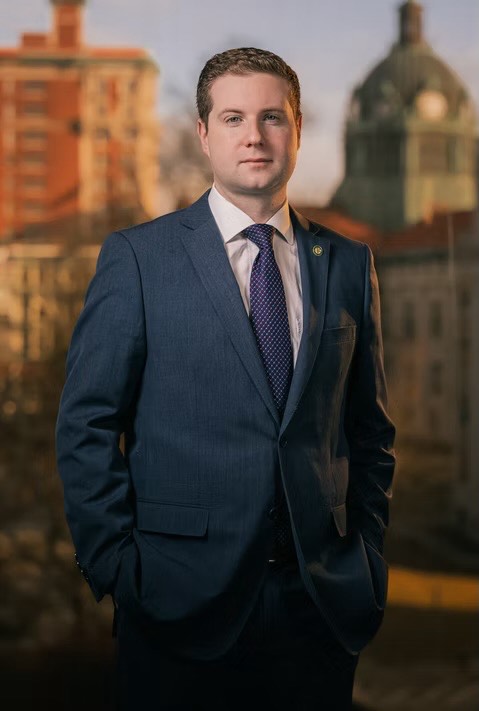
Jared Kraham is the 51st mayor of the city of Binghamton and is running for reelection on the Republican and Conservative Parties’ ballot lines. Elected in 2021 as the city’s youngest mayor, Kraham previously served as deputy mayor for nearly eight years.
Pipe Dream requested a sit-down interview with Kraham, which he agreed to. Responses to questions have been lightly edited for clarity.
Looking back on your first term, what are some achievements that you are most proud of? Is there anything you would do differently?
“I think the things that I’m most proud of are the rebuilding of the Binghamton Police Department, the fact that at a point early on, when I was mayor, we had more than 30 open positions in BPD. We worked with the union, we upgraded pay, we changed some policy and improved recruitment, and we’ve been able to retain more officers, and we are on track to have a fully staffed police department for the first time in 20 years, basically, at the end of next year, once that recruit class graduates. So I would say that public safety and the investments and achievements that we’ve had there have been something that I’m really proud of. Also, according to FBI statistics, 2024 was the lowest index crime rate in the city’s history that’s on record, and violent crime has dropped almost 30 percent since I’ve become mayor.
I would say other top-of-mind things that I professionally and personally am proud of are the work that we’ve done on railroad bridges and getting those upgraded at zero cost to the taxpayers. We released that damning and detailed report a couple years ago on the condition of bridges, and it made the railroads fix the bridges. And these have been things that have been crumbling for, like, my entire lifetime living in Binghamton. It’s sort of the same thing with the Binghamton Plaza, the fact that this is a long, blighted and crumbling plaza owned by an out-of-state slumlord, essentially, that was going to do nothing with it. It’s hurting property values on the North Side, it negatively defined an entire neighborhood of the city, and so, we took aggressive action and won. The appellate division of New York State courts unanimously held that the city could take over that plaza, redevelop it, remove the blight.
And then the last thing I’ll say is just what we’ve done to really prosecute slumlords, the fact that Isaac Anzaroot, in a historic win for the city of Binghamton, was banned from the real estate market. He’s an individual that hurt countless families, countless neighborhoods, not just in the city of Binghamton, but really across Broome County. So I would say public safety, and then taking on those generational challenges that other levels of government just haven’t really worried about or there’s been the thought that they’re too difficult, too challenging, too complex for a mayor to solve. And I took those head-on, and we were able to win on a lot of those cases.”
In recent years, candidates across the country without extensive political or executive backgrounds have risen to popularity. In what ways do you believe your prior experience as mayor makes you a better candidate?
“I would say that while there are some anecdotal examples of that, that’s really not the trend. And if you look at the candidates for mayor across New York state in this year’s slate, the mayor of Buffalo and the Democratic candidates in most of these cities are going to win. So the Democratic candidate in Buffalo is an attorney and longtime state representative. Rochester’s is the incumbent mayor, longtime member of city council and the school board in Rochester. In Syracuse, a longtime deputy mayor, Sharon Owens, is the nominee. And in Albany, it’s a city auditor that has a lot of municipal experience.
And so when I look at Upstate New York and who’s running for mayor, really I think that my opponent is kind of the odd man out, as it relates to relevant municipal experience. So, experience means more than just what’s on a resume, while that’s important. It literally comes down to what background and credentials does a mayor have when there is a natural disaster, when there is a public safety emergency, when there’s a storm like what hit in July on the North Side and East Side of the City of Binghamton. Being able to not wait and think about what to do next, it’s just simply reaction time and responding to the emergency, because I’ve been there before and I know how to do it. I was involved in the flash floods in 2018, I was here during the COVID-19 pandemic and managing the city’s response to that. Public safety emergencies, large fires — these things that I’ve had to deal with are kind of critical moments for any mayor.
And, frankly, what terrifies me is the concept that someone who has no experience in local government would be running for mayor. You know, Miles Burnett is, if you look at just the resumes of the folks involved, the most unqualified person to run for mayor in some time. Joe Burns, who ran four years ago, was a longtime City Council member. Before that, Tarik Abdelazim is someone I disagree with a lot, but he was an eight-year employee at City Hall and was a department head and deputy mayor. Terri Renia was a longtime member of City Council and its president, as well as a successful local small business owner, and Matt Ryan was an attorney and someone involved in the criminal justice system as a public defender. So if you look at all of those resumes, and then you compare my opponent’s, it’s very clear that it’s just not what it needs to be.”
Given threats to federally funded programs such as SNAP and Medicaid, how will you handle these challenges and similar ones from Washington, D.C.?
“So while the city is not an administrator of SNAP, certainly, we have a lot of our residents that are on Medicare. Any changes in the federal government that affect how federal funding is flowing to localities, whether it’s cities or counties, impact city residents. How the city specifically is impacted by these federal cuts is mostly in our Community Development Block Grant funding. So the city gets $1.8, $1.9 million in grant funding every year that we use toward improving low-income neighborhoods, human services like addiction recovery, Boys and Girls Club — we help fund homeless outreach programs with it.
The cut of that funding or the elimination of that funding, as the Trump administration proposed, would be devastating and I think that it’s a complete dereliction of duty on the part of President Trump because instead of investing in cities and the urban cores of America that grow jobs, have our most diverse populations and will, I think, determine where America’s standing is in the world in the 21st century, he’s basically saying, ‘I don’t want to fund it anymore. It’s up to the states.’ That’s not in the in the tradition of American presidents, going back to President Lyndon B. Johnson’s Great Society, the fact that everyone deserves to live in a community of pride, a home of dignity, a city of hope.
These are things that I, as mayor, think about a lot and I take to heart, and I think what you’ve seen in this administration is just an abdication of working with cities specifically to deal with challenges of an urban community, things like housing, things like even public safety — CDBG funding goes towards things like fire equipment and fire houses. So it just is not smart, and I’ve spoken out strongly against it through the New York Conference of Mayors, U.S. Conference of Mayors and then also my own kind of advocacy that I’ve been doing here.”
If you are reelected, what do you see being the top three priorities of your second term?
“It’s very similar to the priorities of the first term. Public safety is the number one priority. That is, really from a municipal standpoint, what local governments were designed to do. The Binghamton Police Department and Fire Department are older than the city itself. So when Binghamton as a village started to gain population, one of the things that they did in the 1830s was basically say, ‘Oh, okay, we need people to put out fires and we need police officers to make sure that we’re safe.’ Those are the basic functions of municipal government.
So when I go door to door, or when I’m talking in neighborhood groups, public safety is the number one thing that people talk about. They want to be safe. They want a fully staffed police department. They want foot and bike patrols on neighborhood streets. They want the city and the mayor’s office to use things like a reformed lockdown law to go after nuisance criminal activity. They want our Special Investigations Unit Task Force to root out our narcotics dealing and dangerous criminals that are trafficking guns, trafficking drugs that are impacting families. So public safety is and will always be the number one concern. I’ve been endorsed by the Binghamton Police Union as well as the Binghamton Firefighters Union, because they said that I am the only candidate that has the experience and track record necessary to guide public safety in the City of Binghamton.
The second most important thing — and again, this is 1A, 1B really — is housing. We have to build more housing: affordable, market rate, all of the above. We have an aging housing stock in Binghamton. I’m very, very proud of the work that we’ve done as New York State’s first pro-housing community as announced by the governor, that we are aggressive on all state programs to help build more housing, whether it’s 100 units in a multi unit residential, or filling vacant lots with new new starter homes, all of these things matter. And Binghamton has become a place that is known for its housing development. In 2024, we set the record for permitted residential construction — so that’s new construction of housing, and that’s upgrading existing housing stock in the city.
So we need a mayor over the next four years that knows how to build housing. And I have built housing. There are many examples, hundreds of units that are either coming online right now, are under construction or are in the project pipeline waiting for tax credits. Binghamton has a great track record on housing, and again, a difference between me and my opponent is that anyone can talk about the need for housing, it’s who actually has the experience and can show we’ve built it. We’ve brought in developers. We have literally new units that are coming online because of spearheading it from the mayor’s office. And that’s really what has to happen. It can’t happen organically, someone who is mayor has to say, ‘I’m going to quarterback this.’
The third thing would be neighborhood quality of life. So that has to do with how are we making our neighborhoods affordable? How are we ensuring that every neighborhood where people live, there’s not blighted properties, that code enforcement is efficient and effective and that we’re investing in our parks and youth programs? The city opened up its first youth recreation center under under my tenure, which is providing great opportunities for kids. We have the highest participation in summer fun in five years. So that will continue to grow. And I think that when people think about what makes neighborhoods strong, it’s strong housing, strong infrastructure, strong parks and recreation systems, and it’s also community events like Porchfest, you know, we want to make Binghamton a place where people want to live.
The other thing I’ll bring up was there was a report out of the Albany Times Union that there’s one metropolitan area in New York state that is gaining population of young people, the only one — it’s Binghamton. And I’m really proud of that. And it shows that we’re developing a city really for the future, and one that people want to stay. Our population has grown in the last census. Young people are choosing to either move here or stay here. And that’s been talked about a long time. And you know, this is the first period in Binghamton’s history that that’s actually happening.”
Many Binghamton residents are concerned with the rising cost and availability of housing. How do you plan to continue addressing the housing crisis?
“Build, build, build. The more housing units we can bring online, the more availability that there is in the market. I don’t agree with onerous regulations that restrict the housing market, which is something that Good Cause Eviction did. One of the things that we’re hearing from the Department of Social Services is that less and less landlords are willing to take on DSS Housing because of the Good Cause Eviction mandate that was passed. So we should not have onerous regulations. We just have to build more housing — that is the ticket to this.
And when I talk about affordability, if you are paying more than 30 percent of your monthly income in rent, that means that you don’t have disposable income for either the necessities or even things that can improve your life. It’s harder to pay that NYSEG bill. You don’t have the money for child care if you want to pick up a second job, you don’t have the money for child care if you want to go and get a degree. Sometimes it’s as simple as a set of tires on your car, or having things that enrich your life.
So, what we can do through housing is deliver permanent affordability. When people live in affordable housing units that are capped on how much they’re paying, every single month they’re saving hundreds and hundreds of dollars that not just benefit those individuals, but that’s good for our local economy. It gets more money flowing, it’s jobs, it’s disposable income. So that is the key to affordability. And when we talk about affordable housing, I think, hopefully, it’s starting to change, the stigma that these are low income projects or this is all homeless housing or something. It’s not. We’re building housing for the average Binghamton resident who’s living paycheck to paycheck, who is working, who wants to raise a family and deserves a home of dignity. That’s the housing that we’re building. And if we’re going to have a workforce that supports all of the open jobs in Binghamton and really grow what our community is, we’re going to need housing to do it.”
Homelessness also continues to affect many in the local community. What are some ways you would tackle this?
“I think, first and foremost, we have to confront honestly what are housing-related challenges with homelessness, and what are mental health and substance abuse challenges that individuals face who people may see in the community and assume that they are homeless. They may not be homeless. They may have a home, but maybe what we’re talking about is people who need supportive services that are not of sound mind, that are acting out and are choosing to live outside. The other thing we can’t do is we cannot allow for homeless encampments to be on public property or in our downtown. What happened at Christ Church was very, very sad, and you had that encampment that led to nuisance criminal activity. There was open burning problems, there was human waste throughout the property, harassment of female employees and catcalling and that sort of stuff. That is not what Downtown Binghamton deserves. It’s not safe for the people that live in these encampments. It’s not safe for the people that that live and work in the downtown area.
What are we doing about about homelessness? We’re having a very strong relationship with our homeless outreach providers that are connecting people with services, and we’re building more housing that will improve the lives of homeless individuals, specifically working with Greater Opportunities for Broome and Chenango, Inc. and expanding dozens and dozens of new housing units. Housing really is the key.
The other thing that that I’m very, very proud of is that Binghamton is a leader in mental health crisis response. So when an individual is experiencing a mental health crisis, they really don’t need a police officer, they need a counselor. We have, working with the Mental Health Association of the Southern Tier, an ability for a trained mental health counselor to go on a call and that’s going to be expanded next year in partnership with Broome County — I talked about in my budget address. We’ve long been advocating for that, and Broome County and the city are partnering to expand that program and have it happen on a dispatch level.
So, the sooner we can get someone who’s experiencing homelessness that doesn’t have any of the substance use or mental health needs, that is a housing issue. When someone is experiencing those, housing alone will not be the solution. We have to have supportive services with substance use disorder as well as mental health services in order to truly get them in a place where they can be successful.”
With the recent resignation of Police Chief Zikuski, could you describe your approach to public safety and what role the Binghamton Police Department will play in it?
“The Police Department is our most critical tool for fighting crime in the city and cleaning up neighborhoods in terms of narcotics trafficking and in crime. I’ve said many times before that more cops doesn’t always equal less crime, it’s not as simple as that. You have to have a 21st-century approach to policing. That means community policing, that means cops getting out of their car, walking a beat, being on foot or on bike, talking to neighbors, passing out their business card. You don’t want communities to feel like the only time they see police are when they’re responding to to a crime or someone is a victim of a crime. So that hot spot kind of community policing has been expanded greatly as mayor. Cops walking the beat downtown into neighborhoods has been critical.
We also have made investments in gun violence reduction, partnering with the Bureau of Alcohol, Tobacco, Firearms and Explosives on technology that helps us solve gun crimes more quickly than ever before. We used to have ballistics that were involved in a shooting. It could take six months sending it to the state police lab and waiting for results. We can now get those results back in a matter of a few hours, which means that we can solve crimes quicker, we can prevent retaliatory shootings and really focus on reducing gun crime in the city. Shortly after I was mayor, I invested a million dollars in gun violence reduction. We’ve seen that in the violent crime numbers that have been reduced.
We also need to invest in technology. Twenty-first century policing means using 21st-century technology. Pole cameras throughout commercial business districts, license plate readers that are the biggest tool that detectives have to solve crimes. This technology doesn’t require an increase in manpower. It is relatively inexpensive if you compare it to what it would take to hire that many cops. So we can do things more efficiently with public safety too, but it takes investment, and it takes a mayor that has experience in public safety in order to continue the progress that we’ve seen. I think, as it relates to the police department in general, I want a forward thinking police department. I want to recruit the best and brightest to choose to serve in the police department. I think that Binghamton is the largest law enforcement agency in the Southern Tier. It should be viewed as the premier law enforcement agency, and we should pay our officers that way too.
And so, negotiating contracts that make them paid higher will allow us to recruit the best, retain the best and also make sure that the police department reflects, from a racial standpoint, the community that they’re serving. We need to hire more Black officers. We need to hire more female officers, to more adequately reflect the community that we’re serving. The best way we can do that is to recruit and make it a profession that people want to go into. One of the things that we saw happen during the pandemic, and certainly in the aftermath of George Floyd, is no one was signing up to take the police test. It was abysmal. And this year we have the highest number of recruits, which is far more than we’ve ever had in the last several years. That means that people want to join the force and we’re going to get a diverse and qualified group of applicants.”
What is your opinion on the current state of Binghamton’s infrastructure? What would you do, if anything, to improve the city’s infrastructure in a second term?
“Binghamton needs to take on large-scale infrastructure projects to improve our city. We have major projects happening downtown and on Main Street and in neighborhoods all over the city. For many, many decades, the city, as part of its annual infrastructure plan was just paving roads but not fixing the underground storm water, sewer and water lines that are really the heart and soul of our infrastructure projects. So we’re doing more of that. We’re spending more money on water and sewer lines.
We’re also getting more grants, I think, than ever before to tackle these large-scale infrastructure projects. This past winter was a very harsh winter on our roads with the freeze and thaw cycle, but we’ve been able to bring in a technology called RoadBotics, which uses artificial intelligence to rate all 151 miles of city streets. This is on the Binghamton’s Public Works website. You can look up the street where you guys live and see what condition it’s in. So we’re using technology to get better at at improving infrastructure.
We’re also focusing on multimodal transportation. The fact that the folks who use our streets are not just cars, that they’re cyclists, that there’s pedestrians and that we want to build a very, very walkable downtown, and the infrastructure upgrades that are going on right now help do that, but also commercial districts. We’re going to reduce traffic accidents on Main Street due to those improvements. It’s not just having a smooth paving surface, but it’s about fixing the underground utilities, as well as things like sidewalks, curbs, making it more pedestrian friendly. So my administration has had record breaking investments in infrastructure. We’ve been able to get huge grants to fix major projects, and we’ve used infrastructure as an economic and community development model, both in downtown and in neighborhoods across the city.”
What makes you a good candidate for young voters and students?
“I’m the youngest mayor in Binghamton’s history. It’s, of course, more complicated than that, but I would say that I’m not that far away from you guys, right, in terms of age. I graduated from from college in 2013. I’m a young person that’s starting my future here, I recently got married. I am not somebody who’s been in the system for 50 years, or I’m on the kind of the twilight of my career, and neither is my opponent. But I think what I’ve shown as mayor is a willingness and really a belief that Binghamton should be thinking about punching above its weight on everything that we do. When we make investments in events like LUMA and Porch Fest or new events that are happening downtown. Our whole point is that just because Binghamton is a smaller city does not mean we need to have small dreams for what this city can become.
I think that we have an outstanding relationship with Binghamton University. I’m really excited about the new president that’s coming in — I had a chance to meet Anne D’Alleva at her event last week — and how the University can kind of play a role in economic development for our entire community. There is no other more important institution than Binghamton University in terms of the future of the city of Binghamton and Broome County. It’s our major employer. We have unbelievable talent coming from across the world to Binghamton, both with undergraduates and graduate students. We have all of the people that work at Binghamton University, the professors and the professionals. It is an incredible asset and we needed to continue to leverage that relationship.
And I talked to mayors from Gainesville, Florida to West Lafayette, Indiana, where Purdue University is, and I see how decades ago, those communities really leveraged their relationship with the university. And I said this at the debate, I’ll kind of reiterate it. First of all, you guys should be incredibly proud that you go to Binghamton University. It is unquestionably one of the greatest colleges in the world. It’s I’m jealous sometimes actually and I went to Syracuse University, it’s a great school, but Binghamton University is really good. If you look at the list that the University is now on, with UNC Chapel Hill, the University of Virginia, Michigan, University of Texas at Austin, all of these public Ivies. And you look at what their home municipalities or those college towns are, the economy is booming, housing is being built, it’s a hot job market. People are choosing to move there. These places are hubs for innovation, for jobs, for growth, because they are these great college towns. That is what Binghamton should be as well.
If we’re going to compare Binghamton University to UNC Chapel Hill on academics and everything — we’re on that same list — we need to start comparing Binghamton to Chapel Hill, North Carolina, to Austin, Texas, to Ann Arbor, Michigan, to Gainesville, Florida. That’s the category that I want Binghamton to be in. Booming, people making investments because the college is thriving, all of the ancillary arts and culture that comes from a great college town, these are the goals that we should hope for, and that is good for average Binghamton residents too. The growth of the University, people always assume that it’s student housing tightening the housing market in Binghamton, or there’s traffic on the Vestal Parkway. It’s good that there’s traffic on the Vestal Parkway, it’s good that it’s tough to get a reservation at a restaurant in downtown when the students are here. These are all really good things and the markers of a healthy local economy.
I don’t think anyone can argue that Binghamton University is not the most important institution from an economic development standpoint for the next decade. I get that as mayor, and I want to work on growing that and having positive impacts that will help out everyone in the city of Binghamton.”