





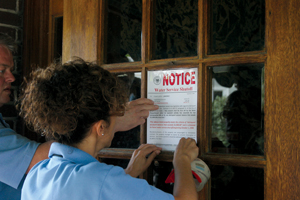
Some Binghamton University students living off campus could have their water shut off starting Oct. 1. The cause? More than 200 property owners Downtown owe in excess of $1,000 in water and sewer bills.
The shut-off is just one step in a series of water reforms passed this year, aimed at decreasing the number of delinquent payments across the city. The reforms also include rescheduling the billing schedule and new payment options.
According to Andrew Block, director of community relations for the city of Binghamton, the reforms were introduced to help the city with bill collection.
Current delinquencies owed to the city for water/sewer bills stand at more than $550,000 collectively for property owners who owed more than $1,000 each, and more than $400,000 collectively for property owners who haven’t made payments to their water/sewer bills in two consecutive cycles.
Block said Mayor Matthew T. Ryan put a project team together in April to create the renovations after concern was expressed by County Executive Barbara Fiala.
“Too many water bills remain unpaid, and the amounts are added to tax bills,” Fiala wrote in a letter to Mayor Ryan on April 1. “This unnecessarily adversely affects the county cash flow.”
According to Block, the reforms passed through City Council in May. A list of the delinquent properties that are subject to shut-off — many of which are located on streets where many students live, like Seminary Avenue and Walnut Street — was released last week by the city.
“Starting today [Monday, Sept. 15], the city is sending out notices that water shut-off will commence on Oct. 1 for those properties that have not complied with the water billing policy,” Block said. “In addition, the city has posted [notices] on the properties for which the water bills have gone into delinquency.”
Block said that property owners would have until 4 p.m. on Sept. 26 to either pay the water bill or set up a method by which they would pay it, if they planned to pay in person, to avoid the shut-off.
“We at the city encourage residents in the community as well as property owners to pay their water bill,” Block said.
Rob Mead, a senior chemistry major, said he hadn’t heard about the water shut-off yet.
“If that happens, I’d be pissed,” said Mead, whose property and landlord are both listed on the delinquent list.
David Husch, director of Off Campus College, said that the department had no definite plans to help students yet because they didn’t know how many would be affected.
“We would certainly work with the students if they came in,” Husch said. “We would work with them, with their landlords, with the city to try and get this rectified.”
Husch emphasized that most of the delinquencies were probably up to the landlord or past tenants, and not the fault of current residents.
Block said that the city didn’t expect to have to shut off water for all of the properties listed, and that he believed many would pay before the deadline.
“If a landlord or some third party is responsible for paying the water bill and they haven’t done so, then we would encourage, if need be, the residents to come and pay for the water bill at City Hall themselves,” Block said. “The city will be happy to accept such payment.”