





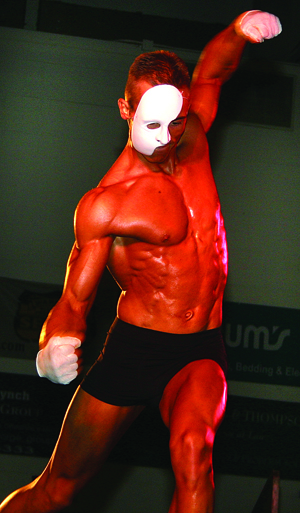
The images that come to mind at the mention of the phrase “Greek God” tend to be similar: a toga-clad Adonis, oiled up and glistening under the spotlights, flexes and poses for a screaming crowd. It’s one that Binghamton University’s greek scene has been trying to debunk as myth, emphasizing the philanthropic roots of the event and the other, more cerebral, aspects of the competition.
So at the 21st annual Mr. Greek God contest Saturday night, physical appearance — the “pose down” — only counted for one-fifth of the total score. Regardless of the point breakdown, it’s fair to say that the evening’s six contestants (and the other would-be competitors who didn’t make the cut within their own fraternities) spent most of their prep time molding their physiques. For some, it was a months-long process that involved intense dieting, rigorous exercise and nearly divine self-control.
Senior Jonathan Maldonado, the representative chosen for Phi Kappa Psi, said that in addition to training extensively throughout the year, those who wish to participate in the competition spend much of their summer in the gym in hopes of being chosen as their fraternity’s representative when the decision is made at the beginning of the school year.
“I enjoy it, so I’ll always do it, that’s why I decided to do the competition,” said Maldonado, who came in third place on Saturday.
Maldonado said that he generally works out from one to two hours each day by “circuit training,” in which he performs sets of two or three exercises as quickly as possible, taking breaks for only 20 seconds or so before continuing with the next set. The workout’s fast pace serves as a form of cardiovascular exercise in addition to helping build muscle.
Senior Ben Griffing, Chi Phi’s entry, began working out when he was only 12 years old and now spends as much as four hours a day in the gym. A typical workout for him includes at least an hour of cardio along with 1 1/2 to two hours of weight training.
Along with working out, contestants paid strict attention to their diet and nutrition in order to achieve an even greater level of physical fitness. Maldonado said that before the summer even began he did something called “bulking,” where he ate as many protein and carbohydrate-filled meals during the day as possible, in order to bulk up. When summertime came, he switched to a diet in which he consumed carbohydrates only during the day and ate protein (usually in the form of shakes, cottage cheese and lean meats) at night. And he cut out culinary vices like sugar, mayonnaise and butter from everything he ate.
It was, he said, a difficult nutritional regimen to maintain.
“Having such a rigid diet each day wears on you mentally, not only physically,” Maldonado said.
And they endured all of that stress just in the hopes of being selected to represent their fraternity.
But once they made the cut, preparation could begin for the non-Herculean parts of the evening. Mr. Greek God, after all, is a charitable event, and co-chair Arielle Harary said that the question-and-answer session, essay, toga and formal wear based sketches — as well as ticket sales, contestant entry fees, mandatory fraternity donations and jars of impromptu cash donations from the “Penny Wars” portion of the contest — managed to raise nearly $5,000 for the Elizabeth Glaser Pediatric AIDS Foundation. Much work, which started in early September for many fraternities, went into painting scenery, creating costumes and other preparations for the sketch portions. (For a closer look at how Mr. Greek God was judged, see the sidebar accompanying this story.)
And those other — formerly less important — characteristics of the contest seemed to take the day, as judges’ comments on winner Dusan Lakic, of Alpha Sigma Phi, focused on his “great theme, awesome chariot … [and] excellent stage presence.”