





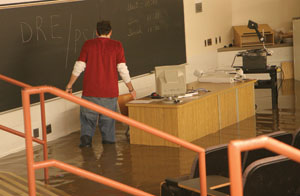
Over two weeks after the flash flood that ravaged campus and damaged the Engineering Building, Binghamton University is still assessing the damage caused by the Nov. 16 rains.
Although only 2.5 inches of rain fell, it fell quickly on already saturated soil. Broome County was forced to issue a state of emergency, and all evening classes and activities were canceled. Several parts of the University were flooded; the Engineering Building suffered the most damage with knee-deep water in the Engineering lecture hall.
According to Gail Glover, a University spokeswoman, a quick response helped to minimize the damage on campus. Crews worked overnight on Nov. 16, draining and dehumidifying the affected areas. The bulk of the clean-up has now been completed, but a few areas are still in need of repair.
Karen Fennie, the spokeswoman for Physical Facilities, said that “most of the damage has been taken care of. However, there are still some suites in the Engineering Building that need to have their carpets replaced. The University is now looking into whether it is most cost effective to replace these with carpet or tile.”
Glover added that “there is also some work we have to do on the East Gym fields, but the weather will determine when the work will be done.”
Students and faculty could be seen frantically removing equipment from the basement of the Engineering Building on Nov. 16, as water poured into the complex.
Estimates about the total cost of the damage are not yet available. When asked, Glover said, “At this point, we are still assessing the total cost, but will be seeking reimbursement from our insurance carrier and FEMA.”
The recent flooding served as another reminder that Binghamton is frequently faced with bad weather.
The University has procedures in place designed to ensure student safety and minimize damage. According to Glover, “Binghamton University has an Emergency Operations Center that swings into high gear in the event of an emergency — weather or otherwise. The EOC activates staff members and departments as needed, depending on the situation, and launches emergency procedures that include input from offices such as Student Affairs, Physical Facilities and Public Safety.”
This was the second flood to hit Binghamton in recent months, adding more damage to areas already affected by the flooding in June.
The connector road behind Mountianview that was closed after the November flood has not been reopened, but according to Glover, that is normal for this time of year.
“The salamander ramps make plowing problematic and since it is considered a Nature Preserve area, winter plowing, sanding and salting can impact the surrounding environment. It will reopen when the salamanders cross in the spring,” she said.