





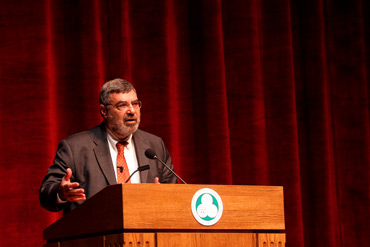
Prominent journalist and author Rami Khouri spoke at Binghamton University’s Anderson Center Chamber Hall on Wednesday to an audience of about 100 people. Khouri, who also writes an internationally syndicated weekly column called “A View from the Arab World,” urged the crowd to think critically about the information given by the American media.
Khouri expressed his views about relations between the United States and the Arab world, stating that his goal for the evening was to offer a different, insider’s perspective on the region. Khouri believes that while select American journalists have often done great work, “coverage by the mainstream media of the Middle East is abysmal. It is very poor quality, highly distorted, highly incomplete and largely driven by political motives.”
Khouri also criticized America’s misrepresentation of the Middle East, warning that “one must be very careful of interpreting the Middle East through the lens of Israeli lobbying groups and the U.S. government.”
He also criticized America’s unconditional support of Israel, frequently referring to Israel as the world’s only remaining colonial power and citing its occupation of Palestine and South Lebanon.
Khouri believes that Islamist organizations such as The Islamic Brotherhood, Hezbollah and Hamas represent a major new force in Middle Eastern politics. As non-state actors they occupy a unique place within the political system, and since Arab governments are frequently corrupt and ineffective, they are unable to provide for their people.
Islamist organizations step in to fill this void, he said, building support and credibility at a local level. These organizations are made up of what were once disparate forces within the Middle East and have increasingly come together to resist the combined forces of Israel and the United States.
Khouri said the popularity of these Islamist organizations is “the single most important political movement in the Arab world.”
He also pointed out several recent events that emphasize the new willingness to defy the United States. The fact that Iran is going ahead with its Uranium enrichment program, North Korea’s nuclear test and the Israeli-Lebanon conflict all demonstrate that the United States, as well as Israel, is losing some of its authority. The United States has tried to influence the world through fear and intimidation, tactics that are becoming increasingly less effective as time goes on.
Khouri stated that the American goal of supporting democracy in the Middle East is not a bad one, and that most people in the Middle East would rather live under a democracy, but want to do so on their own terms.
Khouri told the audience that one solution would be for the United States to use a more diplomatic approach in the Middle East and to stop using what he referred to as a “double standard” when making foreign policies.
Khouri added that in the United States, “the rhetoric is for freedom, the policy is to support occupation.” Khouri pointed to the United States’ efforts in Northern Ireland as an example of good, effective diplomacy, something he believes could be repeated successfully in the Middle East.
Though some saw his commentary as biased, audience members agreed that the lecture was interesting and informative. “I thought it was an incredibly useful, one-sided perspective,” said Johnathan Marr, a senior sociology major.
Lianna Gomori, a junior English major, said, “I thought it was really interesting. As a Jewish American, I think it is important to hear a different perspective on the conflicts between Israel and other countries in the region.”
Khouri is the executive editor of Lebanon’s The Daily Star, and was editor in chief of The Jordan Times from 1975 to 1982 and from 1987 to 1988. His work has been featured in major newspapers like The New York Times, the Los Angeles Times, The Washington Post and The Times of London, and he is a frequent commentator on CNN, CBS and the BBC.