





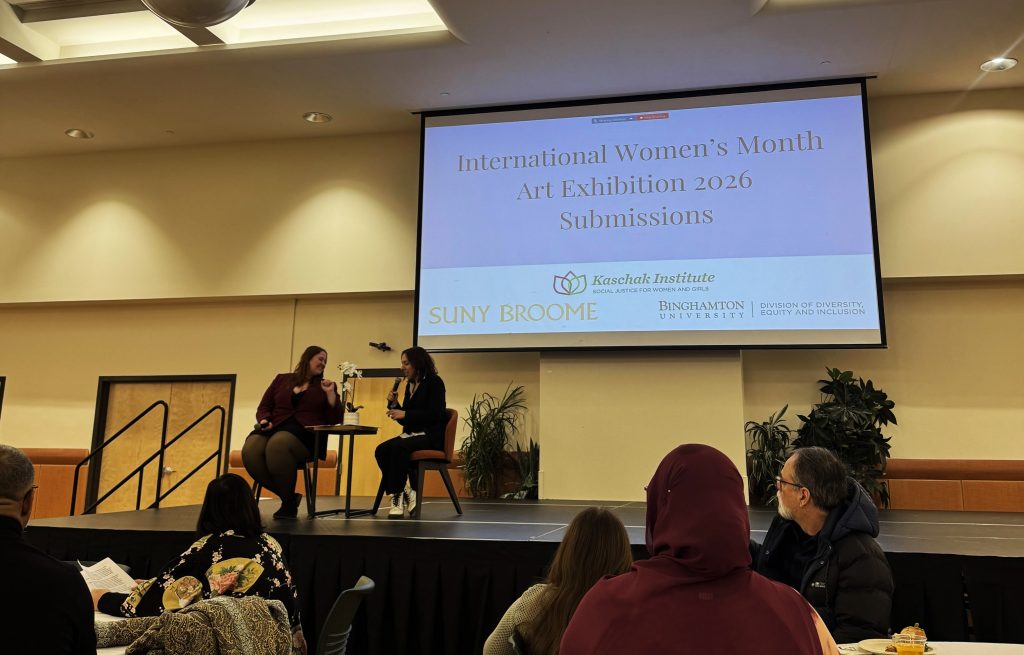
Binghamton University’s Kaschak Institute for Social Justice for Women and Girls, in collaboration with the Department of Diversity, Equity and Inclusion and SUNY Broome, held its fourth-annual International Women’s Day Art Exhibition on Tuesday in the Mandela Room.
The Kaschak Institute is dedicated to social justice, gender equality and environmental sustainability. It aims to empower students to “drive positive change” through research grants, internship support and training workshops and events.
This year’s theme was “Women’s Rights Through the Decades,” embodied through student and community member submissions across the categories of writing, cinema, visual art, graphic design and performing arts. Winners in each category were awarded $250: Emily Rosman, a fifth-year Ph.D. candidate studying translation research and instruction, for writing; Autumn Jacobs, a junior majoring in art history, for cinema; Olga Bobak, a junior majoring in studio art, for visual arts; Merrigan Butcher, a sophomore majoring in anthropology, for graphic design; Dior Wright, a senior double-majoring in psychology and studio art, for performing arts; and Casey Woluewich, a junior majoring in studio art, for people’s choice.
Laurie Kern ‘25, graduate student assistant at the Kaschak Institute and a second-year graduate student studying sustainable communities, and Elyse Rogers, ambassador coordinator at the Kaschak Institute and a senior majoring in environmental science, opened up the programming. They introduced Lorena Aguilar, the Kaschak Institute’s executive director, and Carol Ross-Scott, vice president for student development and chief diversity officer at SUNY Broome.
Aguilar delivered a brief address, saying that despite it being women’s history month internationally, she feels that there’s not much to celebrate, as “a lot of you do not have the same rights that I did 10 years ago.”
“We are not only victims, but agents of change,” Aguilar said. “So, with this exhibition, it’s a way to say women power. We’re here.”
She also highlighted the many hours of “invisible women work” that made the event possible, in a nod to the often unrecognized labor women perform, both in the household and the workplace.
Ross-Scott spoke next, recognizing the value of artistic inter-campus partnerships that allow dialogue, creativity and reflection.
“That is exactly what art allows us to do,” Ross-Scott said. “It gives us an opportunity to pause and to look closely and to consider the many ways women have navigated and challenged and reshaped the world around us. Today’s exhibition reminds us that progress has always required imagination, courage and community.”
Ross-Scott also talked about the artwork that she entered into the exhibition — a recreation of Diana Shannon Young’s “Unruly Crown.” She said she felt compelled to paint her version of the piece because she saw herself so deeply reflected in it. She wanted her submission to represent the essence of women’s rights through the decades — wild and untamed, “because the truth is that the strength of a woman has never always looked polished, important, sometimes it looks like perseverance on the hardest days, sometimes it looks like survival.”
Next, SUNY Broome President Tony Hawkins and BU’s Vice President of Diversity, Equity and Inclusion Karen Jones spoke, discussing the importance of honoring women’s achievements in education, the arts and leadership and emphasizing the position of artistic expression as a form of protest.
After their remarks, the exhibition’s winners were announced and each artist was given the opportunity to take the stage.
Woluewich, the People’s Choice Award winner, discussed the inspiration behind her submission. Her painting began as an assignment in one of her painting classes, where she recreated John Everett Millais’ “Joan of Arc” and gave the painting her own flair.
Woluewich painted her own face with Joan of Arc’s body, saying she felt inspired by Joan of Arc’s strength and rejection of gender stereotypes.
“I am proud to be a woman and I am proud and honored to use my art, which is something I’m extremely passionate about, to help show women [how] it’s okay to be strong, it’s okay to be powerful, it’s okay to break a stereotype,” Woluewich said. “And I hope other people can create art to keep spreading those ideas and I hope I could do that with my own art moving forward.”
After the winners were announced, Timothea Vo, an assistant professor of nursing, presented her submission, a dissertation on postpartum intergenerational conflict among Vietnamese American women and their families in the form of a song. Attendees were encouraged to continue browsing the artworks.
“The story of women’s rights is not a single moment in history,” Ross-Scott said. “It’s a continuum of decades of courage, resistance, progress, setbacks and resilience. It’s the story of women who raised their voices, women who organized communities and women who quietly carried strength, even when the world tried to diminish it. Art captures these stories in ways that statistics or speeches will never capture. It allows us to see the emotional landscape of those struggles and those triumphs.”
Editor’s Note: Merrigan Butcher, the winner of the Kaschak Institute’s visual arts category, is a Pipe Dream Opinions intern. She had no part in the writing or editing of this article.
Editor’s Note: Autumn Jacobs, the winner of the Kaschak Institute’s cinema category, is an Arts & Culture writer for Pipe Dream. She had no part in the writing or editing of this article.