


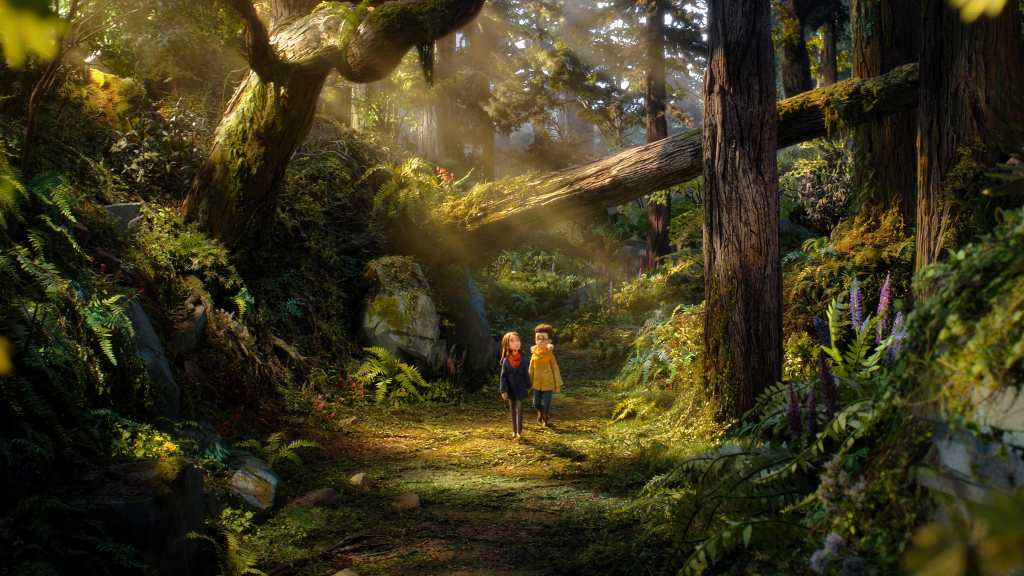
LAIKA Studios’ latest stop-motion spectacle, ”Wildwood,” was released in theaters on Oct. 23, reminding audiences that human creativity and personal touch are still very much alive in the film industry. Based on Colin Meloy and Carson Ellis’ novel of the same name, the film adaptation is a wondrous and delightful dark-fantasy adventure that doesn’t shy away from the grimmer aspects of fairy tales.
The studio’s macabre, yet charming, approach to storytelling and animation is best recognized by its most successful predecessor, “Coraline.” LAIKA has been releasing similarly endearing films like “Kubo and the Two Strings” and “Missing Link,” but ”Wildwood” has been the studio’s most anticipated project — mainly because it’s an expression of artistry more than 16 years in the making.
After watching “Wildwood,” any sensible viewer can instantly understand why the film’s debut took years of immense dedication to the craft. It’s record-breaking, the longest stop-motion animated film ever made, a pursuit that takes colossal amounts of patience and dedication to animate such fluidity. Not only this, but the environments within “Wildwood’s” world are physically real, handcrafted meticulously by the film’s artistic team.
In an interview, director Travis Knight emphasized that every single element, every set, prop and leaf along Prue McKeel’s, voiced by Peyton Elizabeth Lee, venture through the enchanted forest was carefully sculpted and assembled in real life. This makes particular, already breathtaking, scenes of the film even more astonishing. In the film’s third act, an intense battle reminiscent of “The Battle of Helm’s Deep” from “The Lord of the Rings” is sparked, inspiring equal parts awe and shock within the audience. Just a glance at its stunning visuals is enough reason alone to support the film’s success.
“Wildwood” draws inspiration from great fantasy classics to compose its visuals, using the classic trope in which a cast of characters appear in a separate fantastical world, in this case located just beyond the mortal confines of Portland, Oregon. Emulating the plot of the 1986 film “Labyrinth,” a determined Prue and eccentric Curtis Mehlberg, voiced by Jacob Tremblay, explore different sides of the film’s world. Prue embarks on a more customary fantasy quest through friendlier areas of the magical forest, apart from considering the impact of the world’s adverse government. Meanwhile, Curtis is captured by the film’s antagonist, dowager governess Alexandra, voiced by Carey Mulligan. The juxtaposition of these storylines works in the film’s favor by portraying the governess as a brutal, yet still somehow sympathetic villain. Through the various portrayals of her character, ”Wildwood” touches on delicate subject matter in a sensitive way, rather than aiming for pure shock value.
However, while the film expertly portrays its deeper storylines such as the brutality of war in a shocking and rightfully gruesome manner, it still struggles to fully adapt the world’s political systems into a 2-hour and 12-minute runtime. There are some moments where the film sneaks worldbuilding into a conversation, only for it to become lost or diluted, a common problem when attempting to adapt a novel to screen. Nevertheless, audiences should be able to understand the main gist of the characters’ motivations — who is the “good guy” and the “bad guy” — at any given moment. Despite these clear characterizations, “Wildwood’s” complex storylines and character motivations result in an inability to achieve a clean and simple “happily ever after.”
In an era where massive corporations are cutting corners to produce quicker and cheaper animated blockbusters using tools like generative AI, “Wildwood” is a breath of fresh air. The film, with impactful art and storytelling abilities, is perfect for film appreciators of any age. The story centers around the theme of what love drives us to accomplish — the entire process behind the making of “Wildwood” is an ode to the preservation of human-made animation techniques. With 16 years of development, this film is nothing short of a tribute to artistic dedication, LAIKA Studio’s spectacular testament to love.
Rating: 4.8/5