





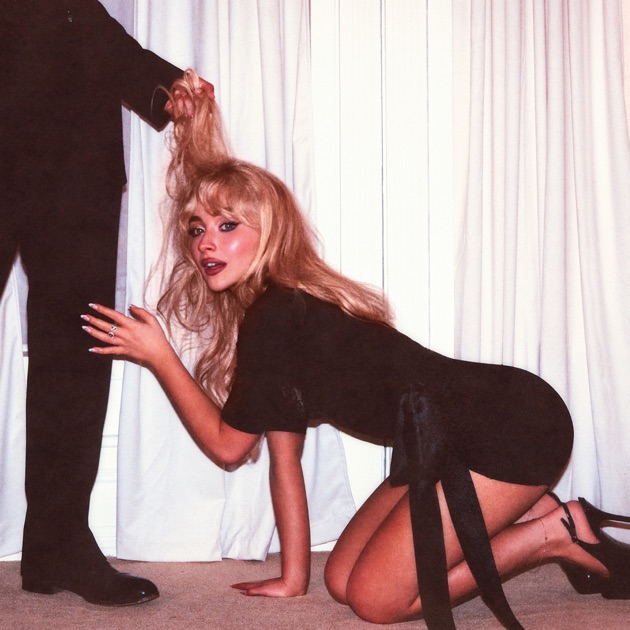
Sabrina Carpenter released her seventh studio album entitled “Man’s Best Friend” on Aug. 29, featuring 12 pop songs with elements of disco-pop, funk and country. Carrying on themes from her previous two albums, “Man’s Best Friend” sarcastically reflects on self-awareness, break-ups, men’s failures in relationships and her own hopeless mindset about romance — littered with innuendos and raunchy jokes along the way.
“The album is not for any pearl clutchers,” Carpenter claimed in an interview on CBS Mornings. “Man’s Best Friend” did spark significant controversy, particular surrounding the album cover, depicting Carpenter on her knees at the feet of a man, said to be pandering to the male gaze with a destructive and triggering effect on women. Others disagreed, asserting it would read satirically when the album came out, challenging the expectations of women’s sexuality as per her previous aesthetic in her sixth album “Short n’ Sweet.”
The album opens with its first single, “Manchild,” released on June 5, less than a year after the release of “Short n’ Sweet” and only four months after she released its deluxe edition. Down to the imagery of a bird riding a turtle, “Manchild” visually and lyrically portrays Carpenter’s hypocritical dynamic with men — she feels the need to jump between childish men despite calling them out for their ineptitudes in life and romance.
“Manchild,” like “Please Please Please” last year, spent a week at number one on the Billboard Hot 100. It also charted number one in the United States, the United Kingdom and Ireland. Both this song and the second single on the album feature extended fun dance breaks replicated online.
Released alongside the album’s release, Carpenter dropped that second single, “Tears,” with a music video starring American actor Colman Domingo in drag. The music video subverts expectations in multiple ways. First, the initial eerie landscape and 1950s-inspired horror cinematography quickly change to a fantastically sexy, disco-horror house, evoking imagery of the horror musical “The Rocky Horror Picture Show” Second, the title indicates a sad tone for the song, but, like the house she stumbles into, the song features some of her boldest lyrics yet — “I get wet at the thought of you” and “Tears run down my thighs.”
In response to critics of her daring lyrics, she said in the CBS Morning interview, “It’s like it’s almost too TMI. But I think about being at a concert with, you know, however many young women I see in the front row that are screaming at the top of their lungs with their best friends, and you can go like, ‘Oh, we can all sigh [in] relief like, ‘This is just fun.’ And that’s all it has to be.”
As for the rest of the album, the songs fit into a few distinct moods and genres.
First, the groovy and spicy songs — “When Did You Get Hot?” and “House Tour.” The two songs take opposite approaches to flirting with a man — the former using direct and sexual language and the latter using cheeky figurative language, which Carpenter assures is to be taken at face value — “And I promise none of this is a metaphor.”
Alongside “Tears,” these songs’ lyrics dance atop distinctive, funky beats. Despite the songs’ meanings, ironically, these are the only tracks on the album that are not labeled explicit.
Second, the songs somberly lamenting a faulty relationship she refuses to give up — “Sugar Talking,” “We Almost Broke Up Again Last Night” and “Don’t Worry I’ll Make You Worry.” These songs all take on a slower, more vulnerable mood.
“Sugar Talking” and “We Almost Broke Up Again Last Night” reflect Carpenter’s attempts to carry on a relationship that does not serve either her or her partner. In “Don’t Worry I’ll Make You Worry,” she confesses that her own mindset toward romance is partially to blame for her relationship failures.
Third, the cheerful songs disguising dissatisfaction in a relationship coming to an end — “My Man on Willpower,” “Never Getting Laid” and “Goodbye.” Returning to the use of hypocrisy in her songs, Carpenter employs witty and self-empowering catchphrases to disconnect herself from the pain of the final straw before the breakup. With their joyful tone, these songs adorn the album with the catchiest chorus melodies — “Goodbye” sounding reminiscent of ABBA’s classic hits.
Finally, the heartbroken songs concealed by coping lyrics — “Go Go Juice” and “Nobody’s Son.” Succeeding the flirting, lamenting and the break up, these songs similarly utilize a cheery tone to conceal the heartbreaking feeling of loneliness by “drinking to call” or “third wheeling.”
As a whole, these songs piece together a masterclass in subverting expectations, pushing the boundaries of feminine sexuality and satirical reflections on doomed relationships to romance. If you are one for cheeky lyrics and heartache, this album is worth a listen.
Rating: 4/5