





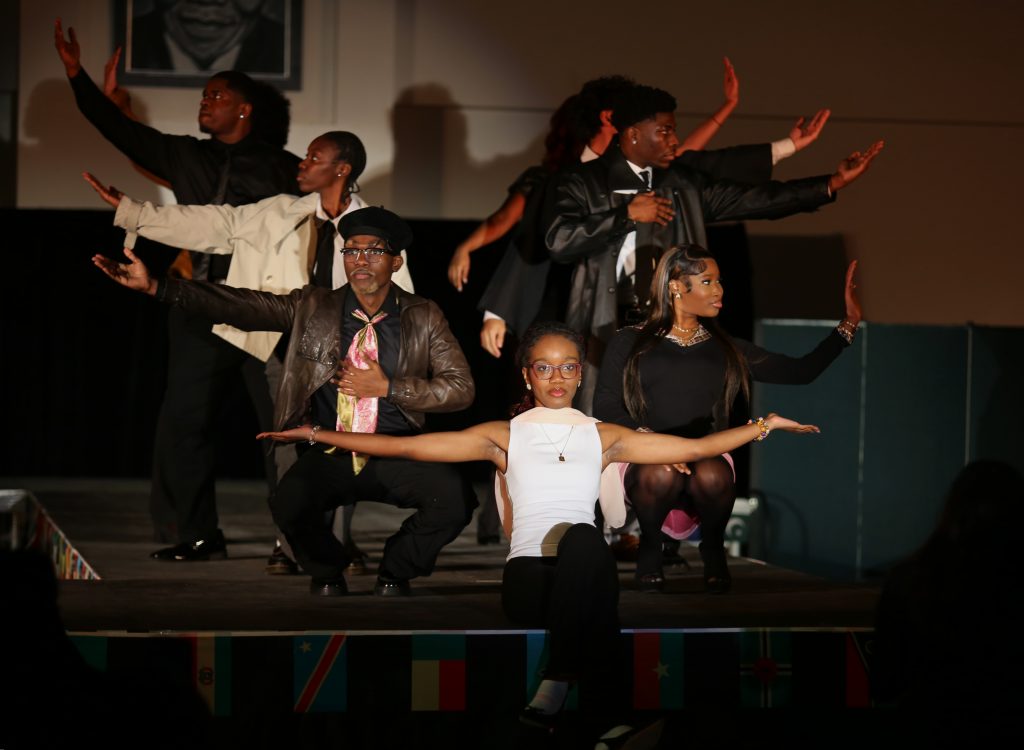
The Thurgood Marshall Pre-Law Society held its second-annual “Runway Without Borders” fashion show on Saturday, dedicated to promoting professionalism and culture and showcasing how the two go hand-in-hand.
TMPS was created to empower students of all backgrounds to enter into the legal profession and fight international injustice. This year, the organization collaborated with Black Women Society, the National Association of Black Accountants and the Business Fashion Society — organizations all dedicated to empowering a professional community. NABA addressed underrepresented students interested in various business disciplines and BFS motivated to connect members with executives and recruiters in the fashion and retail industry.
“This year’s theme, ‘Runway Without Borders,’ is all about showing that professionalism can look different across all kinds of career fields,” Ashely Perez, the secretary of TMPS and a sophomore majoring in philosophy, politics and law, wrote in an email. “We wanted to highlight that professional style isn’t just one style and that people express it in many unique ways depending on their work, identity, and personality.”
Audience members walked into the Mandela Room, the walls and the stage decorated with flags from varying countries, a loud sound system and bright spotlights set up on each side of the runway. The show began with the TMPS E-Board walking down the runway, setting the scene for the student models who followed. Following E-Board introductions, members from BFS introduced themselves next, highlighting the organization’s goal of bringing together business and fashion.
The first scene of the fashion show, “Day to Night,” focused on versatility and demonstrated how fashion can morph from business to casual. The models walked to heavy beat drops and loud music, as many of them stripped off fancy coats that they wore at the beginning of their runway walk, posing powerfully at the end of the stage. One man held a sign reading “The Revolution Will Not Be Televised” as he walked down the stage, then acted out a fight with a man dressed in a robe.
“Professionalism is very important,” Sebastian Rivas Alvarez, an intern for TMPS and a sophomore double-majoring in philosophy, politics and law and global public health, said. “Dressing nice, being able to speak very clearly, being able to talk to people and just always having that attitude. Knowing that us interns, E-Board, we represent not just TMPS, but we represent Binghamton. So having that professionalism is always going to be a good look.”
The second scene followed smoothly, introducing NABA’s E-Board before transitioning into a celebration of professionalism and the power of details. Themed “The Gold Standard,” accessories represented different careers in the scene as style and purpose came together. Whether it was a briefcase loaded with money, a firefighter with a hose, a doctor with a stethoscope, a police officer with a badge or a boxer with gloves, the excellence and attention to detail of each profession were honored.
After the second scene, BWS introduced their E-Board members. After they walked the runway, a special performance followed, where three singers harmonized to renditions of “Be Alive” by Beyoncé and “Blackbird” by The Beatles. They snapped to the beat and sang a cappella as the audience swayed to the songs.
“We wanted the show to feel like a full experience, not just clothes on a runway,” Elodie Agath, president and founder of BWS and a junior majoring in biology, wrote in an email. “The music, the pacing, the transitions, and the story behind each segment all work together. We want people to walk away feeling moved, inspired, and connected to the pieces they saw.”
Next came a brief break, where students received dinner and TMPS thanked the organizations in attendance, demonstrating the community, unity and energy in the building as everyone cheered for those who attended.
Scene three brought sharp and clean energy to the runway with “Men in Black.” Models created a bold presence and mysterious vibe as they walked down in suits, adding all sorts of spins, twists and poses to build even more excitement.
The overwhelming energy continued into scene four, where transformations in the simplest form were prioritized with “She’s All That.” An artistic choreography was presented, utilizing hats and uniform lines. The audience was more alive than ever as they stood up and moved their whole bodies to the beat of the rap songs and deep bass music. Some even jumped up and down as women in dresses, suits and other business outfits stunned, leaving a lasting impression on the stage.
Next, audience members were asked to walk the stage and showcase their own outfits. Some of the remaining attendees got out of their seats to move closer to the runway, supporting their friends who modeled. After the audience sat down again, the last scene brought precision and balance to the night. “Trifecta” focused on groups of threes, displaying unity, identity and pride as they moved in synchrony and wore identical, if strikingly similar, outfits.
With this year’s fashion show only in its second year, the organizations hope to continue and expand the event in the future.
“I definitely see this becoming a yearly event that grows bigger each time,” Agath wrote. “I’d love to bring in more student designers, more cultural elements, and maybe even outside collaborations. The goal is for it to become something the campus looks forward to every year and a real platform for student creativity.”