





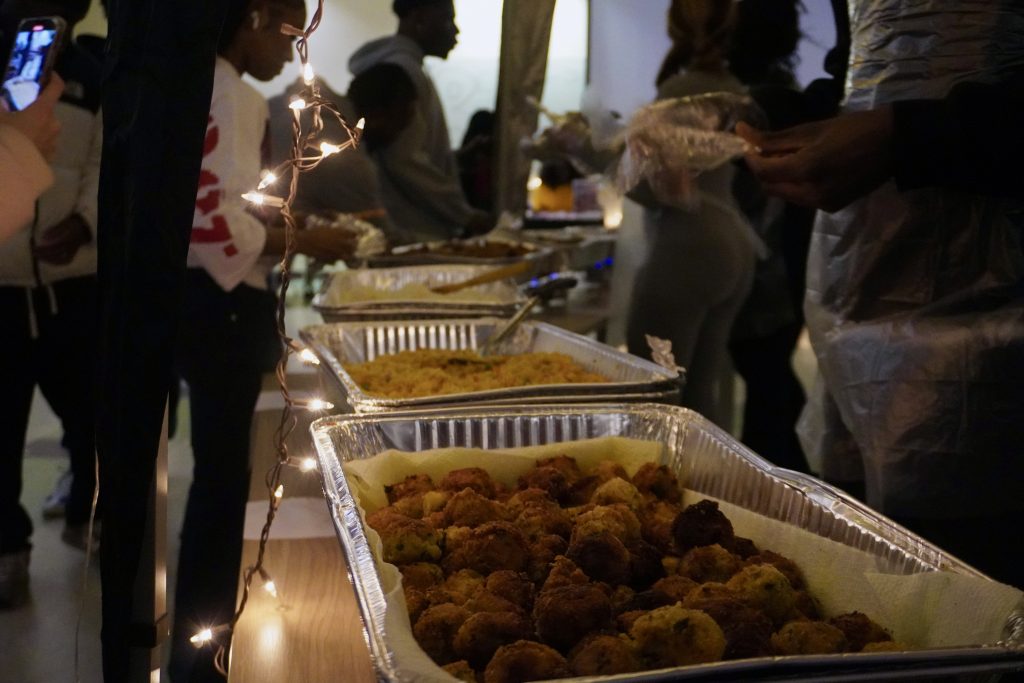
The African Student Organization held “Taste of Africa,” a free night market-style event on Nov. 16, bringing a wide variety of cultural foods found all across the continent for students to experience and enjoy.
Held inside University Union 120, the space was transformed with decorations like a banner-style array of flags of different African countries and whiteboards with the letters “ASO” sprawled across them. Attendees were greeted by tables full of food, upbeat music playing in the background and excited chatter from students.
“Food Festival is an annual cultural showcase designed to highlight the beauty of African cuisine, dance, music, art, and tradition,” Fatoumata Barry, ASO’s president and a junior majoring in philosophy, politics and law, wrote in an email. “The purpose is to create a space where students can experience African culture firsthand through food, performances, and community engagement. This is not the first time the event is being held. Food Festival is one of ASO’s flagship annual events, bringing together students from all backgrounds to celebrate African heritage in an immersive and interactive way.”
Before the food was served, guests were first encouraged to try beverages, including water, juice and sobolo — a refreshing West African drink with a deep maroon color and tangy, spiced hibiscus flavor. They were also welcome to stop by student vendors lining each wall, showcasing their personal brands and services with unique presentations.
After guests roamed around the room and connected with vendors, food was served. Beneath a black tent adorned with bright, multicolored lanterns was a circle of tables with platters of food. Among the available options were fried rice and kebabs, but traditional African food was the main preference for many guests. Popular dishes included msemmen, a flaky Moroccan flatbread, and various fried foods ranging from kelewele, a fried ripe plantain snack from Ghana, and maakouda, a savory deep-fried potato fritter from North Africa.
Anaiya Baptista, ASO’s educational coordinator and a senior majoring in philosophy, politics and law, explained how “Taste of Africa” not only highlights the variety of African food, but serves as an educational experience for students to better understand the continent’s complex history and culture. According to Baptista, the event intended to dispel one-dimensional depictions that “center deficit and crisis” by acknowledging the full picture of everyday life experienced across Africa, with 54 distinct countries home to their own unique cultures.
“When we present Tanzanian Kashata alongside Nigerian Suya and Moroccan Msemen, we’re making visible what too often gets erased: extraordinary diversity,” Baptista wrote in an email. “These dishes come from different climates, histories, and traditions. They taste nothing alike. Showcasing this range challenges the monolith and invites people to see the continent accurately.”
Fatoumata Tunkara, an ASO intern and a freshman majoring in global public health, commented on the diversity ASO’s night market displayed.
“It’s not limited to a certain section in Africa,” Tunkara said. “It’s not limited to West Africa, North, South, East — it’s a taste of everything and different cultures, some cultures that I’ve never seen. Today, I made food that I never even heard of. I find that that’s nice, it’s very diverse.”
At its core, the annual night market is a vessel for greater education and awareness. Many student-owned brands strived to incorporate messages pertaining to global issues, specifically in Africa, while the foods and drinks provided a touchpoint for students to learn about African identity and keep it alive.
According to Baptista, the variety of dishes offered at the event demonstrated how African cuisine is “sophisticated and regionally distinct.” She said this helped attendees and members of ASO connect with their heritage and address “oversimplifications they’ve accepted about African politics, history, and culture.”
The event was a huge hit — not only because of the food, but also the opportunity for students to connect and learn from one another. “Taste of Africa” blended culture with community into a night full of endless conversations and delicious food, a night to be remembered.
“We hope attendees leave with a deeper appreciation and understanding of African culture, not just the fun and vibrant parts, but also its history, diversity, and global influence,” Barry wrote. “Most importantly, we want people to feel connected, inspired, and part of a community that values cultural expression, storytelling, and unity.”