





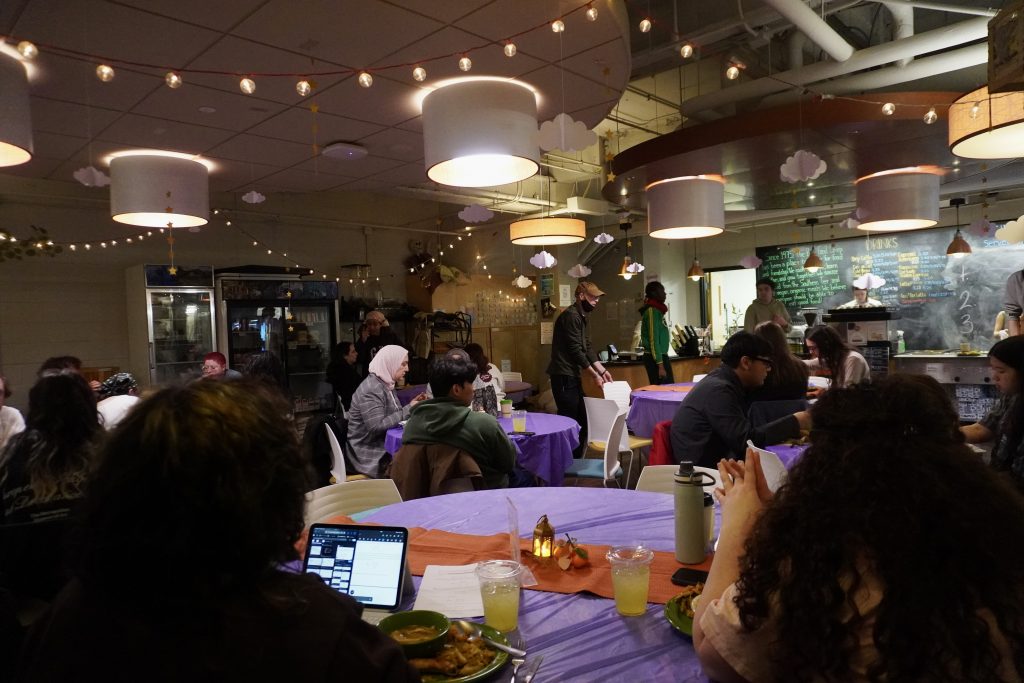
In the Union Undergrounds, Binghamton University’s Students for Justice in Palestine organized “A Night Under the Levantine Sky” fundraiser in collaboration with the Food Co-op on Monday. (5) Through traditional Palestinian cuisine and accompanying music from the Levant, the two organizations brought students from all walks of life together, allowing for the celebration of Palestinian culture.
The Food Co-op’s dining area was adorned with orange table runners, purple tablecloths and orange fruits with gold-plated lanterns. The ceiling hung celestial motifs like clouds and stars, ranging in colors of orange, blue and purple that served as a reminder of each sunset over Jerusalem.
While guests settled into their seats and engaged in lively conversation, music from Arab artists blared over the Food Co-op’s speakers in the background. The soundtrack of the night ranged from contemporary Arab beats to traditional Palestinian vocals.
One of SJP’s co-presidents, who wished to remain anonymous, detailed the process behind workshopping SJP’s “A Night Under the Levantine Sky,” and the significance it held for the Executive Board.
“I think there are a few things that are very easy to unite people, and one of those is food,” they said. “Even if there are some ways you won’t necessarily agree or necessarily connect with people, you can all enjoy food. I think in a time like this where Palestinian culture is being increasingly targeted and actively being erased, [events] like this work to keep Palestinian culture alive and celebrated, and is immensely important and immensely valuable. Especially for people like myself who are members of the diaspora, who more than anything want to see that their culture is acknowledged [and] admired.”
SJP worked with HEAL Palestine, a United States-registered apolitical and nonreligious nonprofit organization, for its fundraising banquet. HEAL Palestine was founded to support Palestinian children and families, providing resources and relief.
Food Co-op volunteers presented a three-course menu of traditional Palestinian cuisines, respectfully adapted to the cafe’s vegan philosophy. The menu consisted of rgaga, a soup stewed with lentils, onions and handmade pasta, and maklouba, a rice-pilaf tatin cooked with fried vegetables including carrots, peppers and potatoes. Kaak bi ajwa, a Palestinian pastry stuffed with date paste, was served for dessert, and was complemented by limonana, a lemonade flavored with mint.
Liam Flatley, events coordinator for SJP and a senior double-majoring in music and environmental studies, helped facilitate the majority of the inner workings between SJP and the Food Co-op.
“We knew that we wanted to collaborate with the Food Co-op,” Flatley said. “We wanted to have some sort of banquet-themed or food-based event to celebrate Palestinian culture because that felt really tangible for people to experience. Recipes, we decided, are this really important, key feature as to how people define their culture.”
During the event, SJP and its E-Board members came together to express that “A Night Under the Levantine Sky” served not only as a fundraiser for Palestinian aid, but a way to connect students during a period of political divide and unrest. With governments and institutions having the power to persecute communities for differing cultural and religious beliefs, SJP emphasized the importance of facilitating an open space where individuals can feel safe to express their heritage.
Zoe Perlman, SJP’s secretary and a sophomore double-majoring in studio art and social work, explained how the event came to be.
“Especially the fact that we’ve been invited to so many organizations’ banquets and community events like this, I was like, ‘why can’t SJP do something like this,’” Perlman said. “And there is a very good reason for that. There is a level of fear in persecution for being associated with SJP. So we really appreciate any org that is willing to connect their name to us, because unfortunately that is the reality of the culture that is on this campus. But, ultimately, we wanted to have a community event where people could really show up, show out and be together in a safe space, but also be a little more visible than we normally are as an organization.”