





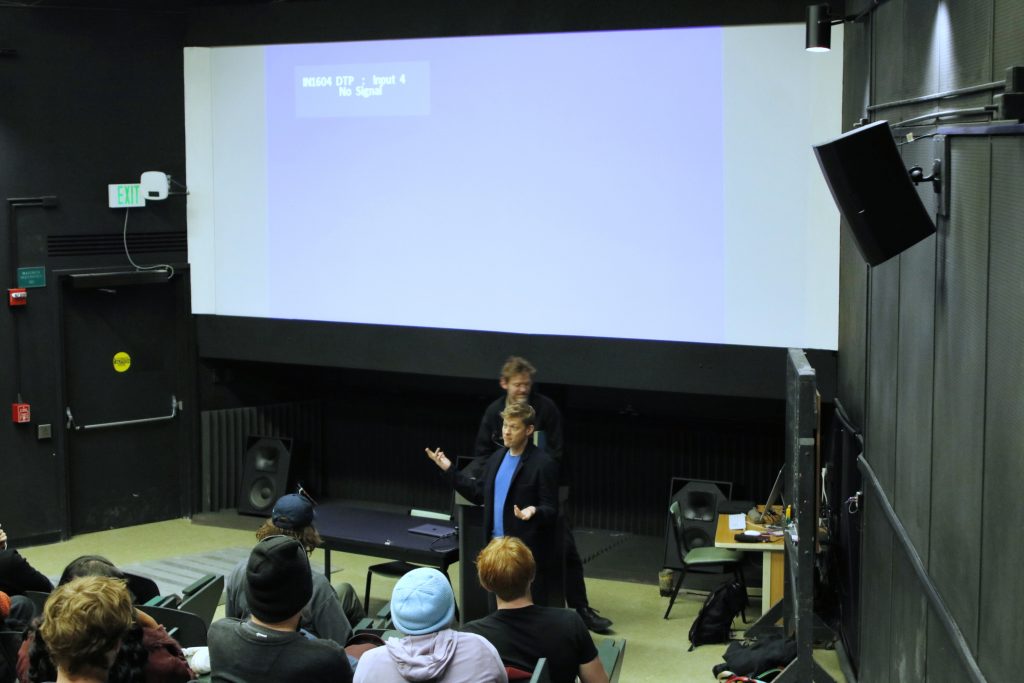
Binghamton University’s Cinema Department hosted the semester’s first installment of the Visiting Film & Video Artists Series on March 17. Students, staff and faculty viewed a new perspective on how media affects perception with filmmaker Sabine Gruffat.
The event, titled “Beyond Resolution,” included an introduction, nine short films and a post-screening Q&A. The films shown were “Disclaimer” (2025), “Headlines: BOMB PARTS” (2007), “A Return to the Return to Reason” (2014), “Brave New World” (2015), “Black Oval White” (2009), “Take it Down” (2019), “Framelines” (2017), “Moving or Being Moved” (2020) and “Souvenir Statuette” (2024).
Gruffat, a French American filmmaker residing in Marseille, France, has explored how media and technology affect human beings and the environment. Her films are intended to cause viewers to inhabit politics differently and see it as a site of change. They also call attention to hidden logics in software and where fragile frameworks emerge. She has presented her work at the Image Forum Festival, the Viennale, Migrating Forms, MoMA Documentary Fortnight and the Copenhagen International Documentary Film Festival.
Daniel Murphy, a lecturer of cinema who helped organize the event, explained why Gruffat was selected for the Visiting Artist Series.
“The Cinema Department has long promoted and fostered works that challenge cinematic convention, works that dare to imagine new potentials for cinematic form,” Murphy wrote in an email. “This exploratory, experimental impulse resonates through Sabine Gruffat’s work. There is a cohesiveness to Gruffat’s creative voice, even though each individual work has a truly distinct identity, both aesthetically and methodologically.”
The films’ diverse time frames display the multitude of technologies and techniques used. The program started off with three silent films, using text from films and newspapers to convey specific themes. The films that followed depicted political protests and nature, including “Take it Down,” which showcased the protests advocating for the removal of the Confederate Monument statue on the University of North Carolina at Chapel Hill campus.
The final two films included 3D animation, which was commonly compared to live action movement, further developing themes of frameworks created from media. She also notes how she took inspiration from other experimental filmmakers, such as Yvonne Rainer, who influenced “Moving or Being Moved” because of her strategy of bringing everyday movement into dance. Gruffat took that idea and turned it into a survey, which is seen in the film. The films were created using digital video, laser-etched film, solarized color-positive film and laser-etched color negatives transferred to digital.
During the Q&A session, Gruffat discussed the effects certain techniques have on viewers. She stated that she liked awkwardness and tension in volume that came from the silent films, which was exemplified by creaks and other minimal noises in the room. She also noted that solarizations and transitions from negative to positive created strobing effects that challenge the viewer’s perception of the events portrayed in the films. The different approaches to filmmaking came from the evolution of technology she has seen throughout her career, which was also displayed during the program.
Gruffat expressed her interest in the varied use of technology in her experimental filmmaking and beyond.
“I think my interest in technology is that as a society we moved through so many different technologies and usually only consider them for one type of use and I think my work is interested in seeing how we can use tools differently or combine different tools in unexpected ways,” Gruffat wrote in an email. “Disturb the signal in some way.”
Gruffat is one of three filmmakers to present her work as part of the Visiting Artist Series this semester. The program aims to provide a window into the lives of practitioners of filmmaking. Gruffat’s time at the University is a part of her current tour, which started with the Lightbox Film Center in Philadelphia. She plans to present her work at the Ann Arbor Film Festival and the Onion City Film Festival.
“Something about Sabine Gruffat’s films that always strikes me is how nimbly she navigates radically different ways of making,” Murphy wrote. “From process-based analog film abstractions to algorithmic animations, Sabine is a maker who is constantly navigating new technologies and new ways of working. Crucially, these shifts in process and format always extend out from the content of the works. These are films that are at once playful and politically engaged, and Gruffat’s diverse formal language reflects this.”