





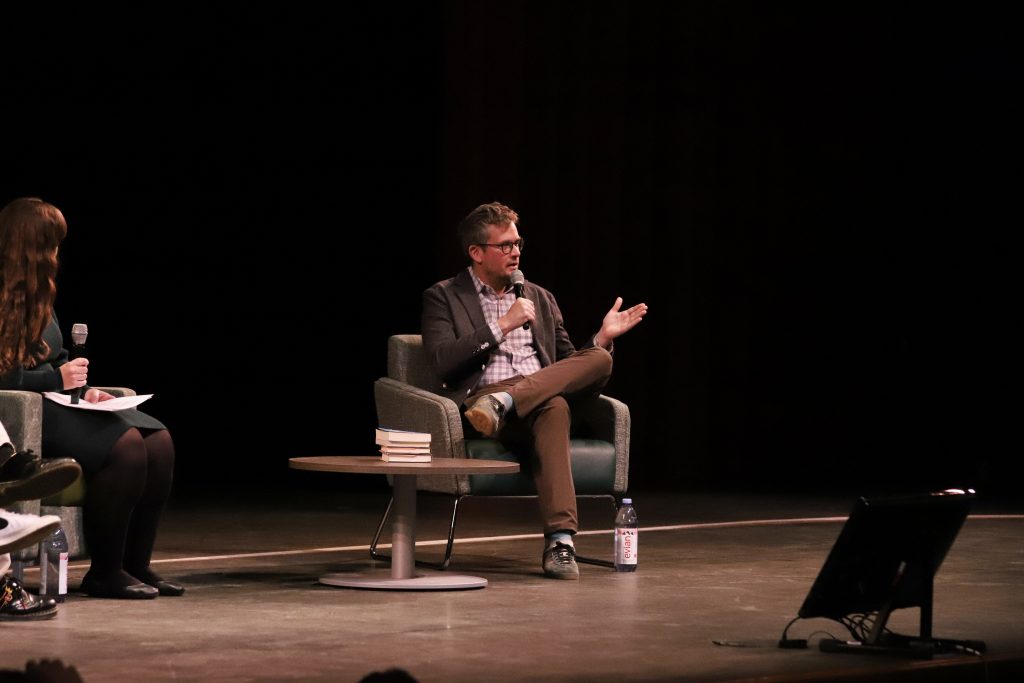
On Friday, the Student Association Programming Board hosted John Green, a bestselling author known for novels like “The Fault in Our Stars” and “Turtles All the Way Down.” As the Fall 2025 Distinguished Speaker, Green offered a night filled with memories, inspiration and life lessons.
Green, best known for his books and online presence alongside his brother, Hank Green, connected with audience members whose childhoods were largely impacted by his work. The crowd was brought through a mix of emotions as Green recounted personal anecdotes.
The Distinguished Speaker Series is dedicated to showcasing speakers who both entertain and inspire the student body.
“Speakers bring knowledge and experiences that go beyond textbooks,” Jennifer Keegin, director of campus activities, wrote in an email. “They connect what students are learning to real life challenges and current events. It helps students understand how what they learn can be applied outside the classroom. With John’s writing — many different topics will be discussed and so we’re looking forward to his perspective on them.”
Atticus Fauci, the Student Association’s vice president for programming and a senior majoring in economics, shared why he believes having Green as a speaker for this series was so important.
“Without getting too deep, John and his works have truly meant a lot to people, especially to those struggling with some outside factors in their lives,” Fauci wrote in an email. “To give people the audience that is John Green and to have them experience his message means the world. Plus in this age of AI, live entertainment and social gatherings have never been more important.”
Fauci, along with Katelyn Pothakul, SAPB’s insights chair and a junior majoring in public health, and Sarah Studenmund, director of the writing studies minor, gave a warm welcome to audience members, thanking them for coming to this year’s Distinguished Speaker event. They then welcomed Green to the stage to ask him questions about his novels and experiences with mental illness and personal relationships.
Studenmund started by asking Green about his latest book, “Everything is Tuberculosis.” Green discussed what made him so interested in the tuberculosis crisis, recounting his experience with a young tuberculosis patient, Henry, who shaped his perception of not just the disease itself, but life as a whole. He realized how different life was for tuberculosis patients and started to question his views on the healthcare system, along with the distribution of medicine and information.
These ideas inspired his research, which led to his novel, incorporating stories like Henry’s that emphasize love and humanity even in times of hardship.
Fauci then asked Green about his first nonfiction book, “The Anthropocene Reviewed,” and what inspired him to write about his own personal life. Green noted that, as more and more people got to know him through his YouTube channels Vlogbrothers and Crash Course, it became increasingly difficult for readers to separate Green from his fiction work. Readers were constantly inserting Green’s experiences into his novels, so he decided to finally write about himself. He expressed how liberating and freeing it felt, as he had not previously written about his personal life.
Green went on to discuss his novel, “Turtles All the Way Down,” which follows teenager Aza Holmes, who struggles with obsessive-compulsive disorder. He commented on the dangers of stigmatizing and romanticizing disorders and illnesses like OCD and tuberculosis, because it defines a person by that one attribute as opposed to recognizing them as a human being.
Studenmund noted how impactful his novel was as someone diagnosed with OCD, as many were able to connect with and feel seen by Aza. Green thanked her and expressed how every book has to be read generously. He writes for sharing, not for building a legacy.
Pothakul asked Green how he balances moments of seriousness with humor in novels like “The Fault in Our Stars.” He explained how love and humor shining through in moments of despair show our true humanity, emphasizing its multidimensional aspects.
“I just think life is funny,” Green said. “It’s also terrible. It’s catastrophic. It’s multitudinous.”
Fauci brought up an iconic line from “The Fault in Our Stars” that Green wrote while sitting in a Starbucks that reflects those ideas: “I fell in love the way you fall asleep: slowly, and then all at once.” Green expressed how he doesn’t purely rely on inspiration to write. He is fueled by love and an obligation to his readers, especially as someone with aphantasia, or the inability to form mental images.
Green then discussed his relationship with his brother, Hank Green, noting how close they have remained over the years through their online presence and collective work toward promoting global health accessibility.
The moderators moved on to the next segment in which they held a lightning round with Green, asking his opinions on Binghamton staples like Baxter the Bearcat, chicken spiedies and being the “carousel capital of the world.” Green rated them out of five, commenting on what he likes and dislikes about each.
Fauci commented on why he believes John Green perfectly represented the Distinguished Speaker Series and what it stands for.
“The goal of the series is to bring someone with a message,” Fauci wrote. “Anyone that saw the John Green talk could tell the man has a passion for helping others. Whether that’s through his charitable works, his deep writings, or in this case, his messages to us. It was a sold out show that left people passionate for life and therefore, the goals were met.”
The night wrapped up with a Q&A session, where audience members asked Green about a variety of topics, from his brother’s Awesome Socks Club — an organization that sells socks with a variety of designs and sends all profits to charity — to his experience with depression in his mid-20s.
In an interview, Studenmund commented on what she hopes audience members took away from this year’s distinguished speaker.
“I think his message is just so hopeful and so sweet, and I really hope that people were inspired to want to think about these larger issues, as well as be kinder, just even in a smaller scale and then kind of think in that larger way and then be kinder to people,” Studenmund said. “And even some of those questions I thought were so heartfelt, and I hope that people heard them and realized that everybody’s got their own struggle, and he shared that, and people in the audience shared that. And that we all kind of work on being kinder to each other, even just some of the questions I thought were so deeply personal. And so, it was really kind of eye-opening to see how much his work has moved people, and I hope that everyone kind of takes his message and goes forward with that.”
As Green prepared to close the night, he left audience members with advice that reflects his spirit of love and kindness that resonates throughout humanity.
“The truth is, if you ground what you do in a measure of affection for humanity and belief in humanity, all that [hard] stuff becomes lovely,” Green said. “It becomes an opportunity to be a community, it becomes an opportunity to serve your community and your neighbors and your family and your friends, and it becomes an opportunity to try to make the world better in small ways, which is the only way we make the world better. So that would be my last piece of advice — try to ground your work and your life when you can in a belief that humanity is worth it.”
Editor’s Note: Katelyn Pothakul, SAPB’s insights chair, is an assistant arts and culture editor for Pipe Dream. She had no part in the writing or editing of this article.