





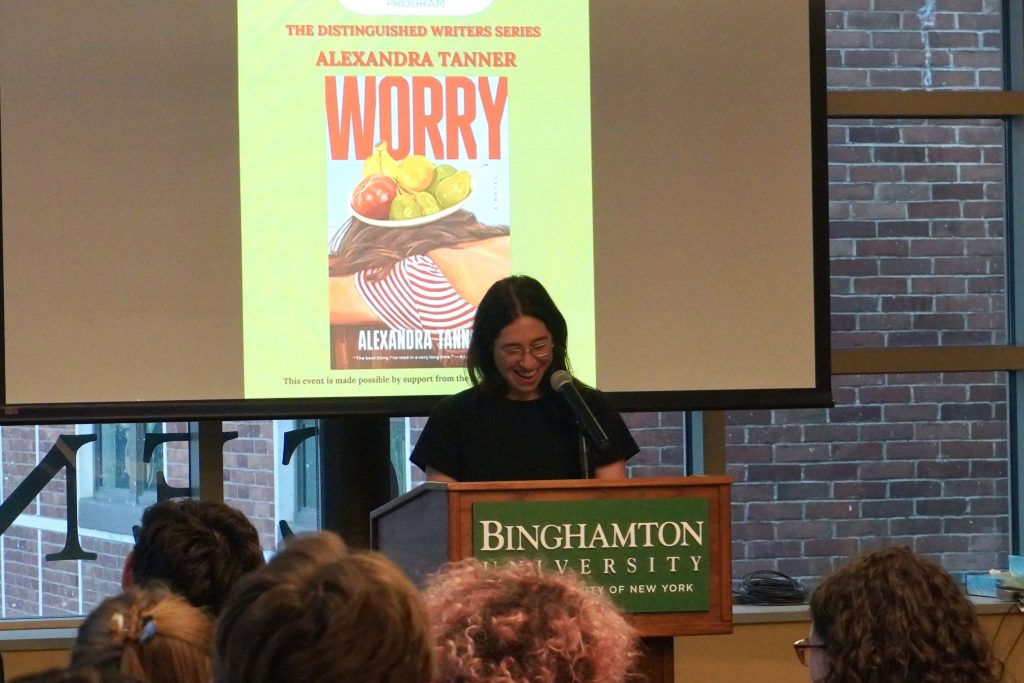
Students and faculty gathered in the Jay S. and Jeanne Benet Alumni Lounge on Thursday for a conversation with author Alexandra Tanner. Filled out by a captivated audience on a snowy afternoon, the space offered the opportunity to discuss Tanner’s novel, “Worry,” engaging with her thoughts and insights.
The novel centers around two sisters, Jules and Poppy, who reunite under the same roof after Poppy shows up at Jules’ doorstep needing a place to stay. Poppy appears full of hives, highlighting her physical unrest, whereas Jules’ emotional unrest is expressed through her struggles to find her place in the world.
Their relationship as siblings faces deep complications amid the oppressive noise of the modern world, including an abundance of casual scrolling sessions. Oftentimes, conversations between the pair are hijacked by events and ideas presented on social media.
Tanner interweaved complex topics together, including media, misery and Mormon lifestyles. She said aspects of the book were influenced by her own experiences, like how she went through a phase of scrolling through Mormon mom content on social media and the odd sense of enlightenment it brought to her.
The desire to indulge in niche content showcases the striking absurdity of the recent ways humans perceive and interact with the world.
Claire Luchette, an organizer of the event and an assistant professor of English at Binghamton University, discussed their thoughts on the novel.
“I’ve been obsessed with Alex Tanner’s work since forever,” Luchette wrote in an email. “In her novel ‘Worry,’ she sort of shivs you with these insights about how bonkers it is to be alive right now and how much work it takes to rise above your own wretchedness.”
Both in prose and presence, Tanner provides comfort in a digital age of messiness, as vulnerable writing like Tanner’s work can uplift those in a time when readers may feel isolated.
Touching on complex subject matters in a funny and relatable way is no easy feat. When asked by an audience member how she blends humor and dark themes of isolation and judgment, Tanner stressed how she wanted her sensibility to speak for itself. This involves being unafraid to mold an authentic perspective to a story or writing in general, letting go of any obsequious tendencies or overthinking others’ perceptions.
Tanner discussed what she considers the most rewarding part of being a storyteller.
“It’s a chance to take all the lonely things that are in your head that you’re like, ‘Does anyone else feel that?’” Tanner said. “’Has anyone else thought this is normal? How is everyone else, what’s going on there?’ And either getting a response from your writing that someone does connect with it and they say, ‘Oh, I have felt that before,’ or someone challenging what you set down in an interesting way, is also really exciting.”
A student in the audience asked how Tanner captured the cadence and spontaneity of real-life conversations. She discussed stealing from the world around you, turning real people and real conversations into stories.
Tanner mentioned that this includes not straying from filler words people naturally use in conversation and incorporating moments while talking when people feel the need to digress or go on long tangents. Perfect dialogue with flowing rhythm is not usually found in real life and Tanner lets that messiness enhance her art.
Another important layer to the themes covered in “Worry” is that of family dynamics and the absurdity of sibling relationships. The constant bickering over the most senseless and useless subject matters that siblings often find themselves conflicting over is unfiltered in Tanner’s writing. She is not afraid to provide commentary on how painful and confusing family relationships may be.
She discussed that she wanted to show the way siblings talk to each other through the way siblings talk to each other, not a perfect interaction free of conflict and disagreement. Instead, she portrays the opposite with the majority of Jules’ and Poppy’s interactions, invoking a sense of loathing and animosity.
Tanner touches on a topic many people struggle with — the trials and tribulations of a family. Aren’t siblings supposed to always be there for each other and support each other through the highs and the lows? Her writing points out that this isn’t always the case, but there can still be love underneath the surface.
The writing process for the book started several years prior, in 2019. Rather than only writing based on her own ideas, she actively integrated the world around her into her ideas and the book itself. “Worry” was a personal project that required constant attention and updates whenever Tanner was influenced by a certain daily observation.
“My writing schedule with ‘Worry’ was really serious and I was locked in,” Tanner said. “I was writing constantly, every free moment I had and I think it was because it was set in a specific time period and I was like, I have to capture something about the right now. So, I have to write it really fast and I have to incorporate everything I’m seeing throughout my days.”
“I think you can’t make the same vase twice,” Tanner continued. “You write something and you think you know how to do it and you’re like, ‘Oh, I’ll just do that again,’ and then the next project is completely different and there’s no way to tell until you’re in it.”
Tanner’s book “Worry” is a read that many students, or anyone living in the 21st century, will find relatable and hilarious for its commentary on family life and the perils of the internet.
“It’s such an engaging reading,” AJ White, a professor of English, said. “I found a startling level of verisimilitude in both the dialogue and the psychology that went into the creation of the characters. I also really appreciated, as the author described, the shifting dynamic between the two sisters that sometimes are each other’s advocates and often are each other’s foils.”