





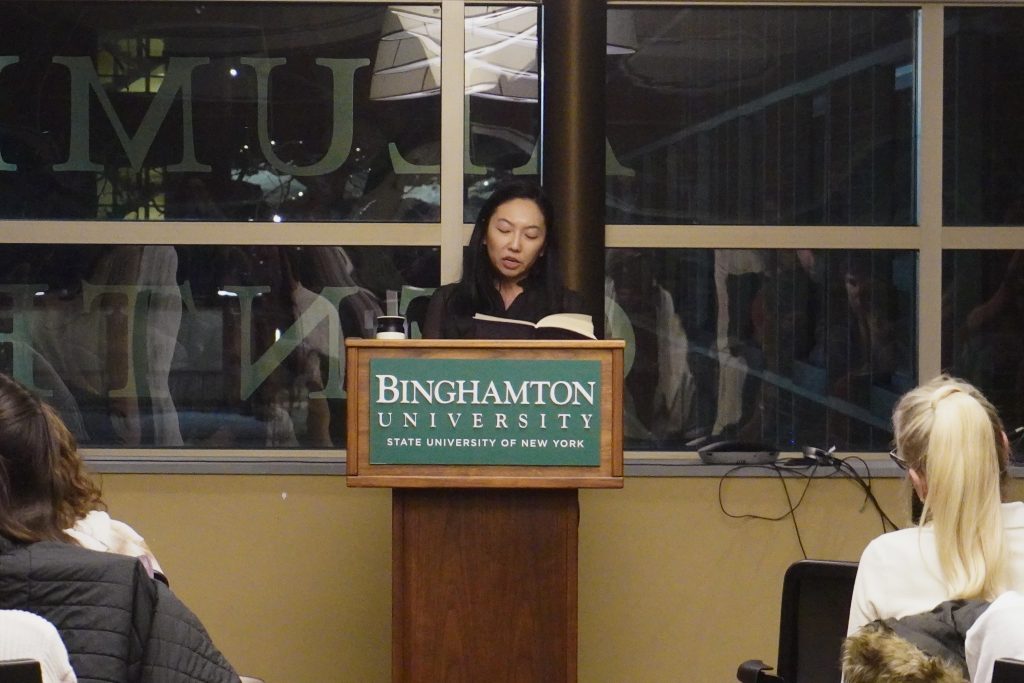
Students and staff joined the Creative Writing Program in the Jay S. and Jeanne Benet Alumni Lounge on Thursday for a conversation and reading with poet and physician M. Cynthia Cheung. The evening revolved around her poetry collection “Common Disaster,” which focused on her experience working in health care during the COVID-19 pandemic and explored universal themes about connection and humanity.
The lounge made for a quaint and intimate atmosphere, providing space for the audience to connect with the author. Refreshments and light snacks were available in the back of the room, and people engaged in light conversation before the event started.
“For creative writing students, we want to connect them with living authors who will both share their work and converse about their craft and lives as writers,” Jennifer DeGregorio Ph.D. ‘21, a lecturer and associate director of creative writing, wrote in an email. “For the wider community, we hope to create bonds across disciplinary differences; this event in particular was a wonderful way to engage with students and faculty whose studies and work are in healthcare.”
After Cheung was introduced, she began by reading pieces from her poetry collection. The audience listened as her words filled the silence and sat heavily in the air. The poems explored themes of death, womanhood and the unsettling or even grotesque aspects of working in healthcare.
Cheung, of Houston, Texas, reflected on why she felt her work was important and timely to share in this moment.
“We live in a time of violence,” Cheung wrote in an email. “Permutations of brutality have been happening for centuries in our country, and we are only recently coming to grips with the suffering inflicted by American exceptionalism and Western imperialism. I hope I have in some small way pushed back on erasure and against indifference with these poems.”
Cheung shared that she started writing during the pandemic, when she was warded off in a section of the hospital for COVID-19 patients for almost two consecutive years. Her next readings focused more heavily on the pain she experienced during this time, recalling how people were begging her to save their lives and her having to accept that there was only so much one person could do.
Following the “Common Disaster” readings, Cheung shared some pieces she wrote that introduced poetic forms of Chinese literature into the English language — something she hadn’t seen done many times before. The room gave her a hearty round of applause following the impact of the final poem, before the start of a moderated Q&A session.
The poet explained how she began writing poems in a goal-oriented way, similar to how she felt she functioned as a physician. She stressed the importance of imagination and empathy — especially in health care, where a lack of these traits can be damaging to the vulnerable state of a patient.
Christina Muscatello ‘08, a clinical assistant professor of nursing and the coordinator of the arts in healthcare minor in the Decker School of Nursing, works closely within the convergence of art and science. She shared her insight on how literature affects people’s well-being.
“Poetry and literature have a unique capacity to support well-being because they validate the full spectrum of human experience — clarity and confusion, joy and grief, coherence and fragmentation,” Muscatello wrote.
“Poetry offers participants a chance to express themselves creatively, and sometimes appropriately disjointedly, when words often fail; what might be labeled fragmented in another setting becomes lyrical, profound, and fully human,” she added. “Training students to witness and facilitate that kind of expression reshapes how they understand health, dignity, and communication.”
Cheung’s work reflected this distinction, detailing the intersection of science and art. It explains that science was a way to understand the world, whereas art was a language to cope with the uncertainties that healthcare is so full of.
She expressed her concern about the many physicians who lose empathy or feel diminished in their field of work, noticing that burnout has become increasingly normalized. It was writing that allowed Cheung to grow more in touch with her empathy and help her become better equipped to keep an open ear during interactions with patients.
When the questions concluded, the audience gave Cheung another round of applause. It is clear from work like Cheung’s that humans will never stop relying on the arts to get them through hard times. For those who are struggling, the arts are a strong force in creating connections between the aspects of the world humans continually misunderstand.