





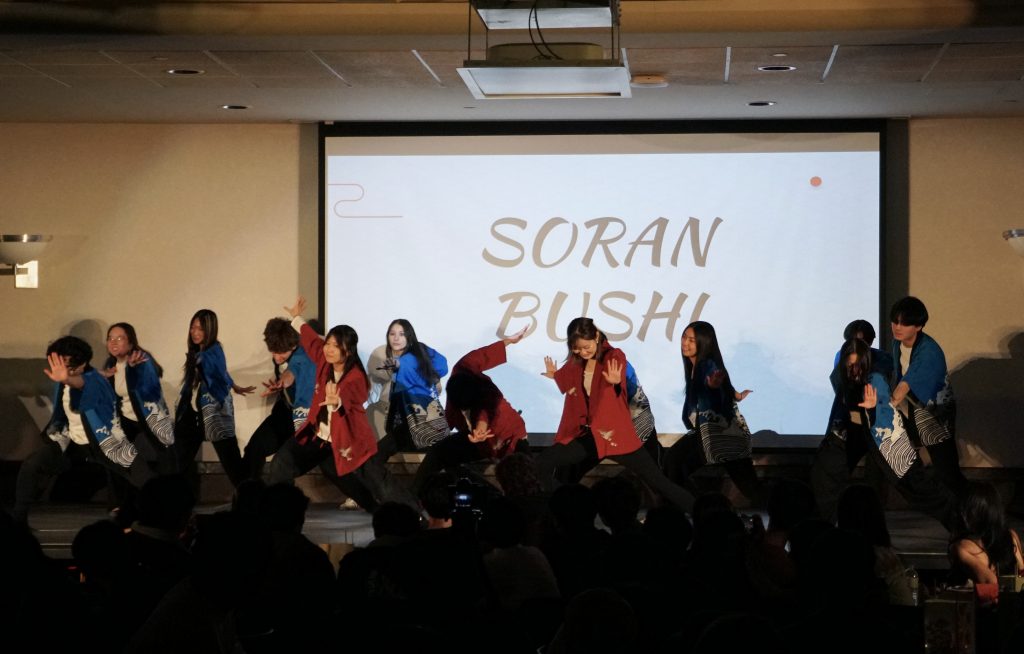
The Binghamton University Japanese Association held its largest annual event of the year, Japan Night, on Sunday in the Mandela Room. The event was themed around the Japanese phrase “etsu ni hitare,” which means to take joy in accomplishments, satisfactions and to work hard for your own benefit.
The Mandela Room was decorated with colorful lanterns, hanging painted masks and signs titled “Japan Night.” Attendees sat at tables adorned with unique and vibrant lantern centerpieces, alongside various origami designs spread across the table cloths, while enjoying as much food as they could from the large buffet catered by Mein Bowl.
“Japan Night is the largest event of the semester, and one that seeks to show off a minor, less known aspect of Japanese culture through the skit and decorations,” Rintaro Onishi, president of BUJA and a junior majoring in biochemistry, wrote in an email. “It is the culmination of the efforts of the entire E-Board, and we always hope to create a magical inviting space to the general body, and hope that they take away the aspect of Japanese culture that we are trying to share.”
This year’s theme also emphasized the importance of fully enjoying the present moment with friends, without concerns for pending tasks or personal gain.
After each individual segment, members of BUJA performed a portion of a skit based on the event’s theme. The skit starred Sophia Fogiel, a BUJA advisor and a junior majoring in industrial and systems engineering, and Takuto Kobayashi, a BUJA cultural chair and a sophomore majoring in business administration. Fogiel played Sierra, a martial artist whose self-worth stemmed from consistent winning. After losing a tournament, the character is seen struggling with her self-confidence. Eventually, a Japanese god helps Sierra repair her relationship with herself and strengthens her bond with her brother, played by Kobayashi.
“The theme and the storyline for this year’s skit was based upon the ‘God of Success’ and the relevancy of Shintoism in Japan,” Mona Kitagawa, the treasurer of BUJA and a sophomore majoring in anthropology, wrote in an email. “It is based upon a god, Inari. We also had a theme of delving into the joy and staying in the moment.”
After the first portion of the skit, the Kimono Fashion Show began. Kimono models graced the stage with traditional Japanese clothing decorated with accessories. Each model was introduced by the hosts as they posed with intricate patterned kimonos.
Next, the “Boys Dance” featured male members of the E-Board dancing with style to a pop song.
Throughout the event, the hosts presented multiple interactive games onstage that encouraged volunteers from the audience to participate. In the “Ramune Game,” five members of the audience chugged soda as fast as they could and whoever chugged the fastest won.
The next game was called the “Ohashi Game,” where contestants raced against the clock to see who could gather the most beans using only chopsticks, with the prize being a LEGO set. Finally, the last game was “What’s in the Box,” where contestants stuck their hands in a box and guessed the item. Whoever guessed the most items correctly won a humidifier.
Other performances from the event included the Bossa with BUJA playing a cover of “Bored” by Laufey, a Soran Bushi performance of a traditional fisherman’s dance, Unkai Daiko with a powerful drum performance, the “Girls Dance” with female E-Board members showing their moves and finally an energetic dance routine by MODA, showcasing cartwheels and high spirits.
Toward the end of the event, the comedy competition took place. Members of the different subgroups of the Asian Student Union battled it out onstage in a stand-up comedy competition, resulting in big laughs and mayhem from the audience. At the end, the audience voted for whoever made them laugh the most.
Afterward, contestants entered into a raffle to win a brand new TV. The names of all raffle players were displayed on a digital wheel that was spun in front of the audience. Attendees cheered as the spinning wheel landed on the raffle winner, who excitedly raced to the stage to accept their prize.
To conclude the event, Onishi delivered a heartfelt speech thanking all E-Board members and organizations involved and expressing gratitude to those who helped transform Old Union Hall into a majestic space for the evening. To end the night, Onishi presented flowers to senior E-Board members onstage and took photos with the leadership, while guests gathered at photo hotspots like the torii gate backdrop, creating unforgettable memories together.
Haruka Ito, a BUJA cultural chair and junior majoring in business administration, shared how BUJA is an inclusive organization that welcomes all.
“BUJA E-Board is not only for people with Japanese origins, but for everyone, so almost half of our E-Board have different cultural origins,” Ito wrote in an email. “In order to make a comfortable atmosphere for those who do not speak Japanese, speaking in Japanese during official BUJA work is basically prohibited. I think this cultural diversity in BUJA creates a welcoming cultural atmosphere for everyone.”