





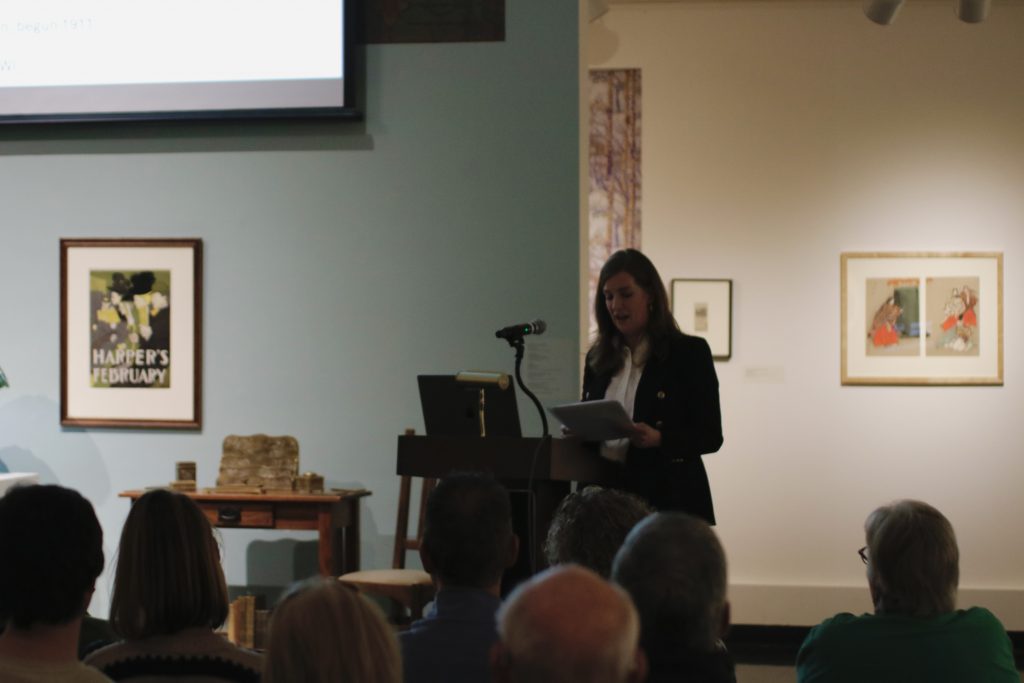
Students, faculty and community members gathered in the Binghamton University Art Museum on Thursday to explore Frank Lloyd Wright’s life, creations and ideas while surrounded by the architect’s visions of a society united with nature. The evening was made possible by the work of Julia Walker, associate professor of art history and guest curator at the museum.
Beginning at 5 p.m. in the Mezzanine Gallery, Walker led attendees through the story of Wright’s life, from his family origins and childhood to his final moments. The lecture closely examined events and figures that profoundly impacted his understanding of the relationship between humans and their environments, both natural and artificial. One anecdote described how Wright’s veneration of nature developed through noticing the intricate details throughout the landscape around his childhood Wisconsin home.
Wright’s prolific career is often considered one of the United States’s greatest contributions to the world of architecture and his works have received recognition for their ability to instill in every inhabitant a feeling of connection to the natural world.
“There’s an almost sort of subconscious way in which his architecture makes you aware of nature,” Walker said. “Not just as surrounding, but nature as a force that dictates the rhythms of your life.”
Mere feet above where the presentation took place, the exhibition “Drawing Connections: Frank Lloyd Wright” occupies the main gallery’s mezzanine, featuring 38 original architectural drawings created by Wright along with his collaborators and students.
The exhibition’s unconventional process of curation contributed to the remarkable experience it offers viewers. Walker collaborated with students in her Art History 480: Rewriting Wright course to craft succinctly written labels that provide historical and thematic context for each drawing.
“It’s also amazing how much they did in how little time they had,” T. Joseph Leach, curator of the museum, said. “Most exhibitions are planned years in advance and they pulled it off in a semester.”
To help her students detect the many complexities within each showcased piece, Walker employed an attention exercise involving staring at a work of art for extended periods. This tactic can allow viewers to reach a meditative state of immersion and develop a more intimate understanding of the piece.
This practice of noticing can be transformative beyond art and architecture. As Walker explained, her research on Wright’s career has revealed ways to apply his philosophy of being present in daily life through devoting attention to one’s surroundings.
“Partly, for Wright, one of the things that distinguished humans from animals was precisely this ability to notice,” Walker said. “Almost like a reverie, where you could stand on a hillside and see the way that the light was filtering through the grasses. And for him, that was not a navel-gazing waste of time. For him, that was instead tapping into our deepest gifts as humans, that gift of noticing.”
With her lecture and exhibit, Walker hoped to depict two messages from Wright’s career — what a single person can create and what can be achieved by viewing problems differently. She also emphasized the critical effects of beauty on young minds.
“It’s becoming increasingly important to me that students experience beautiful things,” Walker said. “That might sound simplistic or cheesy, but I think we need more beauty right now to remind us of what humans are capable of.”