





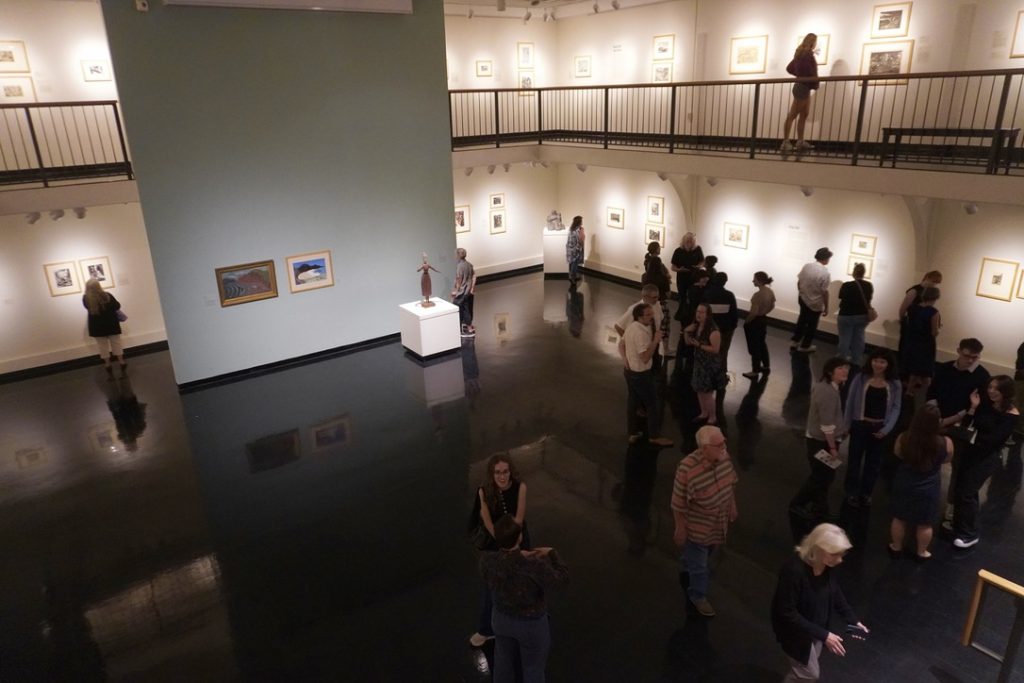
The Binghamton University Art Museum has opened for the semester with its first exhibition, “In the American Grain: Exploring America through Art, 1919-1946,” curated by art history professor Tom McDonough.
With works dating from the beginning of the interwar period to the conclusion of World War II, the show spans a particularly tumultuous quarter-century, which includes the Roaring ’20s, the Great Depression, the implementation of the New Deal and the bombing of Pearl Harbor. The exhibition shows a particular strength of the Binghamton University Art Museum’s collection, many of which were donated by local art collectors Gil and Deborah Williams in 2016. There are also several loans included in the show, with pieces made available from the BU libraries, the Roberson Museum and Science Center and the Art Bridges Collection.
Originally conceived by Professor McDonough and Chelsea Gibson, the director of the Binghamton Codes! Program, the showcase is the result of a pandemic-era project supported by Art Bridges to create digital exhibitions and programming to make art more accessible. At the opening, Professor McDonough remarked that “[Gibson’s] fingerprints are still on this here tonight.”
The exhibition incorporates the original project’s thematic categories: Americans Abroad; City Life; Everyday Americans; Government; Labor, Modernism; Picturing Black Lives; Protest; Rural Life and Labor; The West; War Time; and Women.
The categories are roughly chronological, with the first artwork being Jane Peterson’s 1919 painting “Courtyard of the Doges’ Palace, Venice” of the American tourists that flocked to Europe and its “revered landscapes and renowned museums” from the home they deemed a “cultural backwater.” The exhibition concludes with “Landscape with truck and barracks, Oct 1st 10 A.M.” and “Landscape before the rain, Oct 10th, 1942 7 P.M,” both by Chiura Obata. The two ink drawings depict the Utah internment camp where Obata was detained for being Japanese American.
The progression of the two is one of the few cynical moments of the show, which otherwise details how American artists responded to the tumultuous moment and grappled with the concept of American art and who is included in the country’s hopes and ideals. While innovations of this period are seen across the many works of the show, Obata’s spare and unremitting landscapes depict one of the main constants throughout American history — the need for change and an expansion of the definition and rights of American citizens.
Beyond the limits that American artists like Obata faced during this period, the exhibition showcases how the art world welcomed individuals beyond the wealthy, white, usually male demographic. Women and Black Americans had more autonomy to live and work as artists, often representing themselves and their concerns in new and innovative ways.
One that does this in a particularly interesting manner is James Lesesne Wells’ “Untitled (Man Carving Idols),” dated to around 1929. In this work, Wells, a Black artist, depicts an image of the white artist in his studio creating his own idols. In this space, the idol is removed from its original context and purpose, which often was not as an art object, and used instead as a source of inspiration for “modern art’s experimentation.” He uses this “white European idiom” for this image, demonstrating the complicated relationship the artist likely had with the use of African imagery, divorced from its original meaning by American artists.
Another fascinating example of the ways the boundaries of American art shifted during this period, while still leaving room for change and growth, can be seen in Helen Torr’s self portrait on loan from Art Bridges. The portrait’s intense and arresting gaze is enhanced by the equally noxious and intoxicating green light that casts over Torr. This lets the portrait expand beyond the canvas, making a home close to its viewers, whether that is welcome or not.
While conceived of in a very different political moment, the tension that this exhibition explores surrounding questions of American art and identity are remarkably prescient in the current political climate, at a time where the federal government has attempted to revoke arts funding from programming that promotes “diversity, equity and inclusion” or “gender ideology” in favor of “[reflecting] the nation’s rich artistic heritage and creativity as prioritized by the President.”
“Those things [have] always been a question of who gets to fall under that umbrella of representation, and one of the exciting, inspiring things about American art is that you know art has been a space where that’s really been fought out, like, played out, you know, argued over,” McDonough said.