





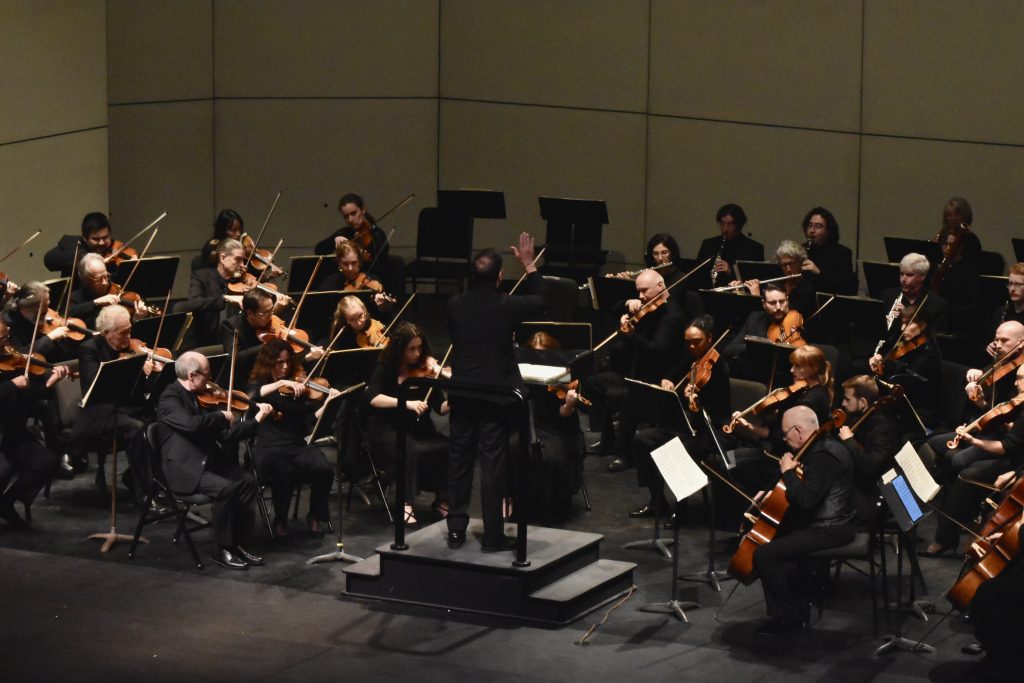
The Forum Theater buzzed with conversation and anticipation before the Binghamton Philharmonic Orchestra took the stage last Saturday. As the lights dimmed, elegantly dressed concert-goers found their seats for the first show in the Philharmonic’s symphonic series, honoring its 70th anniversary.
Thunderous applause erupted as Binghamton Philharmonic Music Director Maestro Daniel Hege took the stage. Serving in the role since 2018, Hege is one of the only Indigenous music directors of an American orchestra, as he is wal’wáma, Chief Joseph Band of Nez Perce.
Hege explained how the night’s theme, “Heroic Journeys,” would be explored throughout the program. The work of Ludwig van Beethoven was central to the theme, as Hege detailed how the second song was formerly commissioned for the 200th anniversary of Beethoven’s birth. He discussed Beethoven’s obsession and inspiration with “fate now conquers” from Homer’s “The Iliad,” one of the most well-known heroic epics from Ancient Greece.
The audience quieted, listening to Hege spin the journey they were set to embark on, as the lights dimmed and the orchestra began to tune.
“In the Seventh Symphony, we hear all of Beethoven’s Hector-like courage in the face of fate and all of his joy in the ultimate freedom of the human spirit,” Julia Grella O’Connell, the program’s director of education and community engagement, wrote in the concert program. “As we listen this season to the culmination of his symphonic output, let us partake of both.”
The first piece, Carlos Simon’s “Fate Now Conquers,” started softly as the instruments escalated through dynamics. From the quiet, clear woodwinds featured in the beginning, the orchestra built in a wave of noise in sections. A cello soloist took the spotlight, immersing the crowd in a haunting melody, easing the building tension of the piece.
The final section had the orchestra once again unite for a fantastic, uniform final note. The bows of the strings flourished as the audience exploded into applause, setting an excited tone for the works to come.
Scattered gasps filled the theater as highly decorated pianist Tomoko Kanamaru took the stage, sparkling under the lights. Kanamaru has played with professional orchestras since the age of nine, gaining notability with orchestras across the United States and Tokyo. With an expansive education and teaching background, she has previously performed Beethoven’s works.
Kanamaru gracefully smiled at her warm welcome and made her way to the grand piano center stage, completing full harmony with the Binghamton Philharmonic in their next piece. Hege raised his hands, ushering in the beginning of Franz Liszt’s “Piano Concerto No. 1 in E-flat Major.”
The piece featured four movements, each with a pattern of alternating sounds between the orchestra and piano. It became a form of call and response as they bounced off each other’s momentum. A featured solo came from the principal violinist, once again calling out.
Kanamaru connected with the music as her body moved with the notes and her facial expressions danced to the music’s tone. Her hands constantly moved as she often opened her palms to the sky or beckoned to the orchestra. Each motion became open ended, almost gesturing for fate to dictate the journey.
The audience was captivated by her synchronicity along with the music — the silence in the theater was nothing short of electric. Kanamaru held onto every note and the audience did the same under her spell. As the piece concluded, the audience shot to their feet for a cacophonous standing ovation. She bowed, her face and outfit shining under the lights, exiting the stage before reappearing for an encore.
The encore was entrancing, as the clear tone of the grand piano filled the hall with a calming melody. As Kanamaru finished, she leaned back and looked up, smiling and raising her arms toward the sky. The theater once again filled with cheers, as Kanamaru was decorated with flowers and took her bow with Hege one final time.
The lights came up for intermission and the audience stirred, beginning to chat about the show. Marianne and Steve Konka, of Cincinnatus, NY, shared their experience of the performance so far. Marianne commented on the pianist’s prowess, specifically in Liszt’s pieces and they discussed the beauty of the theater itself. The couple said that the philharmonic is a special place for them, recounting stories of nights they watched enchanting performances here while they were first dating.
“There is something extraordinary that happens when we gather in a concert hall: a moment of stillness, then sound — and suddenly, we are connected,” wrote Megan Curinga, the president of the Philharmonic Orchestra board of directors, in the program. “Music transcends words, backgrounds, and beliefs. It brings strangers into shared feeling and turns a roomful of individuals into a community.”
The final piece, Beethoven’s “Symphony No. 7 in A Major, Op. 92,” served as the concert’s finale. The entire symphony followed in a similar suit to the previous pieces, repeating a soft, cycling call and response as each instrument section took a highlight. Sections were bold and brash, with Hege’s conducting matching this energy as the noise grew. Frequent shifts to a minor key made the familiar melodies established in the first movements turn haunting, a question of where the music would go next.
The ending movement truly encapsulated the overarching theme of the performance, focused on the role of fate. The constant back and forth of bold and soft, fast and slow, mimicked a journey with its twists that was making its way to a fateful conclusion.
As the last note rang out in the theater, every seat in the house was abandoned for a standing ovation. The company took their bows and the lights began to illuminate the house, once more bringing the audience back into reality.