





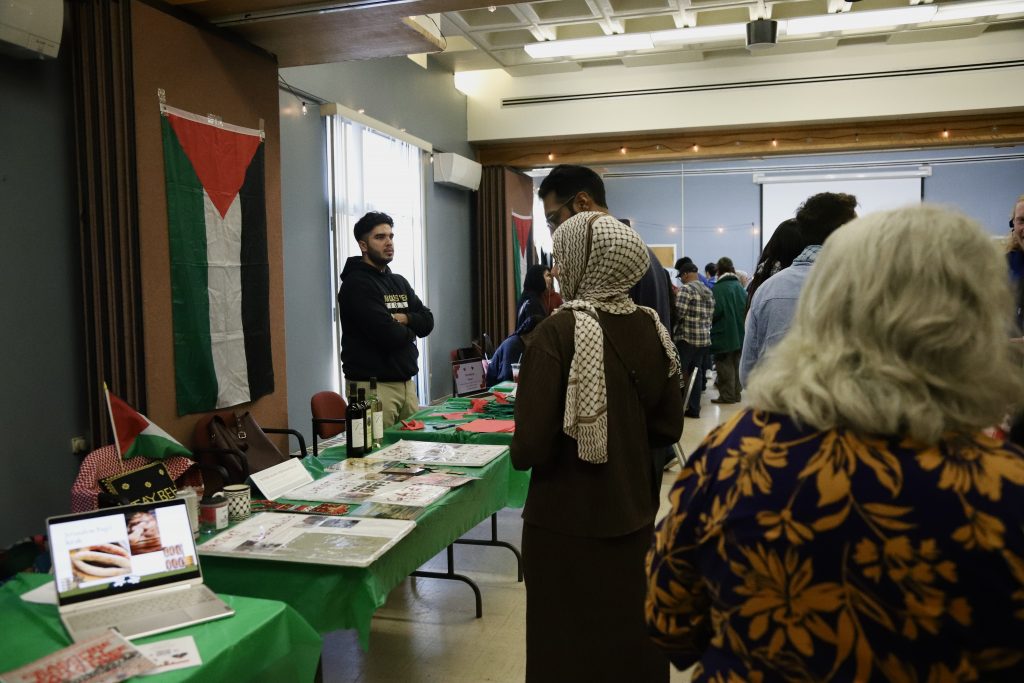
The second-annual Palestine Cultural Festival was held on Sunday at the American Civic Association in Downtown Binghamton. With a community-centered approach, the festival celebrated Palestinian culture through traditional food, music and handmade goods, and provided opportunities to engage with the organizations in attendance.
Although the first Palestine Cultural Festival took place last summer, the event’s organizers decided to move the festival to the fall, allowing the wider Binghamton community to participate.
“The Palestine Cultural Festival was born from a deep desire to celebrate and share the rich, vibrant, and hospitable culture of Palestine — a culture that too often gets overshadowed by images of destruction,” Sumeeta Chaudhri, a central organizer of the Palestine Cultural Festival and a member of the Binghamton University Interfaith Council, wrote in an email. “We wanted to create a space where people could experience the joy, beauty, and resilience of Palestinian traditions firsthand.”
Both student and community organizations lined the room with their designated tables, allowing attendees to move between activities and demonstrations at their convenience. In their respective tabling sections, student organizations led informative presentations on specific elements of Palestinian heritage.
The University’s Arab Cultural Student Association handed out confections and showcased a slideshow highlighting the cultural significance of the herb blend za’atar, a staple in Middle Eastern cuisine. Similarly, Broome Community College’s Muslim Student Association displayed a trifold poster with the history of Jaffa oranges, featuring related artwork, images and poetry that focus on the discussion of Palestinian agriculture amid the ongoing humanitarian crisis in Gaza.
On the other hand, the University’s chapter of Students for Justice in Palestine sold red, white, green and black beaded bracelets with watermelon charms. The profits are set to be donated to Health, Education, Aid and Leadership Palestine, which donates urgent relief to children and families in Gaza.
“One of the most remarkable qualities of our multicultural community is the mutual support shared between organizations, especially in a time when our rights and safety, both as students and as organizers, are increasingly under threat,” SJP wrote in an email. “Regardless, the members of our community show up for one another, recognize and uplift each other’s actions, and collaborate to create educational, informative events that emphasize the interconnectedness of our struggles for justice. In our experience, dialogue remains one of the most powerful tools to encourage our peers from all backgrounds to engage meaningfully with issues of human rights, even beyond Palestine.”
“As activists, we often feel overwhelmed by the weight of the ongoing tragedies around the world, but we cannot let that convince us that we, the student movement, are powerless to stop it,” SJP continued. “Our activism and presence on campus, in any amount, is what threatens the systems that seem to hold power over us, because they are counting on our silence and complacency to uphold the status quo.”
Other student organizations in attendance included The Yiddish Bund of Binghamton, Binghamton’s Muslim Student Association and Binghamton Graduate Students for Justice in Palestine.
On the more creative side of the festival, Women in Hebron, a Palestinian cooperative for embroidered and handmade goods, sold tatreez-patterned pouches, a traditional Palestinian design, and other accessories like wallets, hair clips, jewelry and keffiyehs, patterned scarves typically worn in the Middle East and surrounding arid regions.
Freehand henna art was also available for attendees.
“The festival adds a vibrant thread to the cultural tapestry of Binghamton; conceptualized and brought to life by a Binghamton University Interfaith Council member, a graduate student and a staff member,” Chaudhri wrote. “The event showcases the power of collaboration and grassroots initiative. It’s a space where students and community members from all backgrounds can come together to learn, connect, and celebrate.”
“We’re especially excited to share traditional Palestinian dishes, which are always a hit, and even more so, to showcase the diversity of the Holy Land through the presence of student and community organizations representing Jewish, Christian and Muslim traditions,” she continued. “That interfaith and intercultural unity is something truly special and heartwarming.”
A wide variety of traditional food was arranged at self-service tables. Attendees tasted sides like salata falahiyeh, or farmer’s salad, along with hummus and other dips and flavorful rice dishes with a variety of ingredients like eggplant, chickpeas and almond slices.
“We hope attendees left with full hearts and open minds,” Chaudhri wrote. “Whether they tasted something new, heard a story that moved them, or connected with someone who broadened their perspective, our greatest hope is that they walked away with a deeper appreciation for Palestine and Palestinian culture — not just as a people facing adversity, but as a community rich in life, warmth, and beauty. If even one person left feeling more connected, more curious, or more compassionate, then we know the event made a meaningful impact.”