





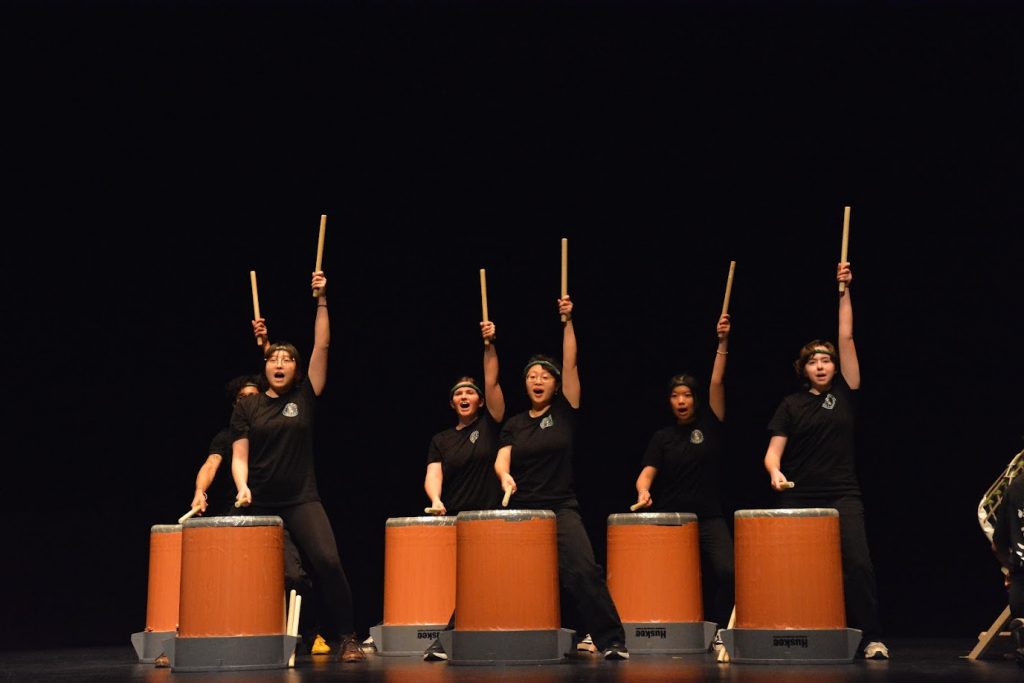
For almost 40 years, one of the largest cultural organizations on Binghamton University’s campus has been the Asian Student Union. Founded in 1987, the organization has remained strong in its core values and cultural events with its seven Asian American clubs: Asian Outlook; Binghamton University Japanese Association; Chinese American Student Union; Korean American Student Association; Philippine-American League; Taiwanese American Student Coalition; and Vietnamese Student Association.
Johnny Pham, president of VSA and a senior double-majoring in biology and Spanish, spoke about ASU’s legacy and the pride that comes from being a part of such a positive community.
“I would describe ASU’s legacy as one of everlasting passion,” Pham wrote in an email. “Since day one of my Binghamton journey I can still remember the impact of seeing everyone’s passion for their organizations and in turn their culture. I am a strong believer that ASU provides the opportunity of creating awesome leaders and this has continually been proven as I’ve continued to interact with old and new members of the ASU community.”
ASU and its subgroups support one another by meeting weekly to coordinate events and discuss issues where they can share their different perspectives. While all seven organizations are united under ASU, each club maintains its own distinct identity, culture and history, forming a harmonious and collaborative community.
One of ASU’s biggest events of the year is “Asian Night,” where all ASU clubs are invited to connect with each other, have fun and express themselves through each organization’s culture.
“Through ASU’s annual Asian Night, we are able to display dances and songs from our individual cultures and celebrate other subgroups who are doing the same,” Ellie Shin, president of KASA and a junior majoring in biology, wrote in an email. “During Asian Night, the Fashion Walk is a performance portraying the various different traditional clothing from all over Asia all at once, which is a perfect way to show that despite our differences, uniting and working together can be beautiful.”
“Subgroups also collaborate with each other in smaller events throughout the year which not only gives us the opportunity to bond with each other, but also find similarities and differences within our cultures,” Shin continued.
The organization has grown with the University over the decades, its legacy evolving alongside it. ASU has a rich legacy of culture and discourse to look back on.
Asian Outlook, ASU’s art, literary and news magazine, has published a variety of pieces on current events and opinion columns. As a mode for creative expression, the magazine reflects the discourse popular during each decade of ASU’s history. Rui Zheng, president of AO and a senior double-majoring in environmental studies and geography, discussed the power students have always had in every era of the organization.
“Each era of AO was very representative of their time — many pieces in the ’80s and ’90s spoke on immigration issues (when large numbers of Asian immigrants were just arriving) while the 2010s was a mix of strong side parts, hot takes, and reporting during Trump’s first term,” Zheng wrote in an email. “So I kind of see AO as a mirror that reflects the current state of mind felt by the Asian community here. Or those arcade basketball machines but instead of balls, it’s ideas. And with media, each contributor has the power to influence, which inspires further dialogue and introspection.”
With a rich history, ASU has helped countless students adapt to college life by providing opportunities to get involved, forge connections and show pride in Asian American heritage.
“ASU’s legacy can be described as culturally rich and immortal,” Shin wrote. “Our individual subgroups will continue to expand with our own traditions and the subgroups will continue to interact with each other, continuing the legacy of ASU for years to come. Because the melting pot of cultures is upheld by each of the 7 subgroups each playing a significant role, it is important for Binghamton University to see how our own unique identities are important in celebrating the overall Asian community.”