





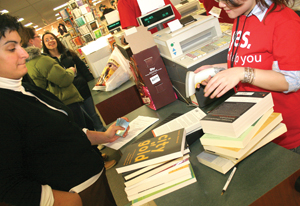
Traces of hemorrhaging credit cards and unwrapped — and therefore nonreturnable — textbooks can be seen strewn around Binghamton University’s campus as the book buying rush got underway this week. But the price of books — estimated last year at $900 a year per student by The Associated Press — may not be enough to deter students from the pricier options.
With three stores to shop for textbooks, as well as Web sites like Half.com, students at Binghamton have a number of different options when it comes to their purchases. But how many students actually take advantage of the different resources, and shop around before committing themselves to a certain offer?
According to some students say, laziness is an underlying factor in the shopping process.
“This is the first place I shopped because of convenience,” said Anjie Morey as she exited the campus bookstore, a graduate student.
Kyle Rodney, a junior history major, expressed a similar sentiment. When asked what his reasoning was for shopping at the bookstore he replied “laziness and convenience.”
For students who prefer to shop online for their textbooks, the New York Public Interest Research Group (NYPIRG) has created a Web site just for students who want to exchange books. The BU version of the Web site is run the by the organization’s Binghamton chapter, which allows students to post items they’re looking to sell.
“The initial idea was created so that students could trade books and get in contact with each other,” said Yonni Levin, the project coordinator for NYPIRG on campus. “It actually lists a spot where you can put your name and the building you live in, and if you want the book you can just show up, give the person cash, and it’ll be a two second transaction. Maybe you’ll make a friend in the process.”
But as practical as a book exchange among students might seem, the site itself only has four books listed.
Other Online shoppers also have the options of sites like Half.com, created by Ebay, in which students can find textbooks for a fraction of the cost of bookstores. Likewise, a Facebook group dedicated to buying and selling used textbooks has proved its popularity with a membership of over 300 students at BU.
But the traditional method of buying textbooks still proves to be common among students, as bookstores have been busy this week helping students prepare for their upcoming semester.
“Put it this way,” said co-manager Andy Kipp of Mando Books on Tuesday. “The lines been out the door for six hours today.”
For students wondering why the prices of textbooks vary between different stores and different Web sites, there are a number of factors that play into the price of a book. Co-managers Kipp and Aaron Berthelette cite their independent store status enables them to come up with their prices.
Campus Bookstore manager Rick Watson claims that the packaging and customizing of books specifically for Binghamton students factors into the process, making it impossible for these books to have a national market value.
“I think the biggest thing is the packaging and customizing of the books. We’re starting to see more and more books that are customized for BU … but what it does is it makes the BU edition useless unless it will be used again,” said Watson. “So even when you go to sell it back, as opposed to it being used and you getting half, you’ll get nothing.”
The Bookbridge uses a similar process when pricing their items, using a net value released by the publisher to determine the cost of new books, said store manager Aryeal Verrecchio.
“For used books, there are two different ways,” said Verrecchio. “ Either we do what we think is a good price, depending on if it was used or not, or we mark it up from the whole sale company’s price as much as possible, while still staying competitive.”
While many students don’t mind spending a little extra cash for the convenience of the bookstore, some don’t mind putting in the extra leg work required to save some money on their text books.
“I’m writing down titles and copying ISBN numbers,” said senior Feaming Tan, a comparative literature major, browsing in the campus bookstore. “Then I’m going to Mando and then I’m going to look online.”