





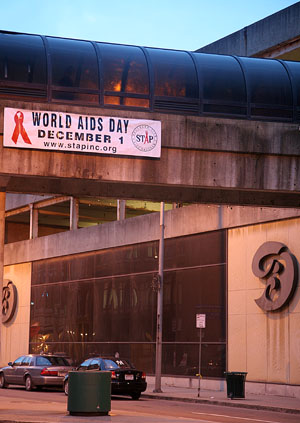
Twenty-five years ago it was known as a gay white man’s disease. Even today — the 18th World AIDS Day — statistics suggest that the stigma is still alive in some of the United States’ most educated: students at Binghamton University.
A student-conducted survey found that 33 percent of the student body believes they are not at risk for the Human Immunodeficiency Virus, or HIV, if they abstain from anal sex. The survey, which was a project for HDEV 480C, “The HIV and AIDS epidemic class,” questioned 420 people on campus.
“People still think that if you’re not a gay man, you’re not at risk,” said Tina Barber, the instructor for the class. “But the risk group [age] is anywhere from 15 to 29 and especially growing among heterosexual women.” Barber added that the statistics suggested the spread of HIV had more to do with unprotected vaginal sex than unprotected anal sex.
The results of the project also showed that a startling 46 percent of BU students have had unprotected sex, of which only 47 have been tested for HIV. Twenty-two percent of people surveyed do not know where to get tested, the survey also found.
Jonathan Gettinger, one of the five students who conducted the survey, said that the figures would “shock” those who saw them: “… They realize, one, how little they know and, two, how at risk they are and how important it is to get tested.”
Barber said she was not surprised by the result because many students do not believe the epidemic is their problem.
“They don’t recognize their own risk,” she said. “Students believe their partners are ‘clean.’ They worry about pregnancy prevention, not STD prevention.”
However, people age 15 to 24 account for half of all HIV infections worldwide. Each year 40,000 new people get infected in the United States, and so far AIDS has claimed the lives of 22 million people in the world.
HIV steadily weakens the body’s immune system until it can no longer fight off infections, resulting in AIDS (Acquired Immunodeficiency Syndrome) — and eventually death. Other than abstinence, using condoms is the most effective way to prevent sexual transmission of HIV.
And while the disease has been officially recognized in the United States since 1981, the myths about AIDS prevail.
“People still think it’s a death sentence, but it has become a manageable disease,” said Ingrid Husisian, director of public communications of Broome County Planned Parenthood. “The most common misconception about AIDS is that you can get it by sharing food, hugging and kissing.”
In fact, 25 percent of BU students surveyed believed HIV can be transmitted through saliva, the study found. In reality, the infection can be passed through blood, semen, vaginal secretions and breast milk only.
So what can be done to increase awareness?
Barber believes education is the key.
The ignorance that the survey revealed, she said, speaks to the fact that there is often inadequate sex education in high school.
“Students are not getting accurate information about HIV, and they carry those misconceptions to college,” Barber added. “Abstinence education is not [a good policy].”
However, students can access the information easily enough on the Internet, but few do so.
“To do that you need to believe you’re at risk — that’s the problem,” Barber said. “So what can you do? A campaign that will be targeted toward young people might raise awareness, but I haven’t seen one.”
Still, REACH (Real Education About College Health) is trying.
This week the organization held three forums and a showcase to commemorate 25 years since the AIDS epidemic has been classified as a disease in the United States.
A forum on Monday entitled “HIV 101” discussed the basics of the disease. On Tuesday, students looked at how the disease affects the global community, and on Wednesday, a speaker from STAP (Southern Tier AIDS Program) talked about his experience living with HIV. About 30 people showed up for each event.
The week concluded last night with a benefit to raise awareness, featuring performances from different student groups. REACH distributed ribbons and information on AIDS in between presentations and collected donations for STAP.
“Our goal is to inform people and to put face to HIV,” said Dina Boccuzzi, a peer educator for REACH. “I really liked the speaker on Wednesday because we got to talk to this guy who lives with HIV. I think it’s better to [educate through] personal experience, showing people how it affects them.”