





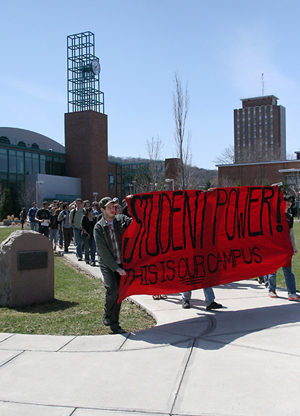
The same day students came together to raise awareness about what they said were issues Binghamton University was ignoring, an administrator joined a group of students to solve one of the problems discussed during said rally.
The Coalition Against Hate, which is composed of students from a variety of cultural and political organizations at BU, organized a “Student Power Rally” on campus yesterday to protest what they said are the administration’s “undemocratic” decisions, such as arming University Police with Tasers, imposing an unreasonable workload for English graduate students and prosecuting anti-war protesters.
Meanwhile, Vice President for Student Affairs Brian T. Rose met with members of the Graduate Student Organization to discuss the University Judicial Board’s decision to pursue charges against students that had been arrested March 18 during the Iraq war protest on the Vestal Parkway. Police had arrested eight students at the war protest, but at press time, it was unclear how many students were going to face the Judicial Board.
According to GSO President Wazir Mohamed, Rose agreed to halt the proceedings and meet with the students involved to discuss the situation.
Rose did not return repeated calls for comment, but issued this statement regarding the issue:
“We respect the rights of students to express their views,” he said. “Binghamton University has a strong tradition of tolerating and encouraging diverse points of view.”
The meeting came as a result of a resolution passed Tuesday in the GSO, which stated that the Judicial Affairs Board had “overstepped the boundaries set by the rules governing their functions.”
The students had appeared before the Judicial Board for a preliminary hearing Wednesday night.
In the resolution GSO asked President Lois B. DeFleur to intervene and halt the Judicial Board until the situation played itself out in the court system. The organization also pledged to hire an attorney for the students if legal proceedings were to continue.
“We see this as harassment, especially when law enforcement is involved and the students are before the courts,” Mohammed said. “Let that process work its way through the courts and let’s see what happens there.”
Andrew Epstein, one of the students arrested during the protest, supports GSO’s actions.
“Whenever you engage in civil disobedience you expect a certain degree of repercussions. What we didn’t expect was for the University to insert itself into the process so early on in such a way that seemed to be one-sided.” Epstein said. “It’s important for those processes to happen independently of the University before they step in and make any action.”
But the plight of the war protesters is only one aspect of an overarching problem, Epstein said.
“There are a lot of important decisions made on this campus without a lot of democracy,” Epstein said. “The administration often makes decisions behind closed doors. Students are the largest group on this campus and I think it’s time we changed the culture on this campus so that students get to participate in these important decisions.”
Mohammed, who spoke during the rally, believes Rose’s actions will help foster a more harmonious campus environment.
“This is a university. We should have a space of dialogue on all these issues between administrative offices and the students,” he said. “We want fairness. We want a democratic space. We want equality under the law. That’s all we want.”