





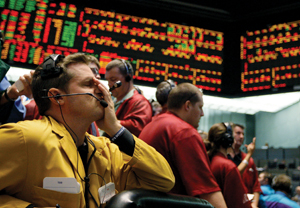
The recent Wall Street credit crisis has sparked unease in the Binghamton University School of Management as students worry about job prospects post graduation.
While the Dow rose 410.03 points yesterday — the biggest percentage point gain since October 2002 — it still leaves the index down about 400 points for the week after Monday and Wednesday’s debacles. The surge followed a report that the federal government might create an entity to absorb banks’ bad debt.
Cliff Nguyen, a BU alumnus who graduated from SOM last semester with a degree in financial engineering, is an analyst at the Bank of America.
“We’ve never really seen anything like this,” Nguyen, a former Pipe Dream business manager, said. “I never would’ve thought it’d happen.”
Earlier this week, Lehman Brothers filed for bankruptcy and Merrill Lynch & Co. was sold to the Bank of America Corp.
These drastic changes in the market have left some graduating seniors worrying.
Alex Lapegna, a senior financial economics major, said he thought the uncertainty of which companies would stay afloat and which could go under is a concern for students. Still, Lapegna, 20, said he wasn’t as worried about finding a job because his major is more diversified than some others.
Melissa Cardillo, a junior management major, expressed a similar opinion.
“The opinions that I have heard these past few days around SOM fall into two categories,” she said. “The optimistic view that hopefully the economy will turn around by the time graduation comes, or the pessimistic view that anyone who was hoping to pursue a career in finance is looking to their second concentration to try and find a job now.”
Over the past few days the issue has proved important enough to pause instruction and have conversation in class about the economic troubles.
“In all of my classes they’ve stopped discussion to talk about Merill Lynch,” Allison Gottlieb, a junior accounting major, said.
However, Elliot Kamlet, a lecturer for the School of Management, said he doesn’t think graduating seniors need to be too worried.
“It’s likely that the job market won’t be as bad as people anticipate, even in finance,” Kamlet said.
Kamlet said that there will still be work for new recruits because it would be cheaper for finance companies to lay off old workers with larger salaries, and hire new people who are anxious to work for less money.
Still, some say the meltdown isn’t going to affect everyone.
“I’m personally not worried about jobs,” Aaron Cohn, a sophomore accounting major, said.
According to Kamlet, accounting firms are anticipating additional workers because of the crisis.
“The demand for accountants remains strong,” he said.
Lili Wang, a junior biology and economics minor, said she had trouble finding internships at Wednesday’s Job and Internship Fair. According to Wang, employers she spoke to said they were probably looking for fewer employees than they had last year.
According to Bill McCarthy, associate director at the Career Development Center, there was a record number of 114 employers at this week’s job fair despite the Wall Street troubles.
“The economy might be tough, but students can’t affect the economy,” McCarthy said. “You need to ask yourself, ‘What can I, as a student, do in this economy?’”
McCarthy said it was important for students to look at the opportunities that are available and then “pursue them hard.”
“Are there less opportunities than before? Yes. Are there still opportunities? Yes,” he added.
— Marina Gaft and information from The Associated Press contributed to this report.