





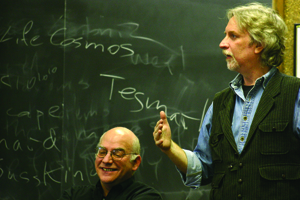
The science and philosophy communities joined together this weekend to explore the impact scientific discoveries have on the various mysteries of life. The Science and Enduring Mystery symposium was composed of a series of lectures by Binghamton University faculty and invited professors and was held on Friday and Saturday.
“The purpose of the symposium was to explore how science creates mysteries — profound questions and problems for which we desperately want answers, but which we cannot get,” said Eric Dietrich, BU philosophy professor and a coordinator of the event.
After writing a book on consciousness, Dietrich was struck by the fact that so little was still known about that aspect of the mind.
“I started thinking that there were a lot of deep problems out there that we have no hope of solving,” Dietrich said. “I also knew that science had an embarrassment of unsolvable problems.”
Four speakers were invited to lecture: Lee Worth Bailey, a professor in the philosophy and religion department at Ithaca College, Gregory J. Chaitin of IBM research, Terrence Deacon, an anthropology professor at UC Berkeley, and Jay Garfield, a philosophy professor at Smith College.
“We chose the speakers based on their past publications on this topic of science and mystery,” Dietrich said.
Topics ranged from mysteries of math theorems and the origin of life, to how the limits of human knowledge create mysteries.
“Gregory Chaitin talked about how there are more theorems, truths, in math than there are proofs,” Dietrich said. “Hence, some mathematical statements are true for no reason whatsoever, which is weird.”
BU faculty members also spoke at the event.
Both days concluded in panel discussions during which the audience questioned the day’s speakers on their lectures as well as other topics. Topics during these panels ranged from consciousness to the definition of “mysteries” and their impacts upon science, and vice versa.
“We don’t know as much as we pretend,” Chaitin said. “People like to write books about what we know and not what we don’t know, which would fill many more volumes. That’s what I would like to read.”
All in attendance seemed to genuinely enjoy the event.
“I thought it was really useful, being given the opportunity to sit and think,” said Junior English and cinema major Andy Simek, who helped out at the event. “You don’t normally get a chance to do that. Normally things are thrown at us with no time given to reflect.”
“Everyone seemed to really like it,” Dietrich said. “The energy was high. Tempers flared which is always a good sign. People talked intently and excitedly between talks and during lunch both days.”
Dietrich also hopes the symposium had a lasting impact on the faculty, students and community members who attended.
“I hope … people see that science is much weirder than we usually think, and so, by the way, is the world and universe,” he said. “Science shows us that we are strange creatures living in a stranger universe, surrounded by robust mysteries.”