





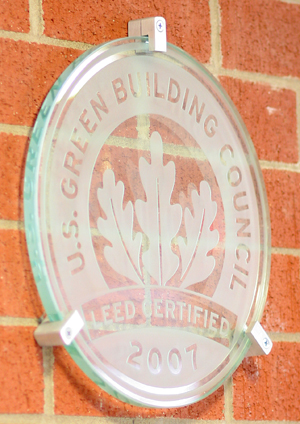
Last fall Binghamton University became the first school in the State University of New York system to be awarded an LEED Green Building Certification.
Leadership in Energy and Environmental Design (LEED) is a program set up by the United States Green Building Council in 1998. The guidelines require buildings to be environmentally friendly and help avoid “green washing,” a common practice of appearing green on the outside, but being environmentally unfriendly in many respects. Many developers are now choosing to use LEED to prove that their building designs are truly minimizing their impact on the environment.
BU’s Cascade and Windham Halls of Mountainview College were designed specifically to meet LEED standards for energy use, lighting and water use, as well as several other sustainable strategies. The East Campus renovations will be designed to meet the LEED silver standard certification.
In New York alone there are 47 LEED registered projects, six of which are at colleges and universities.
The SUNY Board of Trustees decided to follow Gov. George Pataki’s 2001 executive order that encouraged state projects to seek LEED certification. Since then, University at Buffalo and BU have followed suit.
In November of 2007, the Board of Trustees reached a decision not only to reach LEED certification for any new building projects and major rehabilitation projects, but to reach silver certification.
LEED certification may be attained on five levels. The first is simply certification, followed by bronze, silver, gold and platinum levels of certification. These different levels are based on a point system, where specific criteria must be met to gain points, thereby leveling the playing field for developers.
According to Dave Henahan, director of media relations for SUNY, some SUNY building projects might go for gold or platinum certification in the future. Building designers are encouraged to seek as many points as they can.
The best way to become LEED certified is to have an LEED accredited professional on site. These are experts that have been tested by the Green Building Council and found to be well-versed in the certification process.
Anyone can become an LEED AP, and the current list includes anyone involved in the building process, from plumbers and bankers to architects, real estate agents and interior designers.
The APs don’t work for LEED but facilitate the process of certification by having in-depth knowledge of the program and point system. Building projects even get a point for having an AP on the job site, and there are currently around 45,000 in the United States.
The certification process includes a series of submittals of project plans to be reviewed by LEED teams, which determine whether a project meets LEED standards, according to Bianca Ramsey, spokeswoman for the United States Green Building Council.
“The idea and intent is to look at the entire building,” Ramsey said.
Some critics of LEED say certification may not be worth the money it costs to have a building certified, and that the money spent on certification could go toward more valuable projects. But LEED advocates say the money spent during designing and building is recovered after the building is put to use.
Henahan said the SUNY system is conscious of their environmental impact when building, as well as the cost to the budget. Cascade and Windham have seen large energy reductions and the efficiency is clearly visible, Henahan said.
Support for building environmentally friendly buildings stretches over both sides of the building process, for supplies as well as products. The Green Depot, a store located in Brooklyn, is stocked entirely with environmentally friendly supplies for building designers.
According to Ramsey, it’s becoming commonplace to see environmentally friendly products in the marketplace, which makes it easy for developers who want to go green.
While LEED is gaining more popularity as the program grows and changes, the goal is that one day every building can be LEED certified and everyone involved in the building process will follow the program’s guidelines, thereby eliminating the need to review and reward those that do follow the guidelines.
“We hope to do our job so well that we [LEED review teams] will be obsolete,” said Ramsey.