


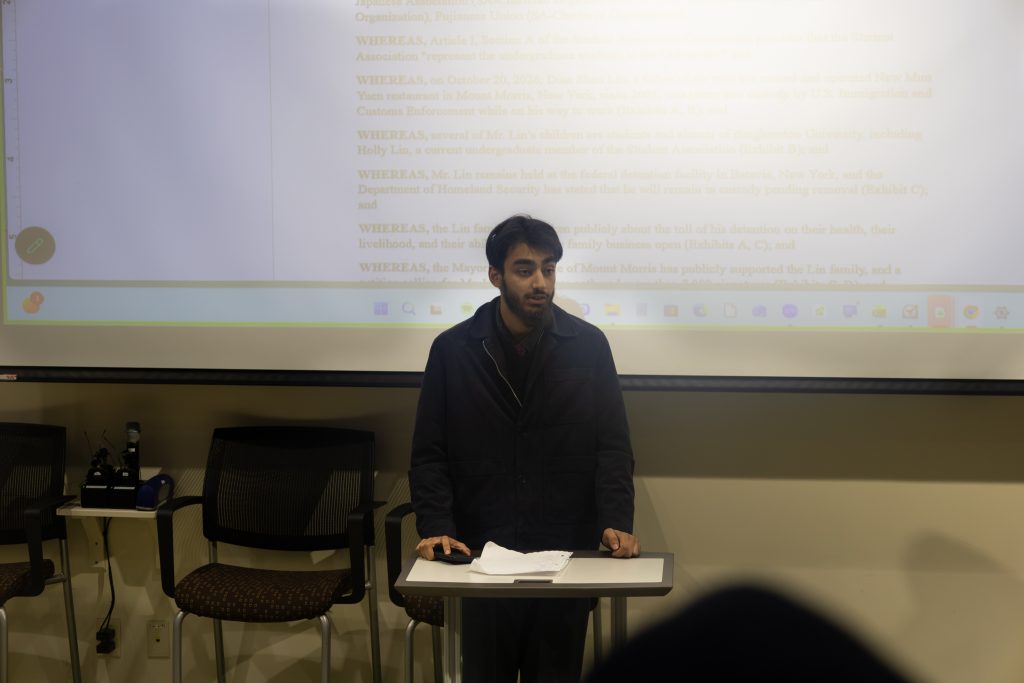
The Binghamton University Student Association passed a new resolution to promote visibility of mental health resources on campus, following last month’s rejection over concerns about the proposal’s authenticity.
The “Resolution to Improve the Visibility of Campus Mental Health Resources Through Signage,” written by Muhammad Bhatti, a sophomore majoring in philosophy, politics and law and an off-campus representative, was voted on at the Congress meeting on Nov. 17.
The resolution urges the University to install additional signage with 988 Lifeline information and directions to campus mental health resources, such as the University Counseling Center, Decker Student Health Services and the Violence, Abuse and Rape Crisis Center.
A previous iteration of the resolution, “Mental Health, Not Mental Hunt: Resolution to Improve the Visibility and Accessibility of Campus Mental Health Resources,” was criticized by SA Congress for allegations that some of the 33 organizations listed as nonvoting sponsors had not actually read the bill.
Luke Fehily, a sophomore majoring in political science and an off-campus representative, said he was “disgusted” by the previous resolution. He argued that mental health is a serious topic and “we’re making it into a political game and a spectacle.”
The previous edition was also criticized for having unclear wording, with members suggesting that the bill should be reorganized. After hearing some of the debate during the Oct. 20 meeting, Rafi Josselson, a sophomore double-majoring in Judaic studies and history, removed himself as a co-author.
The proposed bill later received no votes in favor of its resolution, with 19 against it, including Bhatti, the remaining author on the resolution. Six members abstained.
Following the Oct. 20 meeting, the Off-Campus College Council sent an email to the off-campus community, expressing disappointment that the resolution failed.
“We understand that the bill had its flaws, but our main objection is the way its critique occurred,” the email said. “The bill was introduced with the intent for it to be changed and modified, with the concerns heard by the student association. The representatives targeted its legitimacy rather than focusing on what the authors had in mind and strayed away from the main reason it was brought to Congress in the first place.”
The email also contained a statement by Bhatti regarding the opposition to his bill. The statement named Fehily, Jonah Matteo, a sophomore double-majoring in cinema and political science and a representative from the Hillside Apartments Community; Alexandra DiLauro, a junior majoring in philosophy, politics and law and the president of the Disabled Students Union; and August Rey, a junior majoring in political science and the vice president of student success, who all criticized the bill during the Oct. 20 meeting.
“I don’t object to criticism of my legislation,” Bhatti wrote. “That criticism made the new bill better. I object to my character being put on trial on the floor of Congress, with accusations of manipulation and self-promotion made in public by someone who never sat down with me in private.”
In an interview with Pipe Dream after the Nov. 17 meeting, he said that “certain individuals that were named” have since apologized to him.
In the Nov. 17 meeting, Bhatti brought the new edition, “Resolution to Improve the Visibility of Campus Mental Health Resources Through Signage,” to the floor for debate and voting. The new bill is focused solely on increasing signage for mental health resources such as the University Counseling Center, and was passed with 19 members voting in favor. No members voted against the resolution, and four abstained.
A different bill to formalize the process of adding nonvoting sponsors was also proposed in the Nov. 17 meeting, with Bhatti sponsoring this resolution. Congress voted to table this until the next meeting.
In an interview following the Nov. 17 meeting, Bhatti said the biggest change between the previous resolution and this one was that Congress members were focusing on the content of the resolution.
“I think that ultimately, that was a lesson for everyone, to ensure that we are focusing on the actual contents of the bill and not anything, be it the sponsors or the authors’ intentions,” said Bhatti. “I think that all of those are not pertinent to the bill. And moving forward, I think that Congress representatives at large have learned their lesson.”