





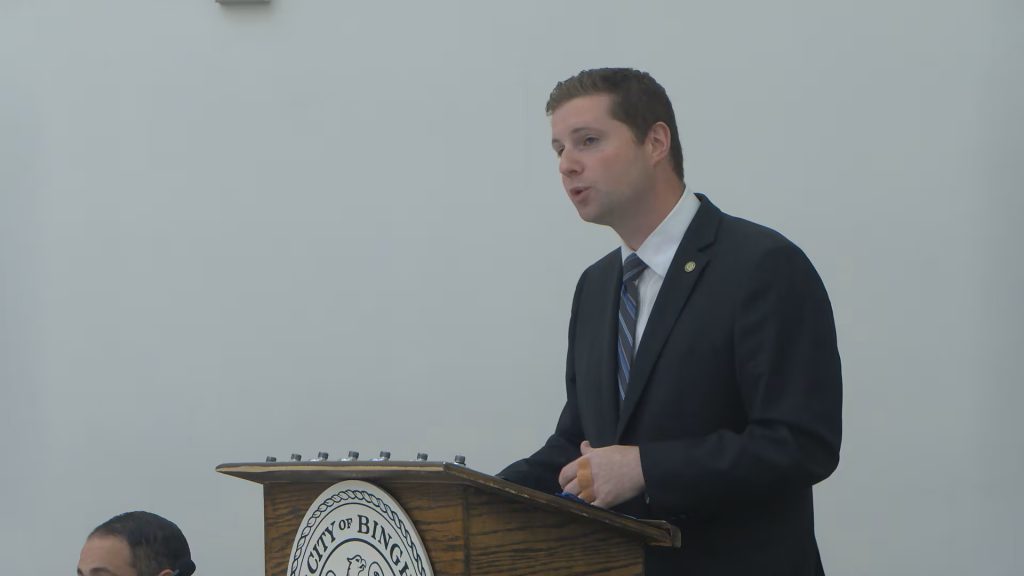
On Tuesday, Binghamton Mayor Jared Kraham delivered his annual budget address at City Hall, with goals of improving infrastructure and aiming to build the city’s identity.
The budget planned for $119.2 million of spending in the 2027 fiscal year, about 72 percent of which is part of the City’s general fund, supporting the public service department salaries and operations.
The proposal also includes a raise in the property tax by 2.9 percent for homeowners. Kraham acknowledged the hike but noted that Binghamton will not be one of the nearly half of New York State cities planning to override the property tax cap, citing a State Comptroller report.
“It’s a really tough economic time right now,” Kraham said. “Gas prices are up. People are sitting at their kitchen tables wondering how they’re going to pay for the utility bills, make a car payment, pay for housing. And so, the city has some of those same stresses too, and we need to make sure that we protect taxpayers as much as possible.”
Kraham shared about his plans to continue investment in the police force. He stated that crime in Binghamton has decreased 24 percent since his installation in 2022, including a six percent drop in violent crime.
Kraham said that through salary increases, benefit expansion and paid parental leave, the police department was able to fill vacant positions and improve retention, leading to a more efficient department.
“Our residents deserve the highest quality police department,” he said. “One that’s a national leader on 21st Century public safety strategies. With declining crime rates, the time to innovate and improve the Department is now. We must have the personnel and resources to follow through.”
Kraham also said that plans to reestablish a second assistant chief position in the police department to “ensure proper oversight, accountability and training.” The position was eliminated in 2021 after it was left vacant due to a retirement.
Last year, Binghamton’s mental health response budget expanded by $100,000 with Broome County and the Mental Health Association of the Southern Tier and instituted two mental health emergency vehicles, allowing professionals to provide on-site support to those in crisis. Kraham pledged to “keep investing” in the initiative this year.
He also announced that designs for a new fire station on the North Side will be completed, with construction beginning in 2028 next to the current station, which is “near the end of its useful life.” He also spoke of the Fire Department’s successes over the past year. Welcoming a new chief of department, the team responds to approximately 11,000 calls annually, 80 percent of which involve a medical emergency, he reported.
After reflecting on the strides in residential development the City had made, Kraham announced a new development project to focus on the South Side neighborhood and area around Binghamton General Hospital.
The mayor said that while UHS is anticipating upcoming renovations, the surrounding neighborhood must be included in the plan for improvement. He continued to express plans for investment in future housing and public safety.
Kraham also called Binghamton University the “economic engine” of the city “for decades to come.” He announced that he wants the city to “lean in” and continue working with the University, in a move that would benefit both students and local families, and hopefully encourage graduates to stay in the Binghamton area.
He shared plans to move the Harriet Tubman Center into the Center City neighborhood, and to host a share of Division 1 basketball games in Downtown Binghamton, in a move to drive off-campus involvement in University sports and to support local businesses.
University President Anne D’Alleva and Director of Athletics Gene Marshall were present at the address. In an Instagram post, D’Alleva shared her gratitude for the ongoing partnership between the University and the City.
Other highlights of the budget address include $10.3 million set for improving streets, including road paving; $175,000 for improvements to Cheri A. Lindsey Memorial Park and First Ward Park; and $240,000 of funding to be directed toward youth support programs, such as the Boys & Girls Club and Volunteers Improving Neighborhood Environments’ summer employment program.
Binghamton Plaza, for which the City received a $75,000 grant in August 2025 to redevelop, is currently accepting bids for its multi-million-dollar demolition. Community planning efforts will plan new expanded park space, commercial activity and more jobs.
The City Council raised some concerns regarding the budget in a press release from Sept. 15, including concerns about the City’s “financial controls, contract management, and administrative transparency.”
“These are not partisan questions,” Council President Michael Dundon said. “These are not disagreements about whether we should spend more on one department or less on another. They are basic questions of financial management, transparency, oversight, and accountability.”
The most pressing concern, according to the press release, is an alleged $730,000 discrepancy in the City’s 2026 budget between the payment made to the Comptroller and the amount approved by the council last year. Other concerns surrounded a lack of communication around financial information and administrative organization.
Kraham said that the budget addresses the needs of Binghamton residents and that the City’s “best days are still ahead.”
“The 2027 Budget puts into place the resources we need to build on the progress of the last five years and deliver lasting change to Binghamton,” Kraham said in a public statement. “It also keeps the City on sound financial footing heading into the future, protecting taxpayers even as cities and households across New York State struggle with rising prices. Years of smart, responsible budgeting have put the City in a position to weather the fiscal challenges of today and be bold as we build the Binghamton of tomorrow.”