





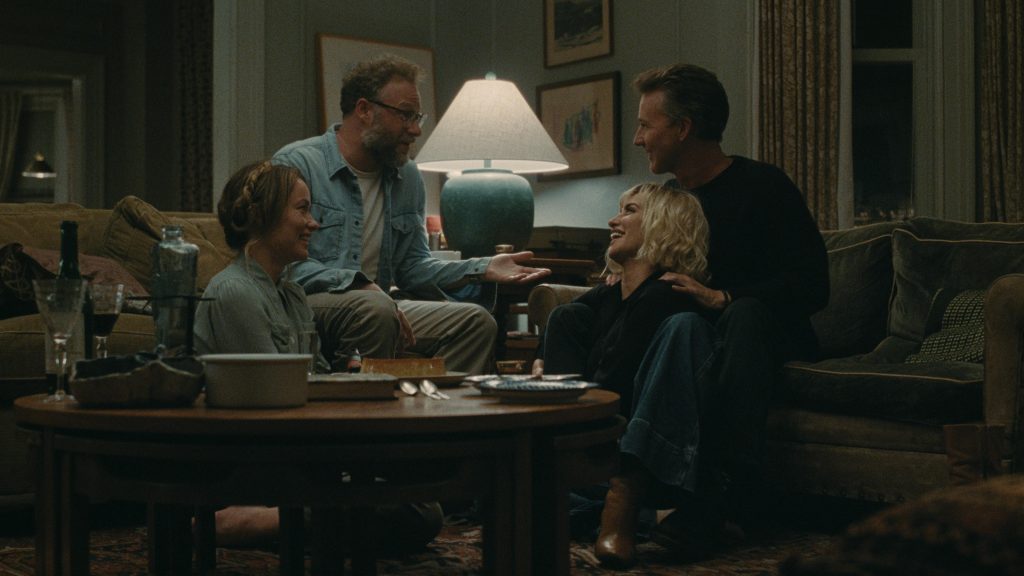
Olivia Wilde’s “The Invite” is a chaotic relationship comedy that depicts one unconventional couple to expose the cracks in another. Adapted from the 2020 Spanish film “The People Upstairs,” it explores relationships, monogamy, purpose and, ultimately, what it means to begin again.
Oscar Wilde’s cynical opening quote, “One should always be in love. That is the reason one should never marry,” introduces the film’s central question: what happens when love remains, but the excitement, vulnerability and curiosity that once defined a relationship begin to disappear?
Joe, played by Seth Rogen, and Angela, played by Olivia Wilde, are a married couple whose lives have settled into a predictable rhythm. Joe teaches music at a conservatory after abandoning his career as a musician, while Angela has stepped away from her artistic ambitions to become a stay-at-home mother. Their constant bickering is funny, precisely because of its familiarity. They interrupt each other, misunderstand each other and seem to have stopped really seeing each other.
Then there are their upstairs neighbors: Piña, played by Penélope Cruz, and Hawk, played by Edward Norton.
Having been together for only a year, Piña and Hawk seem to exist in an entirely different world. They are openly nonmonogamous, sexually liberated and unafraid of the unpredictability that comes with allowing other people into their relationship. While Joe and Angela have built their lives around routine, Piña and Hawk seem to build theirs around the unknown.
But the film isn’t arguing that one couple has figured out the secret to a successful relationship while the other has failed. Instead, Piña and Hawk serve as a mirror for Joe and Angela, exposing what the married couple has been unwilling to confront.
“The Invite” asks a deceptively simple question: why do we accept things that don’t make us happy simply because we’ve become accustomed to them?
Joe has accepted a career that makes him miserable. Angela has accepted a life in which motherhood has largely replaced her artistic identity. And together, they have accepted a marriage in which intimacy and spontaneity have slowly become afterthoughts. Their problem isn’t necessarily that they have been together for too long. It’s that they have stopped questioning whether their way of life still works for them.
That distinction becomes especially important as the film explores monogamy. Piña and Hawk’s relationship challenges the assumption that inviting other people into a partnership must inherently weaken the connection between two people. For them, openness is not about replacing one another, but allowing desire, curiosity and new experiences to exist within their relationship, rather than treating those feelings as threats.
The film never quite asks viewers to abandon monogamy. Instead, it asks why certain desires are treated as inherently dangerous when they could simply be communicated. Everyone wants to feel desired and seen, and Piña and Hawk are simply more comfortable acknowledging those desires than Joe and Angela are.
That difference becomes even more apparent through Angela’s obsession with creating the perfect evening. She meticulously prepares their apartment and dinner, hoping that impressing their neighbors will somehow produce the excitement she has been missing. But her fixation on perfection only creates more pressure. She tries to manufacture the experience she wants instead of allowing herself to experience what happens naturally.
And, of course, everything goes wrong.
The resulting chaos becomes the catalyst for Angela and Joe to confront the dissatisfaction they have spent years avoiding. Their relationship is not something that needs to end, rather, the version of their relationship that they have been living needs to.
Similarly, in his individual life, Joe’s sense of self has become tied to the belief that he failed as a musician. Instead of pursuing something that might make him happy, he repeatedly resigns himself to being miserable. His frustration becomes so normalized that he treats it as inevitable.
Angela faces the same crisis. Her passion for art has not disappeared, but it has been pushed aside by motherhood and domestic responsibility. Her meticulously designed home becomes one of the few remaining outlets for her creativity, but even that begins to feel like another source of external validation.
The film’s answer is not necessarily to leave, cheat or completely reinvent your life. It’s to recognize when something has stopped working and have the courage to change it. Rebirth isn’t about becoming an entirely different person, but rediscovering parts of yourself you let disappear.
Piña and Hawk’s purpose wasn’t to provide a blueprint for the perfect relationship, but to disrupt the illusion that there is only one way to live. They bring chaos into a life that has become too controlled, and through that chaos, Joe and Angela are finally forced to be honest with themselves and each other.
Beneath the film’s awkward dinner conversations and escalating absurdity, “The Invite” is about the danger of becoming too comfortable with a life that no longer fulfills you. Sometimes the only way to save what you love is to let the old version of it die first.
Rating: 5/5