





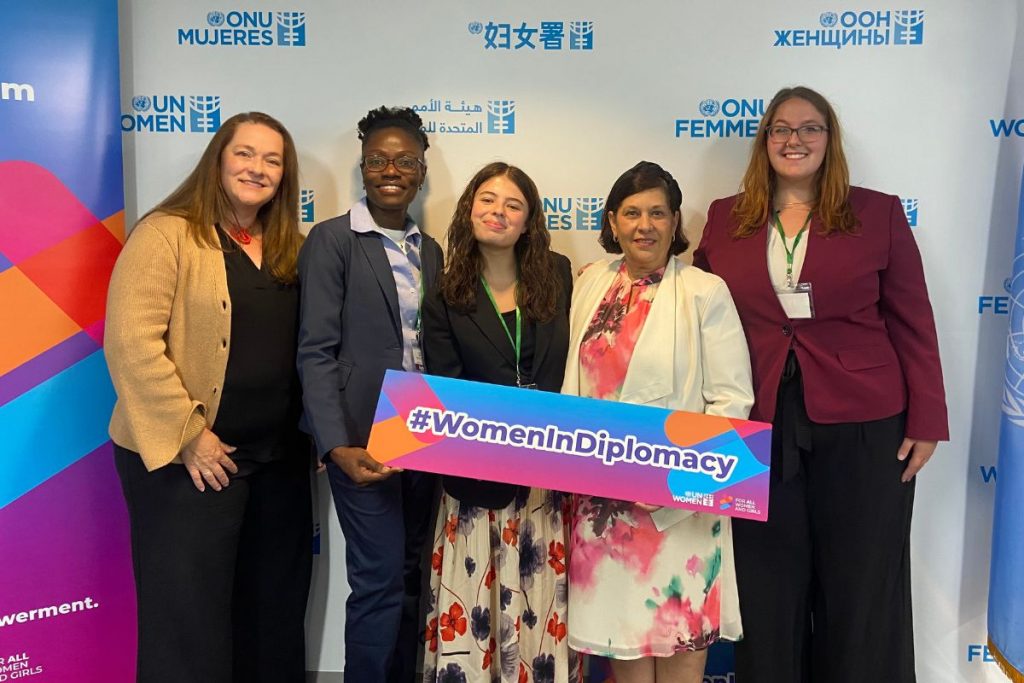
Binghamton University students were recently recognized for their contributions in the Women in Diplomacy project at the United Nations Women’s headquarters last fall.
The Women In Diplomacy project was launched by the London School of Economics and Political Science in 2022 and aims to increase women’s representation in diplomacy by analyzing factors driving underrepresentation and making policy recommendations to address these issues. Ammcise Apply, a third-year Ph.D. candidate studying community research action; Laurie Kern ‘25, a first-year graduate student studying sustainable communities; and Lauren Wilner, a senior double-majoring in philosophy, politics and law and environmental studies, attended the UN Women’s meetings and transcribed verbal responses from female delegates, a critical component of the international report.
“We really do need to take a step back in ensuring that the people who are trying to solve these gender inequalities aren’t themselves facing extreme sexism,” Kern said in an interview with Pipe Dream.
Apply, Kern and Wilner are acknowledged by the report “Strengthening the Representation of Women in Diplomacy: Lessons from the Field,” released by LSE in March, which aims to identify structural and social challenges to women’s representation in diplomacy and present solutions to address these challenges.
Apply said working on the project offered a “unique space” to understand how sexism within diplomacy “continues to mirror broader patterns of inequity that women face in other sectors.”
The report was primarily authored by Karen E. Smith, a professor of international relations and director of the Women in Diplomacy project at LSE, and Marta Kozielska, a policy analyst and advisor and manager of the project.
“Strengthening women’s representation in diplomacy matters because it goes beyond questions of workplace equity and individual opportunity to fundamental issues of human rights, representation, policy effectiveness, and credibility,” Smith and Kozielska wrote in the report.
The University’s Kaschak Institute for Social Justice for Women and Girls collaborated with LSE and UN Women, a UN organization devoted to gender equality. Apply, Kern and Wilner participated in a conversation in which international female delegates discussed sexism in diplomacy.
The goal of the meeting and the report was to address the bias faced by women diplomats when they represent their countries.
“Worst case scenario, there could be a diplomat who is not being heard within these conversations, not being listened to and not effectively able to represent their country due to sexism within their own sphere,” Kern said in an interview with Pipe Dream.
The students transcribed the conversation into written notes because the meeting could not be recorded to maintain the participants’ privacy. Apply, Kern and Wilner synthesized their notes and sent them to LSE to be used in the Women in Diplomacy project.
“This experience was transformative,” Apply told BingUNews. “I came to the meeting as an emerging researcher working at the intersection of climate, gender, and health, and left with a deeper understanding of how diplomacy itself is a critical site for advancing gender justice.”
Kern said her biggest takeaway from the project was the importance of involving men in conversations of gender inequality. Wilner shared that she learned American students need to expand studies about inequity for women by thinking about inclusion more broadly, expanding advocacy beyond the United States. Apply said that she found the project important because it allowed her to learn more about inequality around the world more broadly.
“No matter where you are or how comfortable you may feel in your position or role, don’t ever stop questioning the institution that you’re within,” Kern said. “Don’t stop looking around at who is at the table and, more importantly, who isn’t at the table.”