





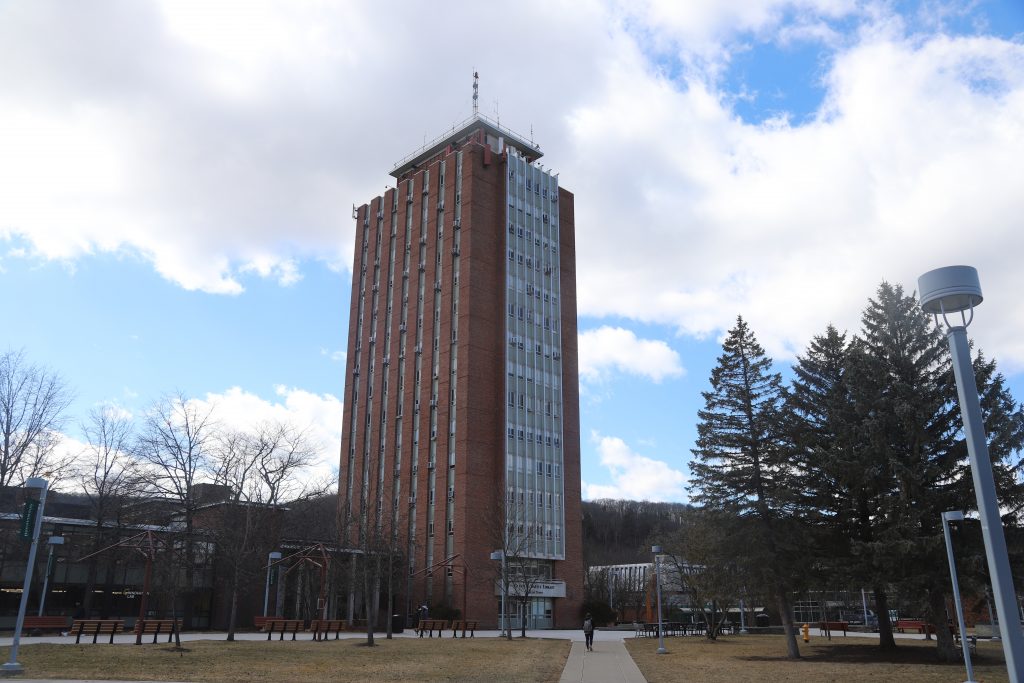
Gov. Kathy Hochul announced that Binghamton University will soon be home to an independent artificial intelligence research center, the first-of-its-kind at a public university in the United States.
Along with a $25 million capital investment from SUNY, Thomas Secunda ’76, MA ’79, cofounder of Bloomberg L.P., provided a $30 million philanthropic donation to support the new Center for AI Responsibility and Research. The initiative is part of New York’s Empire AI project, which Secunda chairs, and began in April 2024 as a way for public and private institutions to boost AI innovation and research in a “safe, equitable, and accessible” way, according to a program fact sheet.
“The Center for AI Responsibility and Research will bring together innovative research and scholarship, ethical leadership and public engagement at a moment when all three are urgently needed,” University President Anne D’Alleva said in a statement. “I am deeply grateful to Governor Hochul and the State Legislature for their visionary support, and to Tom Secunda for his extraordinary generosity and continued commitment to his alma mater. Together, we are creating a research environment that ensures AI will strengthen communities, build our economy and earn the public’s trust.”
Promoting research “that advances AI for the public good” will be one of the center’s main focuses, a University spokesperson told Pipe Dream in a statement.
Other members of the Empire AI consortium include Columbia University, Cornell University and the City University of New York. The first phase of the AI initiative led to the building of a supercomputer at the University at Buffalo, which faculty researchers and students currently use.
SUNY and the University will begin searching for faculty and staff to support the center’s functions, according to a press release from Hochul’s office. The University plans to find a temporary location over the summer for the center’s operations “before finding a permanent, longer-term home for the institute.”
“I’m optimistic about what AI will unlock — new scientific discovery, better health outcomes, stronger public services, and productivity gains that expand opportunity, and I want to thank Governor Hochul for her continued commitment to advancing science for the public good,” Secunda said in a press release statement. “To capture those benefits at full scale, we also need to build trust the right way: through independent, rigorous research that can test systems, measure performance, and explain how advanced models behave in real-world settings.”
“This new Center will help create the tools, standards, and talent pipeline the country needs so AI is not only powerful, but also secure, transparent, and worthy of public confidence,” he continued.
Several University faculty have explored AI usage in their research. Yu Chen, a professor of electrical and computer engineering, recently won $50,000 from SUNY’s Technology Accelerator Fund to build technology that can more accurately detect deepfake videos and other AI-generated content.
On social media, the University clarified that it is not building a data center and a BU spokesperson said the initiative will have “no impact on local resources.”
Some students voiced opposition to the planned AI research center in the comments section of the Instagram post announcing the initiative, with some believing the University should prioritize issues that affect student quality of life, like campus dining.
As part of the project, the University will also “engage in a rebranding to more fully align to the SUNY name and logo” to highlight SUNY’s commitment to research and public education, according to Hochul’s office.
The announcement continues Hochul’s efforts to establish New York as a global leader in addressing the rise in AI technology. Last month, Hochul signed a bill requiring AI developers to publish information about their safety protocols and report any incidents to state officials within 72 hours. First-time violators can be fined up to $1 million.
Earlier this month, Hochul also said she would seek to prohibit or seriously limit the ability of political campaigns to use nonconsensual AI-generated images of people within 90 days of an election.
“Artificial intelligence is advancing rapidly, and as the technology increasingly influences everything we do, we need to be just as nimble in making sure AI works for New Yorkers safely and responsibly,” Hochul said in a press release. “The Center for AI Responsibility and Research will be an independent arm of research that gives New Yorkers transparency and confidence that AI is being developed and deployed in ways that serve the public good, particularly in public sector applications. This effort reflects New York’s policy leadership and our sustained commitment to investing in SUNY research and innovation.”