





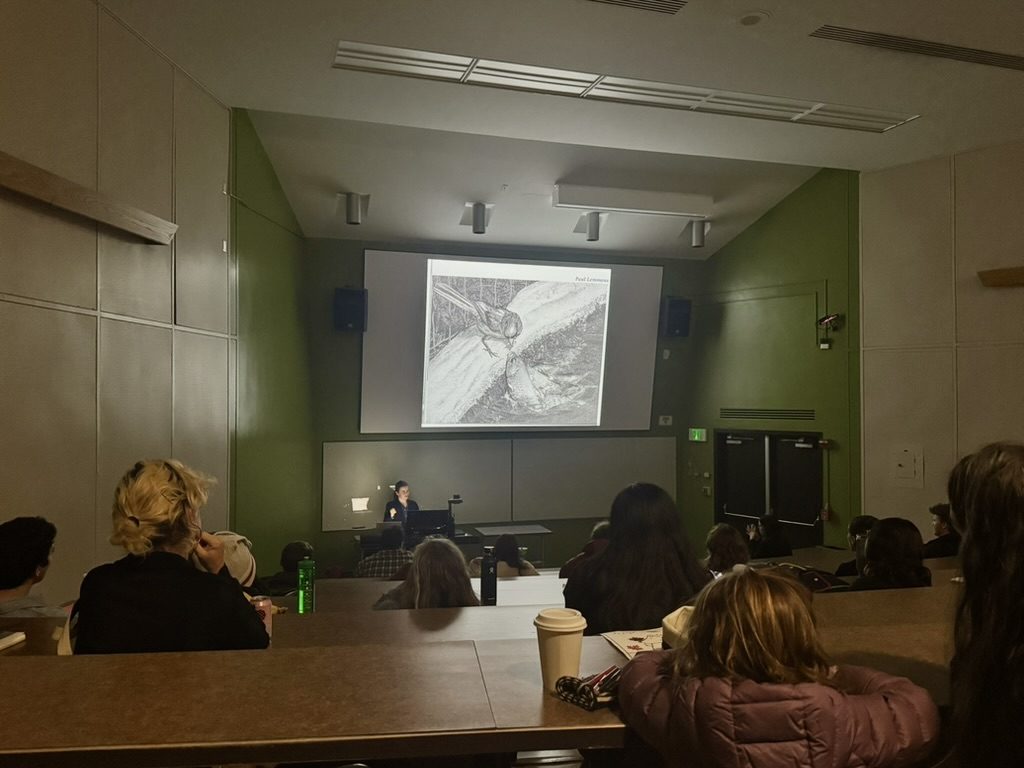
Binghamton University students and staff alike were given a window into the quiet, world-altering experience of motherhood last Thursday, courtesy of visiting artist Aurora Andrews.
The event was both an introductory lecture and an open gallery showcase in the Elsie B. Rosefsky Memorial Art Gallery in the Fine Arts Building. Through her work, Andrews portrays her memories of early motherhood from a first-person perspective, highlighting the small moments of awe and bewilderment that are commonly experienced yet seldom mentioned in the first years of parenthood.
During her lecture, Andrews primarily discussed the evolution of her craft. She spoke about her early works, which included paintings of everyday objects and aspects of life, and how that evolved into a focus on painting light and color in the absence of defined structures and shapes later in her career. This greater emphasis on color, demonstrated in her works like “Red light” and “Night,” proved to be the foundation for the pieces showcased in the exhibition.
“I use color to describe the feelings of a moment: orange and red like the colors you see when you close your eyes, or dark purplish blue and gray like a room at night lit by a streetlight through the window,” Andrews wrote in an email.
In the pieces shown at the Rosefsky Gallery, this intention is clearly apparent. “Playing 1,” “Nursing 25” and “Nursing 19” all evoke a sense of tranquility and closeness, as if the only people in the world are the painter and her subject — a mother and her daughter.
However, this exceptional quality of intimacy Andrews weaves into her works is not the only noteworthy aspect of her art. Perhaps just as crucial to the identity of the collection is how it challenges the traditional sentiments toward motherhood that pollute many avenues of the artistic community.
“The role of parenting, but especially of mothering, for artists is kind of a taboo topic, and it is often viewed as in tension with being an artist,” Emmy Thelander, assistant professor of art and design and co-director of the Rosefsky Gallery, said. “And so it’s sort of brave of her to portray the act of mothering as the subject and quintessentially integrated into her process of being an artist.”
This aspect of Andrews’ work adds a defiant streak to the message of her exhibition. Instead of allowing her responsibilities as a mother to prevent her from creating art, she chose to focus her art on those very same responsibilities.
Rather than viewing her daughter as an obstacle in the way of her creative process, Andrews integrated her daughter into that process. Her works recognize that the bond between a mother and child is not something to be lamented, but to be celebrated and displayed.
“I make paintings in order to share experiences and build connections with and between other people,” Andrews wrote. “An event like this is an extension of that. First-person accounts of motherhood are rare because the people doing it are usually too busy to do anything else. I hope that other people will recognize their own lives, both as mothers and as children, and feel less alone.”