





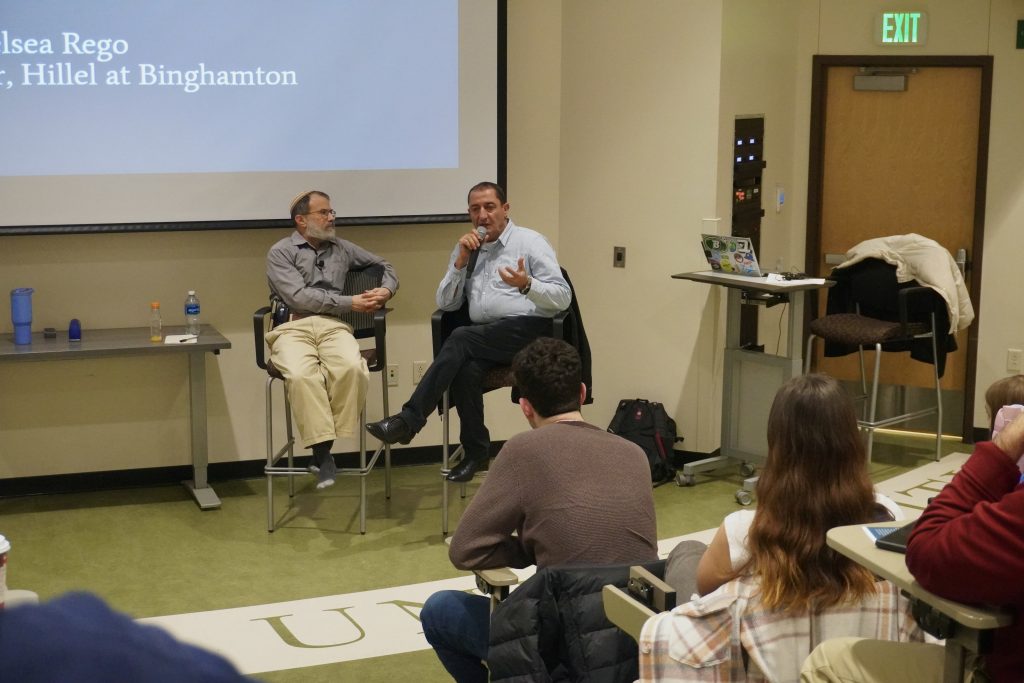
Last Thursday, Hillel at Binghamton University hosted Khaled Abu Awwad, a Palestinian peace activist, and Orthodox Rabbi Hanan Schlesinger for a dialogue on life in the West Bank and the complex dynamics underlying Israeli and Palestinian interactions.
Students and community members gathered in the Admissions Center for the talk, hosted in collaboration with the University’s Interfaith Council and the Multicultural Resource Center. Both panelists work with Roots, an Israeli-Palestinian peace organization “aimed at challenging the assumptions our communities hold about each other, building trust and creating a new discourse around the conflict in our respective societies.”
Chelsea Rego, Hillel’s executive director, moderated the discussion. Ellie Spivak, president of Hillel and a senior majoring in biology, told Pipe Dream she believes the work Roots does is a “crucial and integral step” toward achieving peace.
“In a time when tensions are high and students affected by this ongoing conflict are struck with emotion, Roots models what it means to listen to opinions that disagree with your own, attempt to understand and show sympathy, and remain committed to shared humanity even in moments of deep disagreement,” Spivak wrote in a statement.
Abu Awwad lives in Beit Ummar, a Palestinian village in the West Bank. He told the audience about the death of his brother, who was killed in 2000 by the Israeli army. Two months later, Abu Awwad said a group of Israeli Jewish families visited and gave their condolences.
Those families also shared moments of personal grief, including a story about three Israeli girls killed in a suicide bombing. One of those girls kept a diary where she mentioned peace in the region as one of her dreams for the future, Abu Awwad said.
“Every one of us has his own story about this conflict, and our two stories are so different, which leads to the fact that the story of the conflict, where we call it Palestine, the other side called it Israel, my God called it the Holy Land, ” Abu Awwad said. “In the Holy Land, there are two people with two stories and each story is a truth.”
When asked about the “root of Israeli-Palestinian conflict,” Schlesinger said both Israeli Jews and Palestinians struggle to understand each other’s perspectives and sense of national identity.
Founded in 2014, Roots directly works in the West Bank and hosts workshops and listening sessions among Palestinian and Israeli residents.
Both speakers said the Oct. 7, 2023 attacks and Israel’s subsequent military actions in Gaza have made Roots’ mission more difficult. About 250 people were taken hostage by Hamas while around 1,200 were killed, with most victims being Israeli citizens.
Since then, more than 69,000 Palestinians have been killed, with the United Nations estimating that 92 percent of all residential buildings in Gaza have been damaged or destroyed.
Schlesinger said some participants stopped attending dialogues after Oct. 7 and that it is difficult to recruit new people. He also pointed to new restrictions imposed by the Israeli government, restricting the ability of Palestinians to move within the West Bank.
According to a Palestinian governing body, Israel has erected 916 gates, barriers and walls in the West Bank since Oct. 7, 2023. According to the Associated Press, the installed barriers have restricted the ability of some Palestinians to access certain roads and buildings.
In recent weeks, there has been a reported increase in Israeli settler attacks on Palestinians in the West Bank. The U.N. Office for the Coordination of Palestinian Affairs found that settler violence in October 2025 reached new heights, with at least 264 attacks reported that month.
This year’s annual olive harvest season also faced settler violence, with 126 recorded attacks and more than 4,000 trees and saplings vandalized as of Oct. 30. Last Thursday, Israeli settlers torched and graffitied a mosque near the city of Salfit in the northern West Bank.
Schlesinger said Roots created a hotline where people can report incidents of settler violence. While he lived in a West Bank settlement for the past 45 years and believes “in the Jewish connection, the Jewish belonging to the land,” Schlesinger said he moved to Jerusalem six months ago because of the attacks he saw around him.
Last February, Hillel hosted a Roots talk [HYPERLINK: https://www.bupipedream.com/news/campus-news/hillel-university-organizations-host-presentation-by-orthodox-rabbi-palestinian-peace-activist/148375/] at the University with Schlesinger and Noor A’wad, a Palestinian peace activist.
Attendees were invited to submit questions for both panelists, ranging from their opinion on the current Israeli government to student protests at the University and other college campuses.
Asked whether he knows of a story that gives him hope about achieving peace, Abu Awwad recounted an incident where a fellow Israeli worker went to the home of a settler who killed a Palestinian villager’s sheep and confronted him. The settler then apologized to the Palestinian farmer and gave him money as compensation.
“Bringing together speakers with deeply different experiences allowed our community to witness what genuine dialogue looks like, even when perspectives diverge,” Rego said in a statement to Pipe Dream. “Moments like this remind us that building understanding doesn’t mean agreement but a shared commitment to empathy and learning.”