





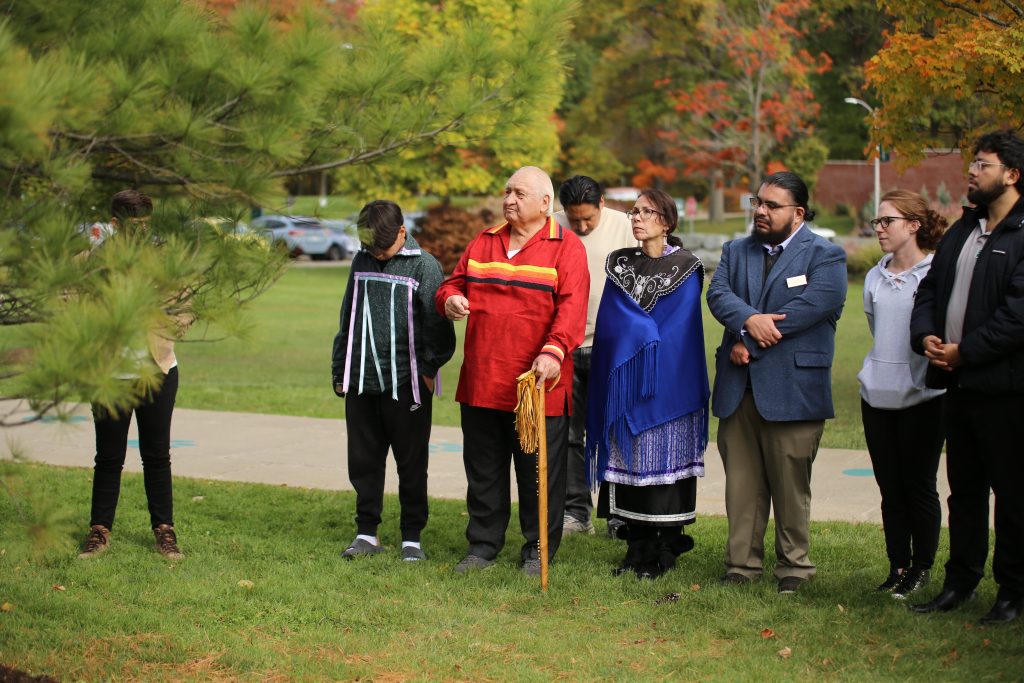
The Haudenosaunee community hosted its annual White Pine Tree Ceremony on the Peace Quad. With multiple generations of native families welcoming faculty and students, the event highlighted an inclusive future that members of the community have been working toward.
The Haundenosaunee Confederacy refers to Mohawk, Oneida, Onondaga, Cayuga, Seneca and Tuscarora nations, which joined together for peaceful decision making while maintaining their individual leadership. The name translates to “people of the long house,” both in reference to physical longhouses and each nation’s metaphorical roles within the confederacy. They have worked together for centuries as they maintain peace and uphold their constitution.
Binghamton University has previously collaborated with the Haudenosaunee Confederacy for several events and programs, including in a festival earlier this year, the building of the Three Sisters Garden and the creation of the role of the Multicultural Resource Center’s assistant director for Native American and Indigenous student initiatives, currently occupied by Tonya Shenandoah. It is this working relationship that brought the White Pine Tree Ceremony to the campus.
“The original Tree of Peace symbolizes the covenant of peace between the original Five Nations (Mohawk, Oneida, Onondaga, Cayuga and Seneca) where they buried their weapons,” Shenandoah wrote. “Historically, the White Pine Tree ceremonies feature planting a Tree of Peace in honor of the 1775 Continental Congress agreement of peace and friendship between the Haudenosaunee (representing all Native nations) and the United States. Today, campus White Pine Tree ceremonies symbolize this continued peace and friendship.”
The ceremony began with the grandson of Mohawk Spiritual Leader Tom “Sakokwenionkwas” Porter reciting the Ganoñhéñ•nyoñ’, a traditional opening address focused on giving thanks. The speech was then translated, explaining that it begins with giving thanks to the Creator and trickles down everything that surrounds us, from people to animals and the food that grows. Ultimately, it highlights the relationship between nature and the Onondaga.
Following this came an acknowledgment of the importance of having a multigenerational display of Native American culture by Porter. This display comes full circle when explaining the significance of the tree, which symbolizes much of the laws and way of life of the Haudenosaunee Confederacy. There is a prophecy that maintains that strange men one day might come and strike the tree down, but the community will hold it up. However, with the United States’ history of violence against Indigenous groups, Porter explained that there was not always a community to rely on.
“For many years, many decades, many generations, only the leaders will uphold the weight of the tree by themselves, because our young men and women will have been taken away from us in residential schools and relocation programs, assimilation programs,” Porter said. “And so, when our leaders want to teach them, they’re not here, they’re gone.”
Even with this sobering truth came a hopeful turn as Porter explained that even though generations of youth were taken from them, there is youth now being raised in these traditions. Looking toward his grandson, he spoke warmly of the ways these younger generations can grow and maintain their way of life.
The White Pine Tree Ceremony itself consisted of all those who came to participate in the event circling an existing white pine tree on the Peace Quad. The group was instructed to pay their respects to the tree, as well as meditate on their own personal intentions. Afterward, the group walked three times counterclockwise around the tree, representing the three breaths that brought humans to life in their creation myth.
The roots under the tree also signified the four cardinal directions, along with the eagle atop the tree, meant to protect from danger. The nearly 2,000-year-old ceremony typically takes 12 days as participants recite the tree’s entire constitution.
Following the ceremony were words shared by faculty who collaborated with the Haudenosaunee Confederacy to present this event, namely associate professor of anthropology BrieAnna Langlie, who spoke about her work with the confederacy and the importance of acknowledging its traditions.
“As an archeologist, I study and I learn from the past,” Langlie said. “However, Indigenous systems of knowledge are not relics of the past. They are ancient and long-lived, but they are also living, evolving and deeply relevant. Indigenous systems of knowledge ask us to reconsider assumptions, to recognize interdependence and approach learning not just as the transfer of knowledge from expert to learner, but as a reciprocal relationship built upon respect and responsibility.”
As this event was open to the public, so was the absorption of this culture that has persisted through the centuries. This notion was inspiring to many of those present, including Eva Mihalik, a sophomore majoring in anthropology.
“I think that the traditions are really beautiful,” Mihalik said. “They extend further than just the Haudenosaunee traditions to the whole world. They were talking about the roots. It goes in all directions — I could find things that are similar to my experiences with being a Christian, my religion, as I found that there is just some universal truths that extend again, beyond culture, beyond what we might identify as and bring us together as people.”