





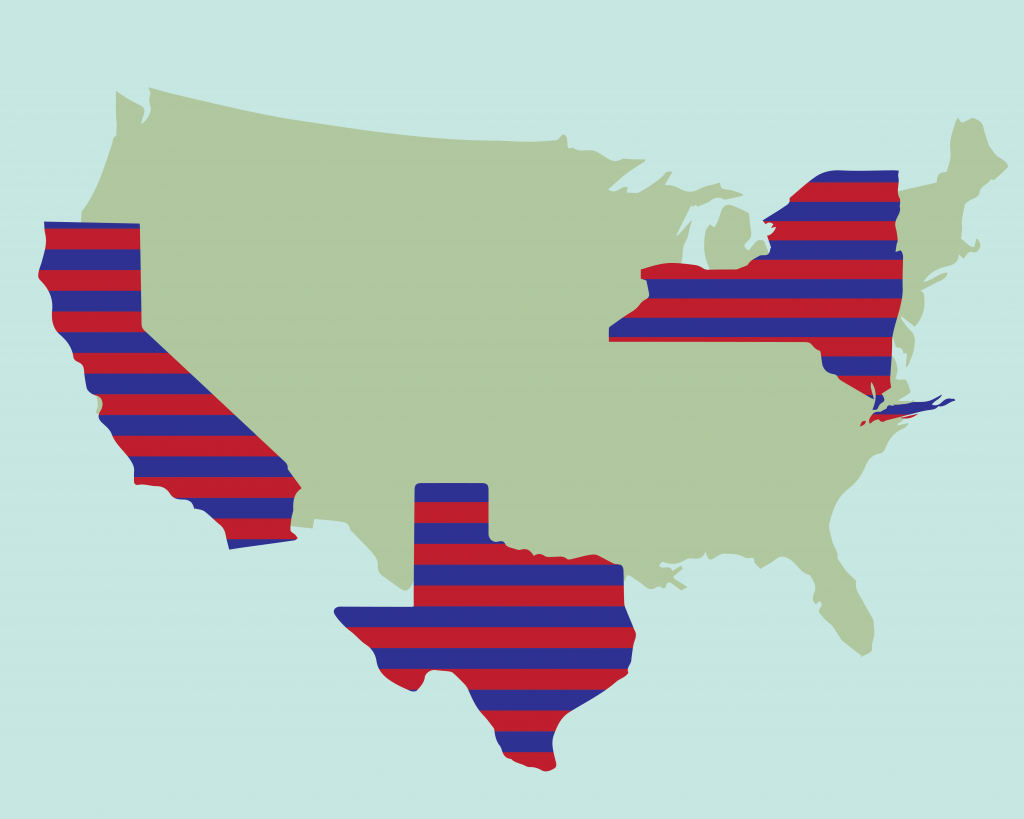
As Republican-led states across the country move to redraw their congressional districts ahead of the 2026 midterm elections, New York officials are discussing how the state could potentially respond.
Over the summer, the Texas legislature approved a plan to redraw that state’s congressional map to give Republicans a better chance at gaining five additional seats in the U.S. House of Representatives next year. This came after President Donald Trump and several allies pushed Republican Greg Abbott, the state’s governor, to pursue redistricting. Democratic legislators in August fled to Illinois and other states for two weeks to protest and raise awareness before ultimately returning.
Texas’ actions launched a redistricting arms race that has quickly spread across the country. California, a state with 43 Democratic and nine Republican House members, is directly countering Texas by offering its voters a chance to override the state’s independent redistricting committee by allowing the legislature to temporarily pass new congressional maps for use until the 2030 census. A September poll by Emerson College found that a majority of surveyed Californians said they would support the measure, known as Proposition 50, in this year’s election.
In August, New York Gov. Kathy Hochul met with legislative leaders to discuss possible plans to redistrict. Since 2014, the power to draw New York’s congressional districts lies mostly with an independent committee. Unlike in California, any constitutional amendment reversing course would need legislative approval in two consecutive sessions before making it to voters, all but ruling it out for 2026.
“If Republicans are willing to rewrite these rules to give themselves an advantage, then they’re leaving us no choice, we must do the same,” Hochul said on Aug. 4 while hosting a meeting with several Texas Democrats. “There’s a phrase, ‘you have to fight fire with fire.’ That is a true statement of how we’re feeling right now.”
New York Senate Deputy Majority Leader Michael Gianaris introduced a bill that would allow the legislature to redistrict mid-decade, a practice currently banned statewide. Assemblyman Micah Lasher, who represents parts of Manhattan, introduced a similar measure in the state assembly.
In a statement to Pipe Dream, Assemblywoman Donna Lupardo MA ‘84 said the nationwide redistricting push by Republicans was a “troubling development.”
“Though New York is considering redistricting to help even the playing field, following California, there are significant hurdles that prevent us from doing this quickly,” Lupardo wrote. “This is not a fight we ever wanted to enter, but the current administration is making it clear that we need to preserve democratic norms in any way we can.”
Republicans in Indiana, Kansas and North Carolina are also weighing plans to redistrict. On Friday, Trump invited Indiana state Republicans on a video call, encouraging them to redraw their congressional map — a move that could eliminate up to two Democrats. North Carolina Republicans plan to vote on a new congressional map designed to make the seat held by Democrat Don Davis, one of the most competitive in the state, more Republican-leaning.
House Minority Leader Hakeem Jeffries ‘92 is reportedly leading discussions with Democrats in Maryland and Illinois on possible ways to blunt the impact of Republican redistricting.
In 2019, the U.S. Supreme Court ruled 5-4 that federal courts did not possess authority to hear cases involving partisan gerrymandering.
On Wednesday, the nine justices heard oral arguments in a case involving Louisiana’s congressional map, which several lower courts determined to be violating Section 2 of the 1965 Voting Rights Act because the map lacked a second majority-Black district, diluting the ability of African Americans to participate equally in the electoral process.
The New York Times estimates that if the Supreme Court finds this application of Section II to be unconstitutional, Republicans could gain around a dozen more congressional seats in the South.
“We applaud Democratic lawmakers for responding to the GOP’s partisan redistricting fight,” Binghamton University College Democrats E-Board said in a statement. “Their efforts are crucial to ensuring that our elections do not become tyrannically controlled by a single party.”