





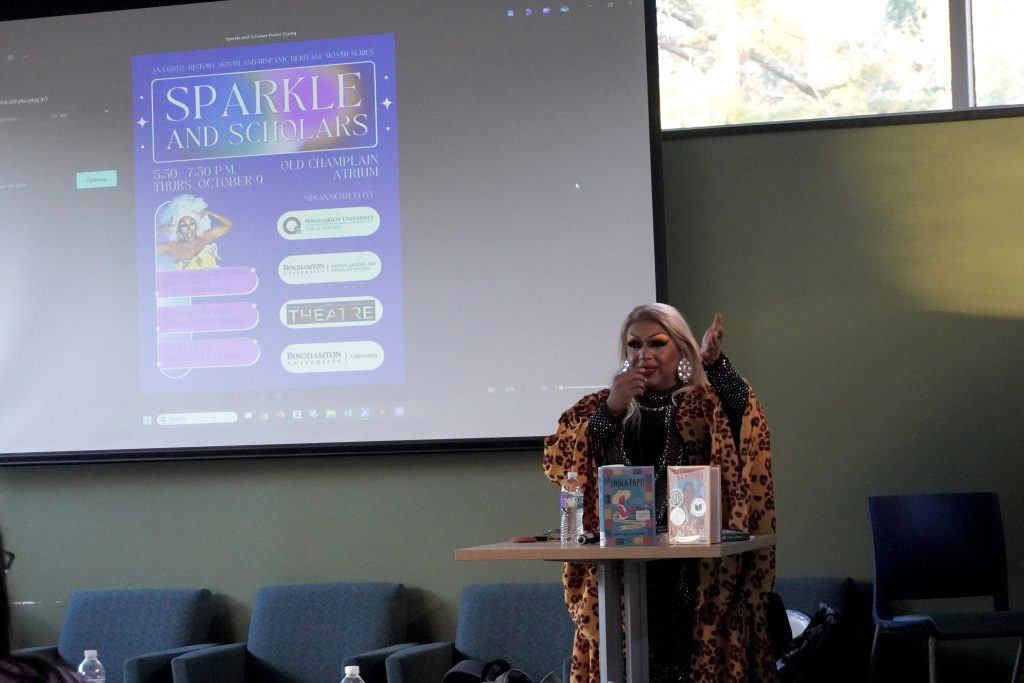
The Q Center hosted an event at the Old Champlain Atrium with drag queen Samantha Vega on Thursday in honor of LGBTQ+ History Month and Hispanic Heritage Month. Titled “Sparkle & Scholars,” the event brought together members of the campus community to celebrate queer expression and scholarship.
In collaboration with the Women, Gender and Sexuality Studies Department and the Theatre Department, the event aimed to create inclusivity and visibility for LGBTQ+ voices at Binghamton University. Bridget Whearty, associate professor of English and the Center for Medieval and Renaissance Studies, and Sean Massey, associate professor of women, gender and sexuality studies, were also in attendance to discuss the importance of queer representation in academic and cultural spaces.
Samantha Vega, a Rochester-based drag performer and activist, returned to the University’s campus for a second year to read from “Ambientes: New Queer Latino Writing,” edited by Lázaro Lima and Felice Picano, a collection of urban fictional stories illustrating Latino and queer backgrounds.
When asked how she first got into drag, Vega recalled her early college days at the Rochester Institute of Technology. As a teenager, she would attend drag shows at the local club up to two to three times a week. While organizing a fundraiser for a queer group on campus, Vega and other student organizers ended up becoming the performers for the show. This was Vega’s first drag performance, and as a performer of all sorts, it provided her with a strong background.
“I really just enjoyed it so much, and it kind of stuck with me because I was a dancer, I was a musician,” Vega said. “Also, I had a little heart for acting as well. And I think drag gave me all of that and a way to express myself and feel powerful and feel pretty.”
For Vega, drag has always carried an element of activism. She said that performing allows one to use the audience’s attention to raise awareness for important social issues.
Vega’s choice of literature for the event reflected her own identity and experiences.
“All the authors I chose were Latinx authors,” Vega said. “So these are all Latino and Latina authors. I wanted something that was a little more contemporary to me. So the ones I chose today, when I read them, some of them made me cry. I could relate to that, relate to them. The timeline was the ’80s and ’90s, which is the era that I lived through also.”
“As a cis gay man myself, it spoke to my experience as a young person exploring sexuality in a way that I hadn’t read anywhere else before,” Vega continued.
Following the reading, the event featured a Q&A segment and presentations from two professors from the Center of Medieval and Renaissance Studies and the Department of Women, Gender and Sexuality Studies. The Q&A segment encouraged questions from the audience, fostering discussion about the importance of literature in queer identity.
Afterward, the faculty presenters included excerpts from medieval sapphic love letters and information about the effects of the AIDS crisis on the LGBTQ+ community.
Massey provided background on an ongoing project surrounding frontline workers during the AIDS epidemic in the ’80s and ’90s.
“What we did was kind of unique,” Massey said. “We did a group interview. We had students, undergrads, who are interested in doing this work, many of them queer or allies, and we did kind of a group interview with each person. So there were these Gen-Zers, basically interviewing elders, queer elders — not all queer, queer and allied elders — about this period of time that really they knew nothing about. And it created this intergenerational dialogue. It really meant a lot, I think, to our interviewees to talk about the experience.”
The event also previewed an upcoming pop-up exhibit from Lark Wilson, a special collections librarian for instruction, reference and engagement at the University. Wilson is organizing the exhibit on Oct. 16 that will showcase queer materials from the University’s archives in collaboration with the Q Center.
The exhibit will include contributions from Massey, as well as local and national collections. Special collections documents are typically only available to view by appointment, so this exhibit is a great way for students to see valuable materials in an open-house setting.
When asked about any advice or message she would give her younger self, Vega reflected on her own coming-out journey.
“I’m pretty happy with my journey in general general, but I think it’s, ‘Don’t be afraid to take chances and stand up for yourself,’” Vega said. “I did not come out until I was in college, and I think being afraid of coming out in the Latino community can be debilitating. And I think for me, maybe it’s just finding the power to be authentic with myself and be with my family and to my immediate circles, and find the strength to come out.”