





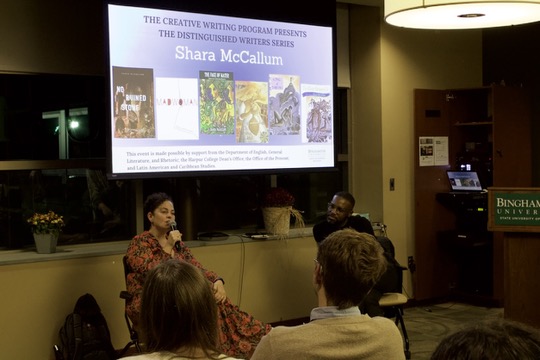
The celebrated author and poet Shara McCallum Ph.D. ‘99 partnered with Binghamton University’s Latin American and Caribbean Studies Department to speak at the BU Distinguished Writers Series on Wednesday.
Students and faculty filled the Alumni Lounge in Old O’Connor Hall for the live reading and Q&A. McCallum read aloud poems from her books “Behold,” “No Ruined Stone” and “Madwoman.” She also discussed her writing process, using her identity and personal life as inspiration for many of her works.
McCallum is an award-winning poet and Edwin Erle Sparks professor of English at Penn State University. The University alumna immigrated from Kingston, Jamaica when she was 9 years old and lived in Miami until she attended her graduate studies at the University of Maryland, College Park. She has published six books — “The Water Between Us”, “Song of Thieves,” “This Strange Land,” “The Face of Water: New and Selected Poems,” “Madwoman,” and “No Ruined Stone” — and contributed to the poetry anthology “Sign & Breath.” “Behold,” her upcoming work, is set to release in 2026.
The event opened with an introduction from Tina Chang, director of the Creative Writing Department. María Luisa Arroyo Cruzado, a second-year Ph.D studying comparative literature, then gave a warm and honoring welcome to McCallum, who, stepping up to the podium, received erupting applause from the audience.
McCallum began with a reading of the poem “Memory” from her book “Madwoman” and then read a few poems from “No Ruined Stone,” a collection that mythologizes Scottish poet Robert Burns and his fictional Jamaican family. The poems were written from the perspective of Burns and his fictional granddaughter Isabella, who lives in Edinburgh, Scotland, passing for a white woman despite being born to an enslaved mother in Jamaica.
“I think that to live in the voice of someone from another time, place, class, influence, even gender is not an easy thing to do, but I think that [McCallum] did it so beautifully,” Chang said.
McCallum elaborated on her process of writing “No Ruined Stone.” As part of her research, she visited archives in Jamaica and looked at bills of sale for enslaved people sold during the transatlantic slave trade. According to McCallum, reading the names of children and seeing how much they were sold for was an extremely difficult process.
The archives aided her in capturing the authenticity of the time period the characters lived in to create a comprehensive story.
Mackenzie Hamelin, a freshman majoring in psychology, was moved by McCallum’s research behind “No Ruined Stone.”
“I think her inspiration for ‘No Ruined Stone’ was incredibly moving,” Hamelin said. “I love that, given her Jamaican ancestry, the story and culture she crafted was something she knew on a personal level. I think it’s so fascinating that she spun history the way that she did, turning something real into something hypothetical.”
McCallum then read poems from her upcoming novel “Behold.” One of the poems, “Self-Portrait,” expresses her identity as a Jamaican American. She also read a poem called “The Nude,” which discussed how women’s bodies are framed in art.
After reading several other poems, a Q&A was conducted by Warren Harding, an assistant professor of English. He prompted McCallum to discuss her writing process and education as a University alumna. McCallum shared that her time as a student greatly influenced her writing process.
Jennifer DeGregorio, associate director of the Creative Writing Department, discussed McCallum’s visit and its impact on students.
“I think that there’s this idea that writers live in an ivory tower and they’re somehow above the rest of us, and poets in particular have this very rarified reputation, but they’re human beings that are doing down-to-earth work about the world that we live in,” DeGregorio said. “And, I think, again, seeing a writer alive and in the person just brings that home and makes the experience of writing more powerful, and it maybe also empowers other students to write themselves, to understand that they could do the work that this other human being is doing.”
In the Q&A, McCallum discussed her relationship with Jamaica and her attempts to assimilate into American culture.
Harding then asked McCallum about her research process for “No Ruined Stone.” McCallum shared that seeing the bills of sale in person took an emotional toll, but it inspired her to write the book from both Robert Burns’ and Isabella’s perspectives, giving the latter a voice based on her own.
After the prepared Q&A, students and staff in attendance asked questions of their own. Afterward, the event concluded with McCallum conducting book signings.
Chang explained the importance of the Distinguished Writers Series and the impact of McCallum’s visit.
“I believe the Distinguished Writers Series that I developed, in that, first and foremost, we want to welcome underrepresented writers,” Chang said. “That, combined with her being an alumni, I think, forges a pathway for underrepresented writers who may be here, who are thinking of becoming writers themselves, can maybe find inspiration in a talk such as this.